

Our Short List of 3
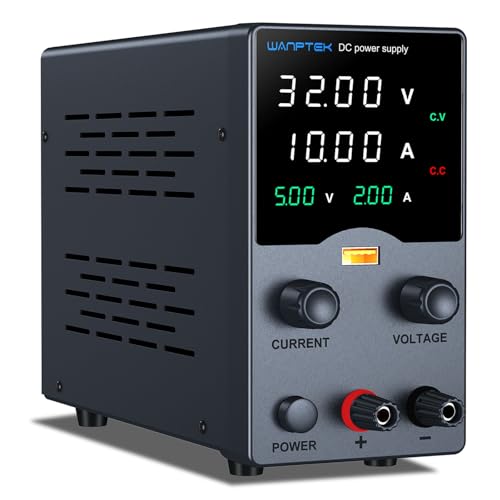
- Best for: Repair and lab benches that want the complete stated protection stack with precise encoder-based adjustment.
- Brand: WANPTEK POWER
- Model: GA3010H
- Output: 30V, 10A maximum
- Display: 4-digit LED, 0.01V and 0.001A precision

- Best for: General electronics benches that want a documented protection list and certification on a 30V 10A switching supply.
- Brand: NICE-POWER
- Model: SPS-C3010
- Output: 30V, 10A, 300W switching regulated
- Display: 4-digit LED, 0.01V and 0.001A resolution
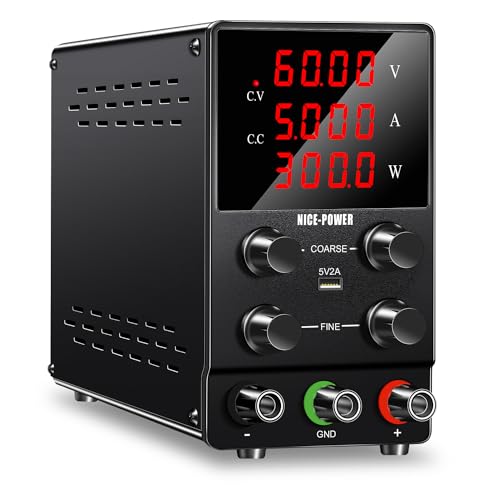
- Best for: Hobbyists and technicians working above 30V who still want OVP stated on a switching supply.
- Brand: NICE-POWER
- Output: 0-60V, 0-5A, switching regulated
- Display: 4-digit LED, 0.01V and 0.001A resolution
- Protections: Overvoltage and short-circuit protection among six stated safety layers
All 3 Picks at a Glance
| Product | Specs | Action |
|---|---|---|
| 1. WANPTEK GA3010H DC Power Supply, 30V 10A |
| Check price on Amazon |
| 2. NICE-POWER SPS-C3010 DC Power Supply, 30V 10A |
| Check price on Amazon |
| 3. NICE-POWER Adjustable DC Power Supply, 60V 5A |
| Check price on Amazon |
Key takeaways
- Compare switching bench power supplies with overvoltage protection, including a WANPTEK 30V 10A unit with OVP, OCP and OTP, and two NICE-POWER switching models.
A bench power supply earns its keep by feeding prototypes, repairs, and charging jobs a controlled voltage without drama. The switching designs in this category are lighter, smaller, and more efficient than linear units, which is why they dominate compact benches. Overvoltage protection is the feature that justifies this particular shortlist: if a fault or a mis-set knob sends voltage climbing, OVP cuts or clamps the output before the excess reaches the board, battery, or device connected to it.
One caution shaped the picks. Several popular bench supplies with OVP in their listings are actually linear designs, and they were excluded here because the keyword specifies switching. All three units below are switching regulated supplies whose listings state overvoltage protection alongside their other protections. They split into a 30V 10A all-rounder with a full OVP, OCP, and OTP stack, and two NICE-POWER models covering the common 30V 10A and 60V 5A ranges.
Quick Picks
As an Amazon Associate we earn from qualifying purchases.
| Product | Best for | Key spec from title |
|---|---|---|
| WANPTEK GA3010H DC Power Supply, 30V 10A | Full protection stack with encoder control | OVP, OCP and OTP protection |
| NICE-POWER SPS-C3010 DC Power Supply, 30V 10A | Everyday bench work with USB output | Switching regulated, over-voltage protection |
| NICE-POWER Adjustable DC Power Supply, 60V 5A | Higher-voltage circuits and charging | 0-60V range with overvoltage protection |
How to Choose
Confirm it is a switching supply, and that OVP is stated
The bench market mixes topologies freely, and some best-selling OVP models are linear units in disguise. Check the listing for the words “switching regulated” and for overvoltage protection named among the protections, not buried in a generic “multiple protections” claim. OVP behavior also varies: some supplies let you set a protection threshold, while others trip at a fixed margin above the set voltage. Either is vastly better than none when the load is a phone board, an ECU, or a lithium pack on a charge lead.
Match the voltage and current envelope to your work
The two common envelopes here are 30V 10A and 60V 5A, and they serve different benches. Thirty volts covers logic, audio, automotive accessories, and most repair work, with 10A of headroom for hungry loads. Sixty volts suits LED strings, e-bike and scooter packs, telecom gear, and series stacks, but halves the current. Total power tells the real story, roughly 300W in both cases here, so a load that needs high voltage and high current at once exceeds either and belongs on a larger frame.
Value display resolution and control feel
A four-digit display resolving 0.01V and 0.001A, common to all three picks, lets you set and verify rails precisely instead of guessing between coarse steps. Encoder knobs beat plain potentiometers for repeatable settings, and an output on/off switch lets you connect leads with the output dead, then energize deliberately. Memory presets and a lock key, offered on some WANPTEK and NICE-POWER variants, protect a careful setup from casual bumps. None of this is decoration; on a crowded bench, control ergonomics decide whether the supply gets used correctly.
Read the full protection list, not just OVP
Overvoltage protection guards the load from the supply; the rest of the stack guards everything else. Over-current protection and short-circuit protection handle wiring mistakes, over-temperature protection covers blocked vents during long runs, and over-power or overload protection limits sustained abuse. All three picks state several of these alongside OVP, and the WANPTEK adds OTP explicitly. Also check the input voltage: the NICE-POWER SPS-C3010 listing specifies 110V US input only, which is fine domestically and a real constraint for anyone planning to travel with the unit.
The 3 Best Options
1. WANPTEK GA3010H DC Power Supply, 30V 10A
- Best for: Repair and lab benches that want the complete stated protection stack with precise encoder-based adjustment.
- Brand: WANPTEK POWER
- Model: GA3010H
- Output: 30V, 10A maximum
- Display: 4-digit LED, 0.01V and 0.001A precision
Repair and lab benches that want the complete stated protection stack with precise encoder-based adjustment.
The headline range is 30V; if your work regularly exceeds that, the 60V NICE-POWER below is the correct envelope instead.
The GA3010H is the most protection-forward unit here. Its listing describes over-voltage, over-current, and over-temperature protection together, and its Q&A states the OVP, OCP, and OTP set explicitly, which is exactly the documentation this category demands. Output runs to 30V and 10A with a four-digit LED display resolving 0.01V and 0.001A, adjusted through a precision encoder knob rather than a coarse potentiometer. A USB fast-charging port handles side duties like powering a phone or a USB soldering iron while the main output works.
Watch out for: The headline range is 30V; if your work regularly exceeds that, the 60V NICE-POWER below is the correct envelope instead.
2. NICE-POWER SPS-C3010 DC Power Supply, 30V 10A
- Best for: General electronics benches that want a documented protection list and certification on a 30V 10A switching supply.
- Brand: NICE-POWER
- Model: SPS-C3010
- Output: 30V, 10A, 300W switching regulated
- Display: 4-digit LED, 0.01V and 0.001A resolution
General electronics benches that want a documented protection list and certification on a 30V 10A switching supply.
The 110V-only input rules out use on 220V mains, and one listing note flags that current limiting behavior differs from a dedicated over-current trip, so read the protection details before relying on them for unattended charging.
The SPS-C3010 is NICE-POWER’s mainstream switching bench supply, and its listing is unusually explicit about safety: it names over-voltage among a protection set that also includes over-current, over-power, overload, over-temperature, short-circuit, and leakage protection, with CE and FCC certification stated. The four-digit display resolves 0.01V and 0.001A, an output switch lets you energize the load deliberately, and a 5V 2A USB port is built in. The listing also specifies 110V input for the US standard, so there is no ambiguity about where it can run.
Watch out for: The 110V-only input rules out use on 220V mains, and one listing note flags that current limiting behavior differs from a dedicated over-current trip, so read the protection details before relying on them for unattended charging.
3. NICE-POWER Adjustable DC Power Supply, 60V 5A
- Best for: Hobbyists and technicians working above 30V who still want OVP stated on a switching supply.
- Brand: NICE-POWER
- Output: 0-60V, 0-5A, switching regulated
- Display: 4-digit LED, 0.01V and 0.001A resolution
- Protections: Overvoltage and short-circuit protection among six stated safety layers
Hobbyists and technicians working above 30V who still want OVP stated on a switching supply.
Current halves to 5A, so loads needing both high voltage and high current exceed this frame; the fan also means it is not the quietest option for audio work.
This variant stretches the envelope to 0-60V at 0-5A for benches whose loads outgrow 30V: LED arrays, higher-voltage battery packs, and telecom or industrial boards. The listing describes it as a variable switching regulated supply with six layers of safety protection including overvoltage and short-circuit protection, automatic constant-voltage and constant-current mode switching, and the same four-digit 0.01V and 0.001A display resolution as its 30V sibling. A 5V 2A USB port, test leads, and a smart cooling fan round out a package aimed at longer, higher-voltage sessions.
Watch out for: Current halves to 5A, so loads needing both high voltage and high current exceed this frame; the fan also means it is not the quietest option for audio work.
Which One Fits Your Situation
You repair phones, laptops, and mixed electronics daily
Take the WANPTEK GA3010H. The full OVP, OCP, and OTP stack stated on the listing matches the risk profile of board-level work, where a voltage excursion costs more than the supply does. The encoder knob makes small, repeatable adjustments around logic rails easy, and the USB fast-charge port keeps a device under repair powered without occupying the main output.
You are setting up a first serious bench
The NICE-POWER SPS-C3010 is the balanced starter: a mainstream 30V 10A envelope, a long and explicit protection list, certification stated, and an output switch that builds good habits. Its documented 110V input is a non-issue on a US bench. It covers the great majority of learning, repair, and prototyping tasks without paying for voltage range you will not touch.
Your projects already exceed 30 volts
Choose the 60V 5A NICE-POWER. E-bike packs, LED installations, and higher-voltage boards simply cannot be exercised on a 30V supply, and this unit keeps overvoltage protection and four-digit resolution while doubling the voltage ceiling. Just confirm your loads fit inside 5A, because the wattage ceiling, not the voltage, becomes the binding constraint on this frame.
Common Mistakes
- Buying a linear supply by accident because the listing led with OVP and never mentioned topology.
- Assuming OVP is adjustable on every model; some units trip at a fixed margin above the set voltage.
- Connecting leads with the output live instead of using the output switch, risking shorts and sparks.
- Running a switching supply at full load with its vents blocked, then blaming the resulting thermal shutdown on a fault.
- Using a bench supply as a battery charger without understanding that OVP is not a charge-termination algorithm.
Frequently Asked Questions
What does overvoltage protection do on a bench supply?
If the output voltage rises above the intended level, because of a fault, a load disconnect transient, or a setting error, OVP intervenes by shutting down or clamping the output. That protects the device connected to the supply from seeing voltage it was never designed for. It is a last-resort guard rather than a regulation feature, and it complements, rather than replaces, careful setting of the voltage before the output is switched on.
Is a switching bench supply worse than a linear one?
It is different, not simply worse. Switching supplies are lighter, smaller, cooler-running, and deliver more power per dollar, which is why they suit compact and portable benches. Linear supplies typically produce lower output ripple and noise, which matters for sensitive analog and RF work. For repair, charging, prototyping, and general lab use, a good switching unit with a full protection stack is the practical choice, as the picks here show.
Why were some popular OVP models left out of this guide?
Because their listings identify them as linear power supplies, and this guide is restricted to switching designs. A well-known example is the Korad KA3005P, whose own title describes a linear supply despite its OVP and OCP features. Mixing topologies would mislead buyers comparing weight, efficiency, and noise, so only switching units whose listings state overvoltage protection were included, even where that shortened the list.
Can I charge batteries with one of these supplies?
You can charge many packs under supervision by setting voltage and current limits correctly, and the constant-current and constant-voltage behavior of these supplies supports that. However, OVP is a fault guard, not a charger: it does not taper or terminate a charge cycle the way a dedicated charger does. For lithium packs especially, use a proper charger for unattended charging and treat the bench supply as a controlled, watched power source.
More from Amazon
Programs that pair well with the guide above. Offers and eligibility are set by Amazon and may change.
Free shipping on eligible items, Prime Video and more. Eligible new members can start with a free trial.
Start a Prime free trialAudiobooks and podcasts to listen to on the go. Eligible new members can start with a free trial.
Try Audible freeAd-free music streaming. Eligible new subscribers can start with a free trial.
Try Music Unlimited freeA free business account with business pricing and bulk-buying tools for work, shop or home office.
Create a business accountAs an Amazon Associate we earn from qualifying purchases.
Write Your Review
No reviews yet. Be the first to share your experience!