

Key takeaways
- Compare dual-display bench multimeters for technical training labs, with two readings at once, true RMS measurement, logging and SCPI control.
Outfitting a training bench is not really about buying the most accurate meter on the page. It is about whether a room full of students can watch two related values at once — voltage alongside frequency, or current next to voltage — without an instructor stopping the class to rewire a circuit or toggle a display. A dual-display bench multimeter solves that teaching problem directly, and it stays parked on the bench where handheld meters tend to wander off.
This roundup is for electronics instructors, lab managers and training coordinators equipping classrooms, college labs and industrial training centers. Every model below is a mains-powered bench instrument whose listing or manufacturer description confirms a dual display that shows two measurements simultaneously. Specs are taken from the Amazon product listings, and models that are handheld, discontinued by the manufacturer, or missing a confirmed Amazon US listing were left out.
Quick Picks
As an Amazon Associate we earn from qualifying purchases.
| Product | Best for | Key spec from title |
|---|---|---|
| Siglent Technologies SDM3045X | Teaching labs networking several benches | 4½-digit dual display with LAN |
| Siglent Technologies SDM3055 | Advanced classes needing finer resolution | 5½-digit dual display, 150 readings/s |
| Rigol DM3058E | Fast sampling demos on older lab PCs | 123 readings/s with USB and RS-232 |
| B&K Precision 5491B | Pass/fail checks and 20 A current work | 50,000-count dual display, 20 A range |
How to Choose
Check what the second display can pair
Dual display only helps a class if the second readout shows a value students actually need next to the first. Useful pairings include AC voltage with frequency, DC voltage with DC current drawn from the same test point, and a reading shown again in dB or as a percentage of a reference. Before ordering, open the listing and confirm the meter offers dual measurement rather than a single display with a bar graph or a clock. Some budget bench meters advertise two display areas that only show time or temperature, which does nothing for a circuit exercise.
Match resolution and accuracy to the syllabus
A first-year course built around Ohm’s law and divider networks rarely needs more than a 4½-digit meter, while final-year work on sensor drift, reference voltages and calibration checks benefits from 5½ digits and a higher count. Compare the basic DC voltage accuracy printed in each listing, because that figure drives most grading tolerances in lab reports. Higher resolution also slows some meters down, so check the readings-per-second figure if students log changing values. Buying uniform meters at one resolution keeps every bench in the room consistent, which simplifies worksheets, answer keys and troubleshooting during practical exams.
Plan interfaces and data logging early
Training labs generate paperwork: students must save readings, attach them to reports and sometimes hand control to a script. A USB host port lets a meter save results straight to a flash drive with no PC at the bench, while USB device and LAN ports support SCPI remote control for automated exercises. Check which interfaces the exact listing includes, because ports differ between close variants in the same family. If your course teaches LabVIEW or Python instrument control, confirm driver support and command compatibility before standardizing on one model for the whole department.
Verify safety categories and current range
Bench meters in teaching labs face beginners, so input protection matters more than headline accuracy. Look for a stated CAT safety category in the listing and match it to the circuits students will probe; a meter marked CAT I 1000 V with CAT II 300 V inputs suits electronics benches but not building wiring work. Check the maximum current range as well. Most models here measure up to 10 A, while one reaches 20 A for power-supply and motor-driver exercises. Finally, confirm fused current inputs and spare fuse availability, because a class set will blow fuses.
The 4 Best Options
Siglent Technologies SDM3045X

The SDM3045X is the natural starting point for a teaching lab that wants dual readouts on every bench without stepping up to a 5½-digit model. Its 4.3-inch color screen shows a main measurement with a second value beside it, so students can follow voltage and frequency through a filter exercise in one glance. The LAN port is the quiet advantage for instructors: benches can join the classroom network for scripted demonstrations, and a USB host port saves readings to a flash drive for grading. Built-in cold junction compensation also supports thermocouple temperature exercises without extra adapters.
Specs
- Display: 4½-digit dual display, 4.3-inch TFT LCD color screen
- Measurement: True RMS AC voltage and current
- Functions: DC/AC voltage, DC/AC current, 2-wire and 4-wire resistance, capacitance, continuity, diode, frequency, period, temperature
- Interfaces: USB Host, USB Device, LAN
- Reading rate: up to 150 readings per second
- Temperature: built-in cold junction compensation for thermocouple measurements
Best for: Teaching labs that want a dual readout and network logging on every bench
Watch out for: The optional SC1016 scanner card is not supported on this model, and its 4½-digit resolution sits a step below the 5½-digit meters in this roundup.
Siglent Technologies SDM3055

Where a course moves past basic circuits into instrumentation, the SDM3055 earns its place. The 5½-digit dual display pairs a primary reading with a secondary one — DC voltage with current, for example — while trend charts, histograms and bar graphs turn a plain measurement into a lesson about drift and noise. At up to 150 readings per second it keeps pace with changing signals during demonstrations, and the math and statistics functions let students compute averages and deviations on the meter itself instead of exporting every dataset. USB and LAN interfaces cover both stand-alone logging and remote control from an instructor station.
Specs
- Display: 5½-digit dual display, 4.3-inch TFT-LCD color screen (480 × 272)
- DC voltage range: 200 mV to 1000 V
- AC voltage range: 200 mV to 750 V
- DC current range: 200 µA to 10 A
- Basic DC voltage accuracy: 0.015% of reading + 0.003% of range
- Reading rate: up to 150 readings per second
- Interfaces: USB and LAN
Best for: Advanced classes that need finer resolution, statistics and trend views
Watch out for: Confirm the listing is the standard SDM3055 and not the SDM3055-SC scanner-card variant before ordering a matched class set.
Rigol DM3058E

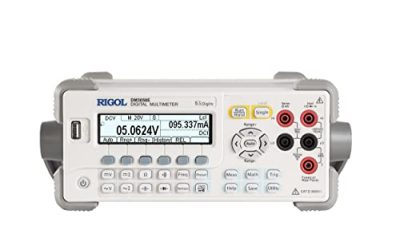
The DM3058E suits programs that teach automated measurement alongside manual bench skills. Its dual display shows two parameters of the same signal, and the 123 readings-per-second top rate is the fastest headline figure in this group, which helps when a class captures settling behavior after a step change. USB and RS-232 interfaces matter in older training labs where serial-equipped PCs and existing SCPI scripts still run the exercises; the meter drops into those setups without adapters or new software. A 1000 V and 10 A maximum range covers the full span of typical electronics coursework.
Specs
- Display: 5½-digit bench multimeter with dual display
- Reading rate: up to 123 readings per second
- Maximum measurement range: 1000 V, 10 A
- Interfaces: USB and RS-232
- Measurement: True RMS AC voltage and current
Best for: Scripted measurement exercises and labs standardized on RS-232 control
Watch out for: Interface options differ across the wider DM3058 family, so verify the ports on the exact listing before matching it to existing course scripts.
B&K Precision 5491B
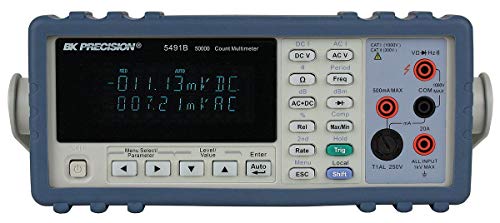
The 5491B is the instructor’s meter in this group. Its dual VFD display stays readable from the front of a classroom, and the limit mode turns routine checks into pass/fail grading: set the thresholds, let students test their boards, and read the verdict without hovering over every bench. The 50,000-count resolution and 0.02 percent basic DC accuracy are plenty for diploma-level work, while the 20 A current range — double most rivals here — handles power-supply and motor-driver labs that would stall a 10 A meter. USB and RS-232 ports with SCPI support round out the remote-control options.
Specs
- Display: 50,000 count, 4¾ digit, dual display
- Basic DC voltage accuracy: 0.02%
- Measurement rate: up to 25 readings per second
- Current range: up to 20 A AC and DC
- Interfaces: USB (virtual COM) and RS-232, SCPI compatible
- Protection: CAT I 1000 V / CAT II 300 V
- Math functions: Rel, Max/Min, dB, dBm, %, Hold, Compare (limit)
Best for: Pass/fail limit testing and higher-current student power labs
Watch out for: More than one Amazon listing circulates for this model under different ASINs; confirm the listing shows the current 5491B with USB and RS-232 before ordering.
Which One Fits Your Situation
A first teaching lab on a fixed equipment budget
Start with the Siglent SDM3045X. The 4½-digit resolution covers introductory coursework, the dual display teaches students to read related values together from day one, and the LAN port future-proofs the room for scripted demos. Buying one uniform model also means one manual, one set of leads and one spare-parts shelf for the whole class.
Final-year projects and calibration exercises
Choose the Siglent SDM3055. Its 5½-digit resolution and tighter DC accuracy support calibration comparisons, sensor characterization and drift studies where the last digit carries information. Trend and histogram views give students a visual handle on noise before they ever open a spreadsheet, and the statistics functions shorten report writing at the end of a long lab session.
Automated tests and scripted demonstrations
Look at the Rigol DM3058E when the syllabus includes instrument control. USB and RS-232 links connect to the PCs most training labs already own, the SCPI command set matches what students will meet in industry, and the fast reading rate captures transients during scripted runs. The dual display still lets the class watch a live secondary value while the script drives the primary measurement.
Instructor demos with quick pass/fail grading
Pick the B&K Precision 5491B for the demonstration bench. Limit mode with clear pass/fail verdicts turns end-of-session checks into a fast queue instead of a bottleneck, the VFD readout stays legible under classroom lighting, and the 20 A range absorbs the power-supply projects that exceed a 10 A meter. It also ships with a calibration certificate and test report, which simplifies lab asset records.
Common Mistakes
- Buying handheld meters with a split-screen gimmick instead of a true bench dual-measurement display, then discovering the second window only shows a clock or bar graph.
- Assuming dual display means two independent channels; every meter here reads two parameters of one connected signal, not two separate circuits.
- Standardizing on a meter before checking that its USB, LAN or RS-232 ports match the PCs and scripts the course already uses.
- Ignoring the current range and fuse protection, then watching a class set of 10 A meters fail during power-supply projects.
- Ordering a mix of near-identical variants — scanner-card, GPIB and base models — so half the benches behave differently from the worksheet.
Frequently Asked Questions
Can a dual-display bench multimeter measure two separate circuits at once?
No. The dual display shows two parameters of the same connected signal — voltage with frequency, or voltage with current through the same test point — from a single set of inputs. Measuring two independent circuits still takes two meters. For training, that pairing is the point: students see cause and effect together instead of toggling between functions and losing the relationship.
Is a 4½-digit meter enough for technical training?
For most introductory and intermediate coursework, yes. A 4½-digit meter resolves voltage, current and resistance finely enough for circuit laws, divider networks and basic sensor work. Courses that grade calibration exercises or track small drift over time should step up to a 5½-digit model, where the extra digit turns borderline readings into clear pass or fail evidence.
Why use bench multimeters instead of handheld meters in a training lab?
Bench meters stay on the desk, run from mains power and present a large shared display that an instructor can read from across the room. They also add the interfaces training needs — USB, LAN and RS-232 for logging and scripted control — plus higher resolution than most handhelds. Handheld meters still belong in the kit for field exercises, but the bench is where structured coursework happens.
What should instructors confirm before ordering a class set?
Verify four things on the exact listing: the model and variant name, the interface set, the included test leads and calibration paperwork, and the current range. Sellers sometimes list close variants — scanner-card or GPIB versions — under similar titles, and a mixed shipment makes every worksheet harder to follow. Ordering one confirmed variant keeps benches identical and spares interchangeable.
More from Amazon
Programs that pair well with the guide above. Offers and eligibility are set by Amazon and may change.
Free shipping on eligible items, Prime Video and more. Eligible new members can start with a free trial.
Start a Prime free trialAudiobooks and podcasts to listen to on the go. Eligible new members can start with a free trial.
Try Audible freeAd-free music streaming. Eligible new subscribers can start with a free trial.
Try Music Unlimited freeA free business account with business pricing and bulk-buying tools for work, shop or home office.
Create a business accountAs an Amazon Associate we earn from qualifying purchases.


Write Your Review
No reviews yet. Be the first to share your experience!