

Key takeaways
- Compare one precision impedance analyzer with selectable test frequencies, then choose the model that matches your components, frequency range and bench habits.
Choosing a precision impedance analyzer with selectable test frequencies is a decision about which components you measure most and at which frequencies their behaviour matters. A capacitor that looks fine at one kilohertz can behave differently at two hundred kilohertz, and an inductor wound for audio work tells a different story from a radio frequency choke. The frequency you measure at changes the reading, so a meter that locks you to a single frequency forces you to guess how a part will behave where it actually works.
This guide is written for electronics hobbyists sorting loose parts, repair technicians checking inductors and capacitors, and engineers who need quick impedance readings without setting up a full bench system. It covers one instrument whose Amazon listing names it an LCR and impedance meter and whose manual confirms that the test frequency can be set by hand. Every specification below comes from that listing and the maker documentation, so you can match the instrument to your own work before ordering.
Quick Picks
As an Amazon Associate we earn from qualifying purchases.
| Product | Best for | Key spec from title |
|---|---|---|
| Peak Atlas LCR45 LCR and Impedance Meter | Quick handheld impedance checks on loose parts | DC, 1 kHz, 15 kHz and 200 kHz selectable test frequencies |
How to Choose
Match the test frequencies to your components
Start with the frequencies your parts actually work at, because a reading taken far from the operating frequency can mislead you. Audio capacitors and crossover inductors are usually characterised near one kilohertz, while small radio frequency chokes and ferrite parts need a much higher test signal to show their true behaviour. A meter that offers direct current plus one, fifteen and two hundred kilohertz covers that spread without asking you to own several instruments. Check that you can pick a frequency by hand rather than relying only on automatic selection, since a fixed frequency lets you repeat a measurement under the same conditions and compare parts fairly.
Decide how much accuracy your work really needs
Precision means different things on a repair bench and in a design lab, so settle this before you compare instruments. A handheld meter with accuracy in the region of one to one and a half percent suits sorting, matching and fault finding, where the question is whether a part is close to its marked value or plainly wrong. Work that feeds a published specification, a safety case or a production limit needs a benchtop analyzer with tighter stated accuracy and proper calibration support. Be honest about which side of that line your work sits on, and do not pay for laboratory grade accuracy when a clear pass or fail answer is all you need.
Look at the measurement range, not just the headline frequency
A wide frequency range is useless if the meter cannot resolve the small values you handle every day. Inductors for filters and chokes are often measured in microhenries, and small ceramic capacitors sit in picofarads, so resolution at the low end matters as much as the top frequency. Check the stated inductance, capacitance and resistance ranges and the smallest step the display can show for each one. A meter that reads down to fractions of a microhenry and fractions of a picofarad will separate parts that a coarser instrument lumps together, and that separation is often the whole point of the measurement.
Check the leads, fixtures and display before you commit
Impedance readings are sensitive to how a part is connected, so the probes and the display deserve as much attention as the electronics inside. Gold plated clips and a proper probe compensation routine reduce contact errors on low value parts, where a fraction of an ohm of lead resistance can swamp the reading. A display that shows impedance in complex form, with magnitude and phase angle, helps you understand a part instead of just recording a single number. Finally, confirm what comes in the box and what must be ordered separately, because a fixture or lead set bought later can delay a project by days.
The 1 Best Option
Peak Atlas LCR45 LCR and Impedance Meter
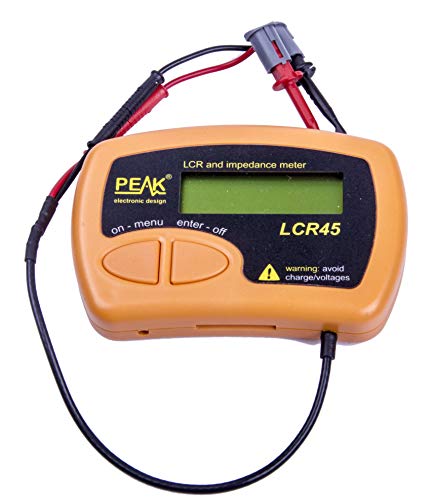
The Peak Atlas LCR45 is a handheld instrument for people who measure loose passive components all day without a bench setup. It identifies the component type on its own, then measures inductance, capacitance, resistance and impedance, showing the result in complex form as well as magnitude and phase angle. The manual confirms that both the component type and the test frequency can be set to automatic or manual modes, so you can let the meter choose or lock in direct current, one kilohertz, fifteen kilohertz or two hundred kilohertz yourself. Continuous readings suit alignment work, and the hold function freezes a result for recording.
Specs
- Test frequencies: DC, 1 kHz, 15 kHz and 200 kHz, selectable manually or automatically
- Measures inductance, capacitance, resistance and impedance, with complex impedance display
- Inductance range: 1 uH to 10 H, with 0.2 uH resolution
- Capacitance range: 0.5 pF to 10000 uF, with 0.2 pF resolution
- Resistance range: 0 ohms to 2 Mohms
- Basic accuracy: around 1 to 1.5 percent, depending on the parameter measured
- Display: continuous fluid readings with a hold function for single measurements
- Probes: gold plated clips, with probe compensation for lead effects
- Power: 12 V battery
Best for: hobbyists, repair technicians and coil winders who need fast handheld impedance readings on loose parts.
Watch out for: it does not measure equivalent series resistance, so it cannot judge capacitor health on its own, and its small handheld format means no benchtop fixture, sweep plotting or computer logging.
Which One Fits Your Situation
You sort and match loose components on the bench
Choose the Peak Atlas LCR45 when your day is spent sorting capacitors, inductors and resistors from bins and drawers. Its automatic component identification saves time, while manual frequency selection lets you compare parts under identical conditions. The pocket format keeps it beside the soldering iron instead of across the room, and the hold function lets you record each value before moving on to the next part.
You wind coils and check radio frequency chokes
Choose the Peak Atlas LCR45 when small inductors are your main work, because its 0.2 uH resolution and 200 kHz test frequency suit chokes and filter coils that a coarser meter would blur together. The complex impedance display shows resistance and reactance together, which helps you judge a coil rather than guessing from inductance alone. Keep the probes short and run probe compensation first for the cleanest low value readings.
You check speaker and audio crossover parts
Choose the Peak Atlas LCR45 when you need impedance readings for audio work, since the one kilohertz and fifteen kilohertz settings sit close to the frequencies where crossover inductors and capacitors do their jobs. It can measure speaker impedance and confirm that a replacement inductor matches the original before you fit it. Remember that it reports impedance at the chosen test frequency, so note the frequency beside every reading you keep.
You need a portable meter for field and repair visits
Choose the Peak Atlas LCR45 when the work travels with you, because a handheld battery powered meter fits a tool bag where a benchtop analyzer never will. It starts fast, needs no warm up and no mains outlet, and its simple menu suits quick checks on site. Carry a spare battery and keep the clips clean, since field conditions punish dirty contacts faster than a clean bench does.
Safety Notes
Impedance analyzers apply a small alternating signal to the part under measurement, so always measure components that are removed from circuit and fully discharged before connecting the probes. Large capacitors can hold a charge long after power is removed, and connecting a meter to a charged part can damage the instrument and injure the user. Never connect the meter to mains powered equipment or to a live circuit, and keep fingers clear of the probe tips while a reading is running. Store the meter dry, remove the battery if it will sit unused for a long period, and follow the maker guidance on probe compensation and cleaning.
Common Mistakes
- Measuring a capacitor or inductor while it is still soldered into a circuit, so neighbouring parts corrupt the reading.
- Using the automatic frequency setting for every part, then comparing readings taken at different frequencies as if they were equivalent.
- Skipping probe compensation on low value parts, where lead inductance and resistance dominate the result.
- Forgetting that a large capacitor can stay charged after power is removed, and connecting the meter before discharging it.
- Choosing a meter by its top frequency alone, without checking whether it can resolve the small values you measure most.
Frequently Asked Questions
What does selectable test frequency mean on an impedance analyzer?
It means you can choose the frequency of the alternating signal the meter applies to the component, rather than being locked to one fixed value. Different frequencies reveal different behaviour in capacitors and inductors, so a selectable frequency lets you measure a part near the frequency where it will actually operate. The Atlas LCR45 offers direct current, one kilohertz, fifteen kilohertz and two hundred kilohertz, with manual or automatic selection.
Why does the same capacitor read differently at different frequencies?
Capacitors are not ideal components, so their apparent capacitance changes with frequency because of series resistance, inductance and dielectric behaviour. A reading at one kilohertz describes the part at one kilohertz only, and the same part can look different at two hundred kilohertz. That is why recording the test frequency beside every reading matters, and why comparing two capacitors requires the same frequency for both.
Can a handheld impedance meter replace a benchtop analyzer?
It can replace one for sorting, matching and fault finding, where the question is whether a part is close to its marked value. It cannot replace a benchtop analyzer for laboratory characterisation, swept frequency plots, production limits or work that needs tighter stated accuracy and calibration records. Choose the handheld when speed and portability matter, and the benchtop instrument when the measurement itself is the deliverable.
How do I get reliable readings on very small inductors and capacitors?
Use short, clean connections, run probe compensation before the session, and pick a test frequency suited to the part, such as two hundred kilohertz for small inductors. Keep the part still while the reading settles, avoid touching the leads during measurement, and repeat the reading to confirm it is stable. If the value drifts between repeats, check the contacts and the probe compensation before trusting the number.
More from Amazon
Programs that pair well with the guide above. Offers and eligibility are set by Amazon and may change.
Free shipping on eligible items, Prime Video and more. Eligible new members can start with a free trial.
Start a Prime free trialAudiobooks and podcasts to listen to on the go. Eligible new members can start with a free trial.
Try Audible freeAd-free music streaming. Eligible new subscribers can start with a free trial.
Try Music Unlimited freeA free business account with business pricing and bulk-buying tools for work, shop or home office.
Create a business accountAs an Amazon Associate we earn from qualifying purchases.
Write Your Review
No reviews yet. Be the first to share your experience!