

Key takeaways
- Five precision bench multimeters for technical training, from 4.5-digit classroom meters to a 6.5-digit lab reference, with specs from Amazon listings.
Buying a bench multimeter for technical training is not about finding the highest digit count on the shelf. The real decision is how the meter behaves in front of a class: whether students can read a stable value from across the bench, whether an instructor can log a drift or a warm-up curve while talking through it, and whether the instrument survives semesters of shared use. A meter that is perfect for a lone engineer can frustrate a room of twenty learners if its display is small, its ranges are fiddly, or it cannot send readings to a computer.
This guide is for electronics instructors, vocational trainers, lab managers, and self-taught learners building a serious training bench. Every meter below is a true bench instrument, chosen from the names and specifications shown on its Amazon listing, with resolution from 4.5 digits up to 6.5 digits so a classroom, a workshop, and a calibration corner are all covered.
Quick Picks
As an Amazon Associate we earn from qualifying purchases
| Product | Best for | Key spec from title |
|---|---|---|
| Rigol DM3058E | All-round training bench workhorse | 5.5-digit, 123,000 counts |
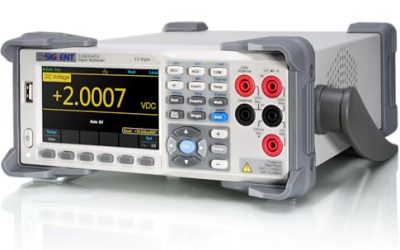
| Siglent SDM3055 | Higher resolution and onboard storage | 5.5-digit True-RMS, 1 Gb NAND flash |
| Siglent SDM3045X | Classroom fleets and automated demos | 4.5-digit dual-display |
| B&K Precision 5491B | First bench meter for basic courses | 50,000-count True RMS |
| Keysight 34465A | Instructor reference and calibration lessons | 6.5-digit Truevolt |
How to Choose
Resolution: how many digits the lesson needs
Digits decide the smallest change a student can see, which is the whole point of a precision bench meter. A 4.5-digit meter resolves a 5-volt rail to a tenth of a millivolt, enough for most introductory labs on Ohm law, divider circuits, and sensor outputs. A 5.5-digit meter adds another digit, so learners can watch a reference drift, compare two nearly identical resistors, or measure the voltage drop across a current shunt. A 6.5-digit meter belongs on the instructor bench or in a calibration exercise, where its extra resolution demonstrates what traceability and noise floors mean in practice. Match the digits to the exercise, not to the catalogue headline.
Functions and ranges: what the syllabus actually measures
A training meter earns its place by covering the measurements a course repeats every week: DC and AC voltage and current, resistance, continuity, and diode test at minimum, with capacitance, frequency, and temperature as valuable extras. Four-wire resistance matters more than it first appears, because it lets students measure low-value resistors and shunts without lead resistance corrupting the result, a classic teaching moment. Check the ranges too: a meter that reaches 1000 V DC and 10 A covers power-supply and motor labs, while a low-current range down to microamperes supports sensor and sleep-current work. If a function is missing, the lesson plan bends around the meter instead of the other way.
Display and connectivity: teaching a room, not one person
A bench meter in training is a display device as much as a measurement device. A dual display shows two quantities at once, so an instructor can demonstrate voltage and current together during a load test, or resistance alongside temperature while a component warms up. Trend charts and statistics turn a slow drift into a visible story on screen. Connectivity decides whether readings leave the bench: USB and LAN with SCPI commands let an instructor project live data, log a whole experiment to a file, or build an automated test sequence students can run themselves. A meter without a computer interface still measures well, but every demonstration stays trapped on its front panel.
Protection and upkeep: surviving shared student use
Training benches see more mistakes than any other bench, so protection and upkeep belong in the decision. Look for clearly stated input protection, such as CAT I 1000 V and CAT II 300 V markings, and for sheathed input jacks that keep fingers away from live terminals. A meter with a bright, wide display also reduces misreadings when students stand at an angle. Plan for calibration from day one: precision meters hold their accuracy only if they are checked on a schedule, so confirm that a local calibration service supports the model before buying a fleet. A durable meter with a calibration plan costs less over five years than a fragile one replaced twice.
The 5 Best Options
Rigol DM3058E

The DM3058E is the dependable core of a training bench: a 5.5-digit meter with enough resolution for precision exercises, a dual display for two-quantity demonstrations, and USB and RS-232 links for logging. Its 123 readings per second keep trend displays lively during warm-up and charging experiments, and the 10 A and 1000 V maximum ranges cover power labs without a second instrument. Instructors value the ten stored setups for switching between lesson configurations, and the true-RMS reading keeps AC lessons honest on non-sinusoidal waveforms. It is the safe first choice when one model must serve a whole syllabus.
Specs
- 5.5-digit resolution with 123,000 counts
- Fastest reading rate of 123 readings per second
- True-RMS AC voltage and current measurement
- Dual display for two simultaneous readings
- USB and RS-232 connectivity
- Maximum measurement range of 10 A and 1000 V
Best for: A training bench that needs one 5.5-digit meter to cover most lessons.
Watch out for: No LAN interface on the E version, so confirm USB or RS-232 fits your logging setup, and confirm it is still sold before buying.
ASIN: B00KBZK1QW
Siglent SDM3055

The SDM3055 steps resolution up for advanced classes while keeping the familiar bench form students already know, which makes it a natural upgrade meter for the front bench. Its dual display suits drift and stability exercises, and the 1 Gb NAND flash stores long measurement runs for later analysis without a computer attached. USB and LAN interfaces support remote control, so an instructor can drive the meter from a laptop at the front of the room. The wide function set, from four-wire resistance to temperature, means one instrument can anchor electronics, instrumentation, and calibration modules alike.
Specs
- 5.5-digit dual-display resolution
- True-RMS AC voltage and current measurement
- 1 Gb NAND flash for onboard storage
- USB and LAN interfaces
Best for: Advanced classes that need finer resolution and onboard storage for long runs.
Watch out for: Listing attributes describe manual range selection rather than autoranging, and one mirror showed it out of stock, so confirm the range behavior and confirm it is still sold before buying.
ASIN: B0BN3584R2
Siglent SDM3045X

The SDM3045X is the sensible way to equip a room: a 4.5-digit bench meter with a large colour screen, dual display, and the LAN and USB interfaces that make automated demonstrations possible. Its 0.1 percent basic DC accuracy is ample for introductory and intermediate electronics, and the built-in statistics and graphing functions let students see mean, spread, and trend without extra software. Temperature measurement with cold-junction compensation adds a useful instrumentation lesson, and the wide function list covers everything a first-year syllabus asks for. Buy several and the whole class works on identical instruments.
Specs
- 4.5-digit dual-display resolution
- True RMS with 0.1 percent basic DC accuracy
- DC and AC voltage and current, 2-wire and 4-wire resistance, capacitance, continuity, diode, frequency, period, and temperature
- Built-in cold junction compensation for thermocouple temperature measurements
- USB host, USB device, and LAN interfaces
- Up to 150 readings per second, with statistics and graphs
- 4.3-inch TFT-LCD screen
Best for: Equipping a classroom with identical networked meters for group work.
Watch out for: 4.5 digits will not resolve the finest precision exercises, so pair it with a 5.5-digit meter for those lessons, and confirm it is still sold before buying.
ASIN: B01IXPKIV4
B&K Precision 5491B

The 5491B is built for exactly this audience: its maker describes it as a dependable bench meter for education, service and repair, and manufacturing. The 50,000-count display with dual readout shows two measurements at once, which helps beginners connect a reading with its context, such as voltage beside frequency. The dual LCD stays readable from the back of a bench, and the simple front panel keeps first lessons focused on the measurement itself. It is the least intimidating meter here, which matters when learners are meeting their first bench instrument.
Specs
- 50,000-count display resolution
- 4.75-digit True RMS bench digital multimeter
- Dual display to indicate two measurements simultaneously
- Frequency measurement to 1 MHz
Best for: First-year courses and shared benches where clarity and simplicity matter most.
Watch out for: A second ASIN circulates for this model, so check the listing matches the 5491B exactly, and confirm it is still sold before buying.
ASIN: B005T7GGJI
Keysight 34465A

The 34465A is the reference instrument of this group, a 6.5-digit Truevolt meter that belongs on the instructor bench or in a calibration corner rather than on every student desk. Its 6.5-digit resolution lets advanced learners study noise, resolution limits, and measurement speed with a real instrument instead of a textbook diagram. Its presence in a lab gives students a benchmark to compare their own readings against. Use it to teach what precision means, then let the 5.5-digit meters handle daily classwork.
Specs
- 6.5-digit Truevolt digital multimeter
- Model 34465A by Keysight
Best for: Instructor reference, calibration lessons, and advanced measurement courses.
Watch out for: This is a lab-grade instrument with a matching footprint in a training budget, so confirm the listing and confirm it is still sold before buying.
ASIN: B011P0NDQ6
Which One Fits Your Situation
Equipping a whole classroom
Buy the Siglent SDM3045X in quantity. Its LAN interface lets an instructor address every bench from one computer, the identical instruments keep lessons consistent, and 4.5 digits cover the full introductory syllabus. Reserve a single 5.5-digit meter for the front bench so advanced demonstrations still have the resolution they need.
Teaching precision and calibration
Put the Keysight 34465A on the instructor bench as the reference standard and let students compare their own meters against it. The exercise teaches accuracy, resolution, and traceability in one session. Pair it with the Rigol DM3058E on student benches so the class still works with a capable 5.5-digit instrument.
Running live demonstrations and logging
Choose the Siglent SDM3055 or the Rigol DM3058E. Both offer dual displays and fast reading rates that make drift, charging curves, and warm-up visible in real time, and both connect to a computer for logging. The Siglent adds onboard flash storage for runs that outlast a single lesson. For a lesson built around one front bench, either meter keeps the whole room watching the same live numbers instead of crowding around a small screen.
Opening a basic electronics course
Choose the B&K Precision 5491B. Its clear dual display, education-focused design, and straightforward controls suit learners meeting a bench meter for the first time, and the 50,000-count resolution gives beginners room to grow into precision exercises later in the course. It keeps early lessons focused on the measurement itself rather than on learning the instrument.
Common Mistakes
- Buying a handheld meter instead of a bench meter: handhelds lack the dual display, logging, and stable bench presence that classroom demonstrations need.
- Chasing digit count while ignoring accuracy: extra digits only help if the basic accuracy behind them supports the measurement, so check both figures together.
- Skipping connectivity: a meter without USB or LAN cannot log data or project readings, which removes the most effective teaching features from the lesson.
- Forgetting input protection for student use: shared benches see wrong-range and wrong-jack mistakes, so stated CAT protection and sheathed jacks matter.
- Leaving calibration unplanned: a precision meter drifts out of specification without scheduled checks, so confirm local calibration support before buying a fleet.
Frequently Asked Questions
How many digits do students need in a training meter?
For introductory electronics, 4.5 digits cover nearly every exercise, from divider circuits to sensor outputs. Move to 5.5 digits when lessons involve reference comparisons, low-value resistance, or drift observation. Reserve 6.5 digits for the instructor bench and calibration exercises, where the extra resolution teaches measurement limits rather than everyday circuit behaviour.
Can a bench multimeter replace a handheld meter in training?
For bench-based lessons it can, and it usually teaches better, thanks to the larger display, dual readout, and logging. Handheld meters still suit field exercises, live equipment checks, and any task where the meter must move with the student. Most training labs keep both: bench meters at fixed stations and handhelds for portable work.
What does True RMS change in a lesson?
True RMS meters measure the real heating value of an AC waveform, while average-responding meters assume a pure sine wave and misread anything else. That difference becomes a memorable lesson when students measure inverter outputs, dimmer circuits, or distorted mains waveforms and compare the two readings side by side.
Do training meters need USB or LAN connections?
They do if the course includes data logging, automated tests, or projected demonstrations. USB suits a single bench connected to a laptop, while LAN lets an instructor reach every meter in the room and build shared experiments. Without either interface, readings stay on the front panel and every experiment must be recorded by hand.
More from Amazon
Programs that pair well with the guide above. Offers and eligibility are set by Amazon and may change.
Free shipping on eligible items, Prime Video and more. Eligible new members can start with a free trial.
Start a Prime free trialAudiobooks and podcasts to listen to on the go. Eligible new members can start with a free trial.
Try Audible freeAd-free music streaming. Eligible new subscribers can start with a free trial.
Try Music Unlimited freeA free business account with business pricing and bulk-buying tools for work, shop or home office.
Create a business accountAs an Amazon Associate we earn from qualifying purchases.



Write Your Review
No reviews yet. Be the first to share your experience!