

Key takeaways
- Compare variable speed drill presses with depth stops by speed range, swing, spindle travel and chuck size, with picks for wood, metal and repeat drilling work.
A drill press earns its bench space on repeatability. Anyone can bore one decent hole with a handheld drill; the tenth identical hole, at the same depth, in the same spot, is where the handheld approach falls apart. That is why the two features in this keyword belong together: variable speed lets you slow the bit down for steel or spin it up for softwood, and a depth stop turns a guessed plunge into a setting you can return to all afternoon.
This roundup is aimed at home workshop owners building furniture, hobby machinists drilling brackets and plates, and makers who batch out parts with repeated holes. Each machine below was chosen because its Amazon listing states a variable speed range and includes a depth stop, and every figure quoted is taken from that listing.
Quick Picks
As an Amazon Associate we earn from qualifying purchases.
| Product | Best for | Key spec from title |
|---|---|---|
| WEN 12-Inch Benchtop Drill Press, Variable Speed, Cast Iron with Laser and Work Light (4214T) | Bigger workpieces on a crowded bench | Variable speed; 12-inch swing; laser and work light |
| WEN 4212T 5-Amp 10-Inch Variable Speed Cast Iron Benchtop Drill Press with Laser | A first press for a small garage shop | 5-amp motor; 10-inch variable speed; laser |
| BUCKTOOL 12 INCH 6.2A Professional Bench Drill Press, Variable Speed Drill Press with IIIA Laser and Work Light | Heavier daily use with added safety switches | 6.2A motor; variable speed; IIIA laser and work light |
How to Choose
Read the speed range as two numbers, not one
The top speed in a listing gets the attention, but the bottom of the range decides whether the press suits metal. Drilling steel with a large bit calls for a few hundred RPM, while small bits in pine want several thousand. The WEN 4214T, for example, lists a mechanical variable range from 580 to 3,200 RPM, which covers both ends of ordinary home-shop work. A press that cannot go below roughly 600 RPM will run hot and dull bits in metal, so check the low figure first and the headline figure second.
Understand how the speed actually changes
Variable speed on these benchtop machines usually means a mechanical drive adjusted with a lever while the motor runs, with a digital readout showing the current RPM. That is a different experience from swapping a belt between pulleys in fixed steps. A lever-and-readout setup, like the ones on the WEN models listed here, lets you creep toward an exact speed for an unfamiliar material. When a listing says variable speed, confirm it also mentions a readout or a lever; if it only lists five fixed speeds, you are looking at a stepped machine wearing looser language.
Treat the depth stop as a working part, not a bonus
A depth stop only helps if it is easy to set and holds its setting under vibration. Listings for the machines below describe adjustable or locking depth stops, which let you set the quill to stop at the same point on every plunge. Think about your real jobs: shelf-pin holes that must not break through, dowel joints of even depth, or a run of identical brackets. Set-up time matters too, because a stop that takes five fiddly minutes per change will quietly stop being used, and the press becomes an expensive way to guess.
Match swing and spindle travel to your stock
Swing is twice the distance from the column to the chuck center, so a 12-inch press can center a hole on a board up to 12 inches wide. Spindle travel is how deep the quill moves in one plunge; the 4214T lists 3-1/8 inches, while the smaller 4212T lists 2 inches. Cabinet sides and thick turning blanks eat travel quickly once a long bit is fitted. Measure your widest regular workpiece and your deepest regular hole, then buy the press whose listing clears both with room left over.
The 3 Best Options
WEN 12-Inch Benchtop Drill Press, Variable Speed, Cast Iron with Laser and Work Light (4214T)
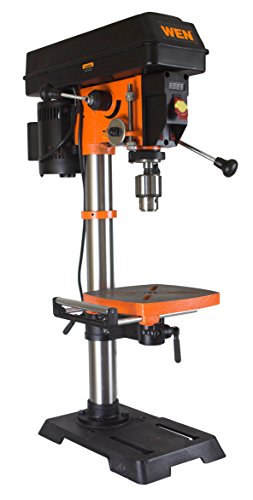
For a bench that handles cabinet parts one week and steel brackets the next, the 4214T is the most complete package here. The listing pairs the widest swing in this group with the longest spindle travel, so larger panels and deeper holes stay within one setup. The built-in laser and overhead light address the two annoyances that slow drilling down: finding the mark and seeing it once the bit is close. It is also the heaviest machine in this roundup, which reads as stability once it is bolted down.
Specs
- 5-amp induction motor with a 12-inch swing and 3-1/8-inch spindle travel
- Mechanical variable speed adjustable from 580 to 3,200 RPM with a digital RPM display
- Adjustable depth stop included, per the listing
- Class IIIA 2.5mW laser and overhead work light
- Beveling 9-1/2 by 9-1/2-inch work table with table roller extension
- 5/8-inch capacity keyed chuck with onboard chuck key storage
Best for: Woodworkers and fabricators who drill wide panels and deeper holes on one bench.
Watch out for: At a listed weight of about 85 pounds, plan a permanent bench spot and a second pair of hands for the lift onto it.
ASIN: B09253MVXN
WEN 4212T 5-Amp 10-Inch Variable Speed Cast Iron Benchtop Drill Press with Laser
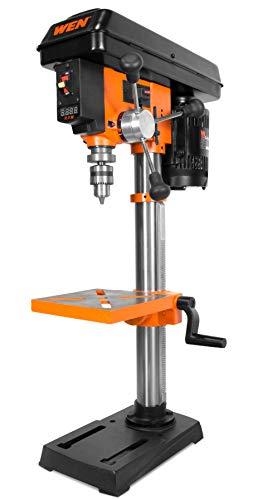
The 4212T fits the buyer setting up a first real workshop corner, where the press shares space with everything else and gets moved rarely but not never. Its listing keeps the same lever-adjusted variable speed idea as its bigger sibling, scaled to a 10-inch swing and a shorter quill stroke that still covers most furniture and hobby metalwork. The digital readout matters at this level because beginners are the people least able to judge RPM by sound. Everything needed for ordinary drilling is in the box, per the listing.
Specs
- 5-amp induction motor with a 10-inch swing and 2-inch spindle travel
- Mechanical variable speed adjustable from 530 to 3,100 RPM
- Digital speed readout displays the current RPM
- Laser and adjustable depth stop included, per the listing
- Beveling 8 by 7.5-inch cast-iron work table
- 1/2-inch capacity keyed chuck; measures 13.2 by 19.3 by 33.9 inches and weighs 57 pounds
Best for: New workshop owners who want true variable speed without giving the bench to a 12-inch machine.
Watch out for: The 2-inch spindle travel is the limit to respect; deep holes in thick stock may need the workpiece raised and drilled in stages.
ASIN: B09252SPKJ
BUCKTOOL 12 INCH 6.2A Professional Bench Drill Press, Variable Speed Drill Press with IIIA Laser and Work Light

The BUCKTOOL DP12VL is the option for a shop where the press runs most days and more than one person uses it. The listing leads with a stronger 6.2-amp motor and adds an emergency stop switch and a no-voltage release switch, details that matter when a machine is shared or when work continues after a power cut. Speed is set across the same broad band as the larger WEN and shown on a digital readout, and the listing’s depth adjustment gauge supports the repeat-depth work this buying guide is built around.
Specs
- 6.2-amp motor, listed as 3/4HP, with a 12-inch swing
- Variable speed from 580 to 3,200 RPM with a digital speed readout
- Class IIIA 2.5mW laser and integrated work light
- Emergency stop switch and no-voltage release switch
- Depth adjustment gauge for setting drilling depth, per the listing details
- Model number DP12VL
Best for: Busy home shops and shared benches where the press sees daily, multi-user work.
Watch out for: Confirm the depth stop hardware and the work light are in the box on delivery, since included components vary by seller listing.
ASIN: B0B76NLKNH
Which One Fits Your Situation
You drill shelf-pin and dowel holes in batches
Take the WEN 4214T. Batch work is where its adjustable depth stop and wider table pay off, because a row of identical holes becomes a matter of sliding the stock along a fence instead of re-measuring every plunge. The roller extension on the table also helps when the board being drilled is longer than the bench is deep.
You are furnishing a one-car garage shop
Take the WEN 4212T. Its smaller footprint and 57-pound listed weight leave room for the other tools a garage has to hold, while the 530 RPM low end still slows down enough for careful work in mild steel. It is the easiest of the three to reposition when the bench has to double as a work surface for other jobs.
The press will be used by teenagers or several adults
Take the BUCKTOOL DP12VL. The emergency stop and no-voltage release switch listed for this model are the features that protect less experienced users and anyone returning to the machine after an interruption. The digital readout also gives a supervising adult a speed figure they can check at a glance before a cut starts.
You split time between hardwood furniture and steel brackets
Take the WEN 4214T. Its speed band runs from slow enough for larger bits in metal to fast enough for small bits in hardwood, and the 5/8-inch chuck accepts a broader spread of tooling than a 1/2-inch chuck. One machine covering both materials avoids the compromise of a press that only behaves at one end of the range.
Common Mistakes
- Choosing a press by top speed alone and discovering it cannot slow down enough for larger bits in steel.
- Treating a five-step belt machine as variable speed, then finding the exact RPM a job needs falls between steps.
- Ignoring spindle travel and meeting the limit halfway through a deep hole in thick stock.
- Setting the depth stop once and never rechecking it, even though vibration and bit changes can shift the effective depth.
- Leaving the press unbolted on a light bench, which lets a heavy cast-iron machine walk and chatter under load.
Frequently Asked Questions
What does variable speed actually change when drilling?
It changes how fast the bit rotates, which controls heat, chip clearing, and the finish of the hole. Large bits and hard materials need slower speeds so the cutting edges do not overheat, while small bits in wood need higher speeds to cut cleanly instead of tearing. A mechanical variable drive lets you adjust that speed with a lever and see the result on a readout, rather than stopping to move a belt.
How does a depth stop improve accuracy?
The stop limits how far the quill can travel, so every hole in a run ends at the same depth without you watching a scale or a marked bit. That matters for shelf pins, dowel joints, and any hole that must stop short of the far face. Set it on a scrap piece first, measure the result, then run the real parts once the setting is proven.
Is a 10-inch press enough, or should I buy the 12-inch?
It depends on the width of stock you center holes in and the depth you drill in one pass. A 10-inch press centers a hole on stock up to 10 inches wide and, in the 4212T above, offers 2 inches of spindle travel. If your projects regularly exceed either figure, the 12-inch machines here give you swing and travel headroom that is cheaper to buy now than to work around later.
Can these benchtop presses drill metal as well as wood?
Yes, within the limits of their motors and speed ranges, and that is exactly where variable speed earns its keep. Slow the machine down for steel, use a bit made for metal, and secure the workpiece so it cannot spin. Very thick steel and large-diameter holes in metal belong on heavier floor machines, so judge your regular work honestly rather than the hardest job you can imagine.
More from Amazon
Programs that pair well with the guide above. Offers and eligibility are set by Amazon and may change.
Free shipping on eligible items, Prime Video and more. Eligible new members can start with a free trial.
Start a Prime free trialAudiobooks and podcasts to listen to on the go. Eligible new members can start with a free trial.
Try Audible freeAd-free music streaming. Eligible new subscribers can start with a free trial.
Try Music Unlimited freeA free business account with business pricing and bulk-buying tools for work, shop or home office.
Create a business accountAs an Amazon Associate we earn from qualifying purchases.
Write Your Review
No reviews yet. Be the first to share your experience!