

Key takeaways
- Compare 5 inverter plasma cutters for small metalworking shops: dual-voltage power, clean-cut capacity, duty cycle and torch types to pick the right one.
A small metalworking shop lives or dies on how fast flat stock becomes finished parts. A grinder with cutoff wheels gets the job done, but it eats time, throws dust across the bench, and leaves edges that need heavy cleanup before welding. An inverter plasma cutter changes that calculation: it slices sheet and plate with a focused arc, follows a straightedge or a template, and leaves an edge that is often ready for fit-up with only light grinding. The real decision is not whether to buy one, but which combination of amperage, cut capacity, and duty cycle matches the thickness you cut most days.


This guide is written for small-shop owners, farm fabricators, auto-body builders, and serious home metalworkers who cut steel, stainless, and aluminum in short runs. The five cutters below were selected from their Amazon listings by output, clean-cut thickness, torch type, and the practical details that matter in a one- or two-person shop, such as dual-voltage input and post-flow cooling.
Quick Picks
As an Amazon Associate we earn from qualifying purchases.
| Product | Best for | Key spec from title |
|---|---|---|
| PrimeWeld CUT60 | Heaviest plate and CNC table plans | 60 amps, 3/4 in clean cut at 240V |
| YESWELDER CUT-55DS PRO | Lightest machine to carry around the shop | 55 amps, 1/2 in clean cut at 220V |
| LOTOS LTP5000D | Proven 50-amp all-rounder for mixed metals | 50 amps, 1/2 in clean cut |
| ARCCAPTAIN CUT50 | Long torch reach on large sheet | 50 amps, 16 ft torch lead |
| BESTARC BTC500DP 10GEN | Rusted and painted metal with air monitoring | 50 amps, pilot arc with air sensor |
How to Choose
Match amperage to the thickest metal you cut weekly
Amperage sets the ceiling on what a cutter can handle, so start with the thickest plate that shows up in a normal week rather than the thickest piece you have ever cut. A 50-amp machine cleanly handles sheet and plate up to half an inch, which covers brackets, panels, gussets, and most repair work in a small shop. Step up to 55 or 60 amps when half-inch plate is routine, or when you cut thicker structural pieces and want the edge to stay clean at a reasonable travel speed. Buying more amperage than your work needs adds weight and electrical demand without improving everyday cuts, while buying too little means slow travel, heavy dross, and edges that need rework.
Check clean cut against severance cut
Every plasma cutter carries two thickness figures, and confusing them is the most common sizing mistake. Clean cut is the thickness the machine slices at a normal travel speed with an edge that needs little cleanup, while severance cut is the thickest metal it can get through slowly, with a rough edge and heavy dross. A cutter listed for a half-inch clean cut and a three-quarter-inch severance cut is a half-inch machine in daily use, not a three-quarter-inch one. Compare clean-cut figures at the same voltage across models, because a figure quoted at 220 or 240 volts drops sharply on a 110-volt household circuit, sometimes by a third or more.
Confirm your power supply and breaker before ordering
Dual-voltage cutters run on both household and shop circuits, but the output changes with the input. On 110 or 120 volts, a 50-amp cutter may deliver only 30 to 35 amps, which limits it to thinner sheet, while full output needs a 220- or 240-volt circuit. Check the outlet you plan to use, the breaker that protects it, and the plug type the machine ships with, because some units need a different adapter or a dedicated circuit to reach full output. A cutter that cannot reach its listed amperage on your available power is a smaller machine than its headline figure suggests, so match the machine to the circuit first and the catalog figures second.
Size the air supply and torch for real shop work
A plasma cutter is only half a system without compressed air, and the compressor decides whether the arc stays stable. Check the airflow and pressure the listing calls for, typically measured in cubic feet per minute at a stated pressure, and confirm your compressor can sustain that flow rather than merely hitting the pressure for a few seconds. Dry, oil-free air matters as much, since moisture shortens consumable life and degrades cut quality, so a filter or dryer is part of the setup rather than an accessory. Torch design matters too: a non-touch pilot arc starts the cut without dragging the tip across the metal, which helps on rusted, painted, or perforated surfaces and extends consumable life.
The 5 Best Options
PrimeWeld CUT60
The CUT60 is the strongest machine in this set, and it suits a small shop that regularly cuts half-inch plate and wants headroom for thicker work. Its 60-amp output at 240 volts and 60 percent duty cycle at full output let it keep cutting through longer runs of plate without long cooling pauses, which matters when a batch of brackets or a frame section has to be finished in one session. The non-HF blowback pilot arc avoids interference with nearby electronics, and CNC compatibility gives the shop a path to a cutting table later without replacing the power source.
Specs
- Output: 20 to 60 amps at 240V, 20 to 30 amps at 120V
- Clean cut: 3/4 in at 240V, 5/16 in at 120V
- Severance cut: 7/8 in
- Duty cycle: 60 percent at 60 amps at 240V, 60 percent at 30 amps at 120V
- Arc start: non-HF blowback pilot arc
- Torch: PT60 torch, CNC compatible, 2T/4T trigger modes
- Warranty: 3 years
Best for: small shops cutting half-inch plate often and planning a CNC table later.
Watch out for: full 60-amp output needs a 240-volt circuit with a 50-amp breaker, so confirm your shop wiring before ordering.
YESWELDER CUT-55DS PRO
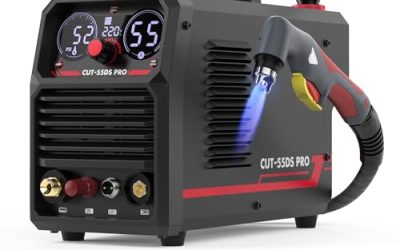
The CUT-55DS PRO is the lightest unit in this group at 11.1 lb, which makes it easy to carry from bench to job site and back, and its 55-amp output sits between the 50-amp machines and the 60-amp PrimeWeld. The non-touch pilot arc with the IPT40 torch starts cuts on rough, painted, and rusty surfaces without dragging the tip, and the large LED display shows air pressure, voltage, and current while you work. Adjustable post-flow cooling from 5 to 20 seconds protects the torch consumables after each cut, and 2T and 4T trigger modes cover both short precise cuts and long continuous runs.
Specs
- Output: 55 amps maximum, 110/220V dual voltage
- Clean cut: 1/3 in at 110V, 1/2 in at 220V
- Maximum cut: 1/2 in at 110V, 4/5 in at 220V
- Arc start: non-high-frequency blow-back start, non-touch pilot arc
- Torch: IPT40 torch
- Display: large LED digital display showing air pressure, voltage, and current
- Post-flow: adjustable from 5 to 20 seconds, 2T/4T trigger modes
- Protection: IP21 rating, overload and overheat protection, built-in rear air filter
- Unit weight: 11.1 lb
Best for: fabricators who move the cutter around the shop or take it to a job site.
Watch out for: clean-cut thickness drops to one-third of an inch on 110 volts, so thicker plate needs the 220-volt connection.
LOTOS LTP5000D

The LTP5000D has been a common sight in small shops for years, and its appeal is straightforward: a 50-amp inverter cutter with a non-touch pilot arc, dual-voltage input, and a 60 percent duty cycle at full output. It cuts mild steel, stainless steel, aluminum, and copper, and the pilot arc lets it start on painted or rusty surfaces without cleaning the metal down to bare steel first. Air demand is modest at 3.6 standard cubic feet per minute at 65 psi, which keeps it within reach of a mid-size shop compressor, and its compact 15 by 6 by 12 in body fits on a crowded bench or a welding cart.
Specs
- Output: 10 to 50 amps, 10 to 35 amps at 110V
- Input: 110/220V dual voltage
- Clean cut: 1/2 in
- Severance cut: 3/4 in
- Duty cycle: 60 percent at 50 amps
- Arc start: non-touch pilot arc
- Air supply: clean, dry, oil-free air, 3.6 scfm at 65 psi
- Dimensions: 15 x 6 x 12 in
Best for: mixed-metal repair and fabrication where one machine must handle steel, stainless, and aluminum.
Watch out for: confirm the listing is the pilot-arc LTP5000D, because LOTOS also sells a similar LT5000D model without a pilot arc.
ARCCAPTAIN CUT50
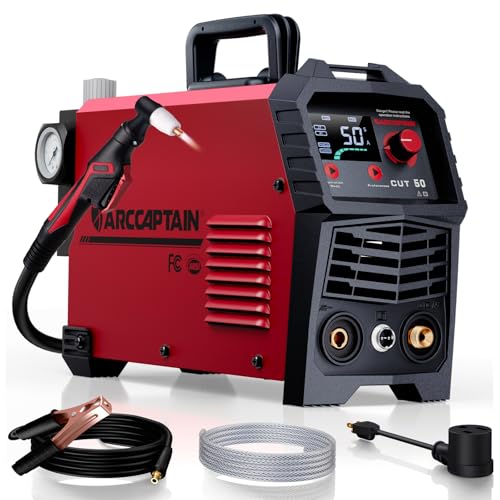
The CUT50 is a 50-amp dual-voltage cutter built around a large LED display and a long 16 ft torch lead, which is the feature that sets it apart in a small shop. The extra reach lets you work across a full sheet on a cutting table or around a vehicle body without dragging the machine along with you, and the built-in regulator and gauge show air pressure at a glance. Post-flow cooling adjusts from 5 to 15 seconds to protect consumables, and 2T and 4T modes switch between short controlled cuts and hands-free continuous cutting. The HF contact arc start handles rough, painted, and rusty surfaces with little slag.
Specs
- Output: 20 to 50 amps at 220V, 20 to 35 amps at 110V
- Input: 110/220V dual voltage, DC inverter IGBT
- Clean cut: 1/2 in
- Maximum cut: 3/4 in
- Display: large LED display
- Post-flow: 5 to 15 seconds, 2T/4T modes
- Arc start: HF contact start
- Torch: 16 ft cutting torch lead
- Air: built-in regulator and gauge, recommended air pressure 40 to 70 PSI
Best for: cutting large sheet and working around vehicles where torch reach matters.
Watch out for: HF contact start can interfere with sensitive nearby electronics, so keep the machine clear of control boards and CNC controllers that lack shielding.
BESTARC BTC500DP 10GEN

The BTC500DP 10GEN is the most sensor-rich cutter in this set, and its air sensor is the reason to choose it. The sensor displays air pressure on the panel, so a drop in supply shows up before it ruins a cut, and the LED screen shows voltage and current while you work. The pilot arc starts without touching the metal, which suits rusted and painted stock, and the adjustable pilot arc timing supports mesh cutting as well as solid plate. Post-flow cooling runs from 3 to 15 seconds, and the 2T, 4T, PA, and PT modes give the operator control over trigger behavior and consumable cooling on long jobs.
Specs
- Output: 50 amps, 110/220V dual voltage, IGBT inverter
- Clean cut: 1/2 in
- Maximum cut: 4/5 in
- Maximum thickness: 12 mm at 35A on 110V at 50 PSI, 20 mm at 50A on 220V at 65 PSI
- Arc start: pilot arc, non-touch arc start
- Air sensor: built-in sensor with LED display of air pressure, voltage, and current
- Air supply: built-in filter and regulator, 1/4 NPT quick-connect, 65 PSI at 250 litres per minute
- Modes: 2T/4T/PA/PT, post-flow 3 to 15 seconds, mesh cutting
- Torch: AG60P pilot arc torch
Best for: shops cutting a lot of rusted, painted, or mesh material where air supply needs watching.
Watch out for: confirm the listing is the 10GEN version, because earlier generations of the BTC500DP share the same model name with different listings.
Which One Fits Your Situation
You cut half-inch plate most days
Choose the PrimeWeld CUT60. Its 60-amp output and 60 percent duty cycle at full output are built for plate work, and the three-quarter-inch clean cut at 240 volts gives you margin on half-inch stock. The YESWELDER CUT-55DS PRO is the fallback if the CUT60 is out of reach, with a half-inch clean cut at 220 volts and a much lighter body.
You move the cutter between benches and job sites
Choose the YESWELDER CUT-55DS PRO. At 11.1 lb it is the easiest machine here to carry, and the IPT40 torch with non-touch pilot arc starts cleanly on rough surfaces wherever you set up. The ARCCAPTAIN CUT50 is the alternative when torch reach matters more than machine weight, thanks to its 16 ft lead.
You cut mixed metals in a repair shop
Choose the LOTOS LTP5000D. It handles mild steel, stainless, aluminum, and copper with a non-touch pilot arc, and its 60 percent duty cycle at 50 amps suits the stop-start rhythm of repair work. The BESTARC BTC500DP 10GEN is the alternative when much of that stock arrives rusted or painted and you want the air sensor watching your supply.
You want to add a CNC table later
Choose the PrimeWeld CUT60. It is the only machine in this set with CNC compatibility stated on its listing, including a machine torch path, so the power source you buy for hand cutting can move to the table. Check the CNC port and torch options on the listing before ordering, and confirm your table controller matches the cutter’s interface.
Common Mistakes
- Comparing severance cut figures as if they were clean cut figures, then finding the edge needs heavy grinding on everyday plate.
- Buying on the 220-volt amperage figure while only having a 110-volt outlet in the work area, which cuts output by a third or more.
- Running the cutter from a compressor that reaches the stated pressure but cannot sustain the stated airflow, which makes the arc sputter mid-cut.
- Feeding wet or oily air into the torch, which shortens consumable life and degrades the cut edge.
- Ordering the wrong generation or the wrong sibling model, such as the non-pilot-arc LT5000D instead of the pilot-arc LTP5000D, or an earlier BESTARC generation instead of the 10GEN.
Frequently Asked Questions
What size plasma cutter does a small metalworking shop need?
A 50-amp dual-voltage cutter covers most small-shop work, including sheet metal, brackets, and plate up to half an inch thick. Move to 55 or 60 amps when half-inch plate is a daily task rather than an occasional one, or when you want a cleaner edge at a faster travel speed on thicker stock. Match the machine to your thickest regular material, not to the thickest piece you have ever cut.
Does a plasma cutter need a special air compressor?
It needs a compressor that can sustain the airflow and pressure in the cutter’s listing, with clean, dry, oil-free air. A small compressor that hits the pressure for a few seconds and then falls behind will make the arc unstable. Check the cubic feet per minute figure at the stated pressure, add a filter or dryer to the line, and confirm the compressor’s sustained output rather than its peak figure.
Can a plasma cutter cut rusted or painted metal?
Yes, if the cutter has a pilot arc. A non-touch pilot arc starts the cut without the torch tip contacting the metal, so rust, paint, and perforated surfaces do not block the arc the way they do with a scratch-start or contact-start torch. Clean the ground clamp contact point for a reliable circuit, and expect more dross on heavily rusted plate than on clean stock.
Is dual voltage worth it on a plasma cutter?
Yes for most small shops. Dual voltage lets the same machine run on a household 110-volt circuit for thin sheet and on a 220- or 240-volt shop circuit for full output. The trade-off is lower amperage and thinner clean cuts on the lower voltage, so treat the household circuit as a thin-stock mode and use the shop circuit whenever the plate gets thicker.
More from Amazon
Programs that pair well with the guide above. Offers and eligibility are set by Amazon and may change.
Free shipping on eligible items, Prime Video and more. Eligible new members can start with a free trial.
Start a Prime free trialAudiobooks and podcasts to listen to on the go. Eligible new members can start with a free trial.
Try Audible freeAd-free music streaming. Eligible new subscribers can start with a free trial.
Try Music Unlimited freeA free business account with business pricing and bulk-buying tools for work, shop or home office.
Create a business accountAs an Amazon Associate we earn from qualifying purchases.
Write Your Review
No reviews yet. Be the first to share your experience!