

Key takeaways
- Compare four dual-channel function and arbitrary waveform generators for technical training labs, with bandwidth, sample rate and channel specs checked.
A training lab does not buy a function generator the way a hobbyist buys one for a home bench. The real decision is whether the instrument can carry a full syllabus — sine, square and pulse work, sweep and burst exercises, modulation demos and two-signal phase experiments — while surviving daily handling by students who are still learning which knob does what. A cheap single-purpose box fails that test quietly: the second channel turns out to be a limited copy of the first, or the arbitrary memory is too shallow to replay the waveforms the course actually teaches.

This guide is for vocational schools, college electronics departments and corporate training centres equipping benches for technical training. Every pick below is a dual-channel bench function or arbitrary waveform generator, chosen from the product names and specifications published on its Amazon page, so the figures quoted here are the ones a buyer can verify on the listing before ordering.
Quick Picks
As an Amazon Associate we earn from qualifying purchases
| Product | Best for | Key spec from title |
|---|---|---|
| Rigol DG1022Z | A shared undergraduate lab that needs a documented standard instrument | 25 MHz max output frequency |
| Siglent SDG1032X | Instructor benches running modulation and harmonics exercises | 30 MHz max output frequency |
| Siglent SDG2042X | Training centres that also demonstrate higher-fidelity arbitrary work | 40 MHz sine wave output |
| UNI-T UTG962E | Equipping many student seats where each bench gets its own unit | 60 MHz dual-channel output |
How to Choose
Read the bandwidth figure waveform by waveform
The headline frequency on a generator listing is almost always the sine wave limit, and it is the number least relevant to a training syllabus. Square and pulse outputs usually top out well below it, and arbitrary waveforms lower still, which matters the moment a course moves from basic sine exercises to digital clock signals or replayed sensor traces. Before comparing models, list the waveforms your practical sessions actually use, then check each candidate’s listing for the per-waveform limits rather than the single big number on the box.
Confirm both channels are genuinely independent
Dual-channel only helps teaching when each output can carry its own waveform, frequency and amplitude, with an adjustable phase offset between them. That is what makes differential signalling, I/Q-style demonstrations and modulated-carrier exercises possible on one instrument. Some low-cost units quietly restrict the second channel to a copy or a fixed relationship of the first. Read the listing wording carefully: phrases about independent outputs, channel coupling and phase control tell you whether the second BNC socket is a teaching tool or a decoration.
Match arbitrary memory and sample rate to the coursework
Arbitrary waveform work is where training generators separate. Sample rate decides how faithfully a stored waveform is reproduced at higher frequencies, and memory depth decides how long and detailed that waveform can be before it must loop or truncate. A course that only generates standard shapes can live with shallow memory, but sessions that replay captured signals, simulate ECG-style traces or build custom digital patterns need the deeper memory and higher sample rates of a true bench arbitrary generator rather than a basic DDS source.
Plan for lab life, not just specifications
A training instrument is handled by beginners, moved between rooms and expected to work for years, so the practical details matter as much as the waveform engine. A built-in frequency counter saves buying separate instruments for measurement exercises. USB or LAN control lets an instructor script repeatable setups across a row of benches. Standard BNC outputs, a clear display and controls that a student can learn in one session all reduce the supervision each bench needs during a crowded practical class.
The 4 Best Options
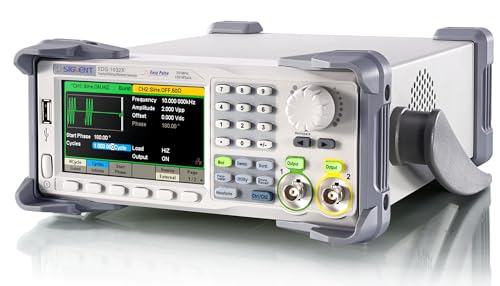
Rigol DG1022Z
The Rigol DG1022Z is the conservative choice for a teaching lab that wants one standard instrument across every bench. Its listing leads with a 25 MHz maximum output frequency, a 200 MSa/s sample rate and 14-bit vertical resolution across two output channels, with 160 kinds of built-in arbitrary waveforms for coursework that moves beyond the standard shapes. That combination covers the core undergraduate syllabus — function generation, sweep, burst and modulation exercises — in a single documented unit from an established test-equipment maker, which simplifies lesson plans, spares and staff training.
Specs
- Max output frequency: 25 MHz
- Channels: 2 output channels
- Sample rate: 200 MSa/s
- Vertical resolution: 14 bits
- Built-in arbitrary waveforms: 160 kinds
Best for: A shared undergraduate electronics lab standardising on one generator model for every bench.
Watch out for: Confirm the listing is the Z-series DG1022Z and not the older DG1022 it replaces, as the two are easy to confuse when ordering.
ASIN: B01N3LBIU6
Siglent SDG1032X
The Siglent SDG1032X suits the instructor bench and the advanced end of a training room. The listing gives a 30 MHz maximum output frequency from a dual-channel design with a 150 MSa/s sampling system and 14-bit resolution, plus a built-in frequency counter so measurement exercises do not need a second instrument. Its channel design supports offsetting the phase between the two outputs and combining waveforms, which is exactly what modulation, harmonics and two-signal demonstrations require. For courses that teach how signals interact, not just how they look, this is the step up from an entry bench unit.
Specs
- Max output frequency: 30 MHz
- Channels: Dual channel
- Sample rate: 150 MSa/s
- Vertical resolution: 14 bits
- Waveform memory: 16 kpts
- Built-in frequency counter
Best for: Instructor demonstration benches and advanced classes covering modulation, harmonics and phase relationships.
Watch out for: The SDG1000X family includes lower-bandwidth siblings, so check the listing variant actually reads SDG1032X with the 30 MHz rating before ordering.
ASIN: B01LECZU98
Siglent SDG2042X
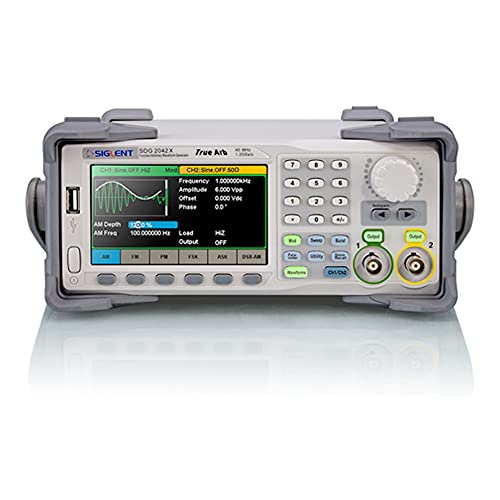
The Siglent SDG2042X is the pick when a training centre’s benches double for professional development or certification work and waveform quality itself is part of the lesson. Its listing specifies dual channels with 40 MHz sine wave output, 16-bit vertical resolution and a touch screen display, built on Siglent’s TrueArb and EasyPulse waveform technologies, with modulation, sweep and burst modes and a built-in high precision frequency counter. USB and LAN interfaces support scripted, repeatable setups across a classroom. It is more instrument than an introductory course needs, but it removes the ceiling students hit on lesser generators.
Specs
- Max output frequency: 40 MHz (sine wave)
- Channels: Dual channel
- Vertical resolution: 16 bits
- Display: Touch screen
- Waveform technology: TrueArb and EasyPulse
- Modes: Modulation, sweep and burst
- Built-in high precision frequency counter
- Interfaces: USB and LAN
Best for: Training centres running advanced or professional courses where arbitrary waveform fidelity is itself a teaching point.
Watch out for: More than one listing variant of this model circulates on Amazon, so verify the model number on the listing reads SDG2042X before buying several units.
ASIN: B01410O55U
UNI-T UTG962E

The UNI-T UTG962E answers a different problem: a training provider that needs a generator on every student seat cannot always fund full-size bench instruments for each one. This compact dual-channel unit’s listing states a 60 MHz output with 200 MSa/s sampling and 14-bit resolution at 1 µHz frequency resolution, and it folds in frequency measurement alongside generation. Students still get two channels for phase and modulation basics, standard waveform generation and arbitrary shapes for introductory exercises, in a unit small enough to store in a drawer between classes and cheap enough, as a category, to deploy in rows.
Specs
- Max output frequency: 60 MHz
- Channels: Dual channel
- Sample rate: 200 MSa/s
- Vertical resolution: 14 bits
- Frequency resolution: 1 µHz
Best for: Equipping a full classroom of student benches where each seat needs its own dual-channel generator.
Watch out for: This listing family also sells the 30 MHz UTG932E, so confirm the selected variant says UTG962E before ordering a classroom set.
ASIN: B0BP6TZCRK
Which One Fits Your Situation
You are fitting out a whole classroom on a fixed equipment budget
Choose the UNI-T UTG962E. The deciding factor at classroom scale is cost per seat, and this compact dual-channel unit still delivers the two outputs, standard waveforms and frequency measurement that introductory practicals require. Students learn the same concepts — frequency, amplitude, phase, modulation basics — on an instrument the department can afford to give every bench, rather than watching one shared generator from the back of the room.
You run a college lab that must standardise and document its benches
Choose the Rigol DG1022Z. A documented instrument from an established maker makes lesson plans, risk assessments and replacement buying straightforward, and its 25 MHz dual-channel specification with 160 built-in arbitrary waveforms covers the standard undergraduate syllabus without paying for headroom the course never uses. Standardising on one model also means any student can sit at any bench and find the same controls.
Your instructors demonstrate modulation and signal interaction live
Choose the Siglent SDG1032X. Demonstrations live or die on channel behaviour: the ability to offset phase between two outputs, combine waveforms and show harmonics in real time is what this model is built around, and the built-in frequency counter keeps the demo on one instrument. It gives the teaching bench the extra depth that student-seat units can reasonably skip.
Your centre also trains working technicians at an advanced level
Choose the Siglent SDG2042X. Advanced trainees meet the limits of entry generators quickly, particularly in arbitrary waveform quality, and the 16-bit resolution, TrueArb generation and LAN control of this model support both demanding coursework and scripted laboratory exercises. It is the unit that stays adequate as the syllabus grows toward professional practice.
Common Mistakes
- Buying on the headline sine-wave frequency while the square, pulse and arbitrary limits the syllabus needs are far lower.
- Assuming a second channel is fully independent, then discovering it only mirrors the first channel during a phase demonstration.
- Ignoring arbitrary memory depth until a stored waveform exercise has to be shortened or looped to fit.
- Forgetting that output amplitude is specified into high impedance on many generators, so levels into a 50 ohm load come out lower than the display suggests.
- Ordering a classroom set without checking what is in the box, then finding BNC leads or the correct power adapter missing on the first day of term.
Frequently Asked Questions
How much bandwidth does a technical training lab actually need?
For most electronics coursework, the honest answer is less than the marketing suggests. Core teaching covers audio through low radio frequencies, clock signals and control waveforms, which the 25 to 40 MHz dual-channel instruments in this guide handle comfortably. What matters more is the per-waveform limit: check the square and arbitrary ratings against your syllabus rather than chasing the largest sine figure on the listing.
Why does a training generator need two channels?
Two independent outputs let students see relationships, not just single signals. An instructor can show phase difference between two sine waves, use one channel as a modulating signal for the other, demonstrate differential pairs or trigger an oscilloscope from the second output while the first drives the circuit. These are standard practical exercises, and none of them work on a single-channel unit.
Can these generators replay waveforms captured from real equipment?
Yes, that is what the arbitrary waveform function is for, within the limits of sample rate and memory depth. A captured or drawn waveform is loaded into memory and reproduced point by point. Shallow memory truncates long captures, so courses built around replaying real sensor or biomedical signals should favour the deeper-memory bench models rather than compact DDS units.
Is a built-in frequency counter worth having on a teaching bench?
It earns its place in a training setting. Students constantly need to verify the signal they have just generated or measure an unknown input, and a built-in counter does that without a second instrument, a second power socket and a second set of leads to manage. Three of the four generators in this guide include one, which reflects how central measurement is to practical classes.
More from Amazon
Programs that pair well with the guide above. Offers and eligibility are set by Amazon and may change.
Free shipping on eligible items, Prime Video and more. Eligible new members can start with a free trial.
Start a Prime free trialAudiobooks and podcasts to listen to on the go. Eligible new members can start with a free trial.
Try Audible freeAd-free music streaming. Eligible new subscribers can start with a free trial.
Try Music Unlimited freeA free business account with business pricing and bulk-buying tools for work, shop or home office.
Create a business accountAs an Amazon Associate we earn from qualifying purchases.
Write Your Review
No reviews yet. Be the first to share your experience!