

Our Short List of 3

- Best for: Labs and industrial teams that need a rugged scope-meter for mains-frequency and power-electronics troubleshooting.
- Bandwidth: 20 MHz
- Input channels: 2
- Display: True-rms digital
- Battery: Li-ion rechargeable, 7 hours
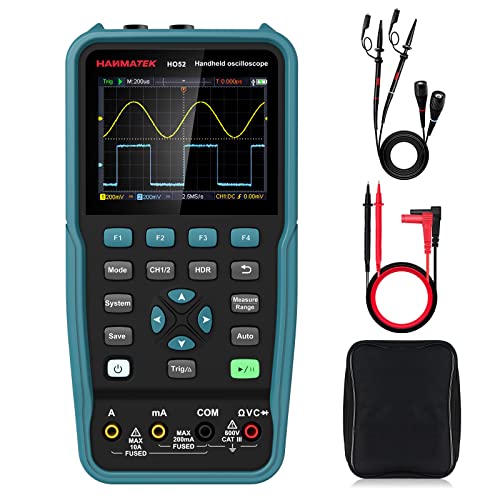
- Best for: Everyday lab and field measurements where a light, mid-bandwidth scope covers the work.
- Bandwidth: 50 MHz
- Channels: 2
- Display: 3.5-inch TFT
- Sampling rate: 250 MSa/s

- Best for: Labs that want one portable instrument for waveform viewing, meter checks and test signals.
- Bandwidth: 70 MHz
- Channels: 2
- Sampling rate: 200 MS/s
- Display: 2.4-inch color TFT
All 4 Picks at a Glance
| Product | Specs | Action |
|---|---|---|
| 1. Fluke 123B Industrial ScopeMeter |
| Check price on Amazon |
| 2. HANMATEK HO52 Handheld Digital Oscilloscope |
| Check price on Amazon |
| 3. Dual Channel 3-in-1 Handheld Oscilloscope Multimeter, 70 MHz Signal Generator |
| Check price on Amazon |
 4. FNIRSI DPOS350P 4-in-1 Tablet Oscilloscope |
| Check price on Amazon |
Key takeaways
- Compare the 4 best handheld digital oscilloscopes for research laboratories, from a rugged 20 MHz ScopeMeter to a 350 MHz tablet scope, to find your fit.
Choosing a handheld digital oscilloscope for a research laboratory means balancing measurement capability against portability. A bench scope stays in one place, but lab work often moves between test rigs, prototype boards and equipment racks, and a handheld instrument follows the experiment instead of forcing the experiment to come to the bench. The real decision is how much bandwidth, sampling speed and measurement accuracy you need before the extra size, weight and cost of a bigger instrument stop being worth carrying.
This guide serves electronics researchers, lab managers equipping shared benches, and engineers who split time between the lab and the field. Each pick below is a handheld digital oscilloscope listed on Amazon, and the specifications quoted come from the product names and specification details shown on those Amazon pages, so you can check every claim against the listing before ordering.
Quick Picks
As an Amazon Associate we earn from qualifying purchases.
| Product | Best for | Key spec from title |
|---|---|---|
| Fluke 123B Industrial ScopeMeter | Rugged lab and industrial troubleshooting | 20 MHz bandwidth, 2 input channels |
| HANMATEK HO52 | Everyday portable measurements | 50 MHz bandwidth, 2 channels |
| Dual Channel 3-in-1 Handheld Oscilloscope Multimeter, 70 MHz Signal Generator | Scope, meter and generator in one unit | 70 MHz bandwidth, 200 MS/s sampling |
| FNIRSI DPOS350P | High-frequency signals and protocol work | 350 MHz bandwidth, 1 GSa/s sampling |
How to Choose
Match Bandwidth to the Signals You Measure
Bandwidth decides the fastest signal a scope can display without distorting it, so start from the signals your lab actually produces rather than the biggest number on the box. A 20 MHz instrument covers mains-frequency work, audio, power electronics and slow control signals, while embedded digital work usually calls for 50 to 100 MHz and fast edges or RF-adjacent signals need 200 MHz or more. A good rule is to choose bandwidth at least five times the highest frequency you expect to measure, because a scope near its bandwidth limit rounds off edges and understates amplitudes. Buying far more bandwidth than your work needs wastes budget that could go to probes, a second channel or better triggering.
Check Sample Rate and Waveform Capture
Sample rate decides how finely a scope slices a waveform in time, and it matters most when you chase short pulses, glitches or fast rising edges. Look for a sample rate at least ten times the bandwidth of the signals you measure, and confirm it applies per channel rather than being shared across channels when both are active. Also check how the scope stores waveforms: the ability to save captures to internal memory or over USB turns a one-off observation into evidence you can attach to a lab notebook or a report. Deep capture memory helps when you need to record a long, slow event and zoom into its detail afterwards, so compare memory depth alongside the sample rate.
Weigh Portability, Battery Life and the Display
A handheld scope earns its place by going where a bench scope cannot, so weight, battery life and screen readability deserve the same attention as bandwidth. A unit over three pounds with a short battery becomes a bench instrument you happen to carry, while a lighter scope with a working day of battery life can stay clipped to a cart or carried between rigs without hunting for an outlet. Screen size matters too: a larger display shows more waveform detail and makes cursors and measurements easier to read, but it adds bulk and drains the battery faster. Check the battery life, whether the battery is rechargeable and replaceable, and whether the display stays readable under lab lighting before you commit.
Look for Built-in Tools and Triggering
Research work rarely needs a bare waveform alone, so the extra functions built into a handheld scope can replace two or three separate instruments. A built-in multimeter handles voltage, resistance and continuity checks without swapping tools, and a signal generator lets you inject test signals while you watch the response on the same screen. Triggering matters just as much: edge, pulse and protocol triggers help you catch intermittent faults that a free-running display would miss, and automatic measurements with cursors turn a visual check into a number you can record. Before ordering, confirm which of these functions the listing actually includes, since two scopes with the same bandwidth can differ widely in what else they do.
The 4 Best Options
1. Fluke 123B Industrial ScopeMeter
- Best for: Labs and industrial teams that need a rugged scope-meter for mains-frequency and power-electronics troubleshooting.
- Bandwidth: 20 MHz
- Input channels: 2
- Display: True-rms digital
- Battery: Li-ion rechargeable, 7 hours
Labs and industrial teams that need a rugged scope-meter for mains-frequency and power-electronics troubleshooting.
20 MHz bandwidth will not cover fast digital signals, and at 3.06 pounds it is the heaviest pick here.
The Fluke 123B is the rugged choice here, built for labs and industrial settings where instruments get knocked around, carried between sites and used in noisy environments. Its 20 MHz bandwidth and two input channels suit mains-frequency diagnostics, power electronics and electro-mechanical troubleshooting rather than fast digital work, and the true-rms display keeps readings trustworthy when waveforms are far from clean sine waves. The seven-hour rechargeable battery supports a working day away from an outlet, and the auto-setup functions shorten the path from switching on to seeing a trace. It is the heaviest pick here, so it suits a lab trolley or a test station more than a coat pocket.
Watch out for: 20 MHz bandwidth will not cover fast digital signals, and at 3.06 pounds it is the heaviest pick here.
2. HANMATEK HO52 Handheld Digital Oscilloscope
- Best for: Everyday lab and field measurements where a light, mid-bandwidth scope covers the work.
- Bandwidth: 50 MHz
- Channels: 2
- Display: 3.5-inch TFT
- Sampling rate: 250 MSa/s
Everyday lab and field measurements where a light, mid-bandwidth scope covers the work.
50 MHz bandwidth limits high-frequency work, and the compact display makes detailed waveform analysis harder.
The HANMATEK HO52 sits in the middle of this group, pairing 50 MHz of bandwidth with two channels in a package light enough to carry all day. That combination covers audio work, microcontroller projects, sensor signals and electronics debugging, where a 20 MHz scope would round off edges and a 350 MHz tablet would be more instrument than the job needs. The 3.5-inch TFT display is large enough to read waveforms and measurements without squinting, and the 250 MSa/s sampling rate keeps pace with the signals its bandwidth can show. Its high maximum input voltage makes it a practical choice for checking mains-referenced circuits and power stages with suitable probes.
Watch out for: 50 MHz bandwidth limits high-frequency work, and the compact display makes detailed waveform analysis harder.
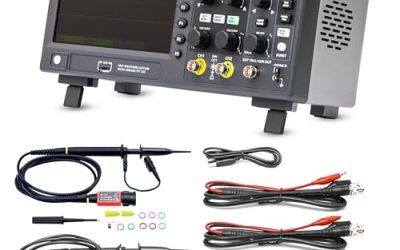
3. Dual Channel 3-in-1 Handheld Oscilloscope Multimeter, 70 MHz Signal Generator
- Best for: Labs that want one portable instrument for waveform viewing, meter checks and test signals.
- Bandwidth: 70 MHz
- Channels: 2
- Sampling rate: 200 MS/s
- Display: 2.4-inch color TFT
Labs that want one portable instrument for waveform viewing, meter checks and test signals.
70 MHz bandwidth restricts high-frequency testing, and the 2.4-inch display is small for detailed analysis.
This 3-in-1 instrument combines a 70 MHz dual-channel oscilloscope with a multimeter and a signal generator, so one handheld unit covers waveform viewing, voltage and continuity checks, and test-signal injection. That consolidation matters in a lab, where bench space is shared and the right tool is often in another room: carrying one device instead of three shortens setup time for experiments and prototype checks. The 200 MS/s sampling rate and 2.4-inch color TFT display suit embedded work, sensor characterization and control-signal debugging, though the small screen rewards users who save captures for inspection on a computer. It is the most versatile pick here for labs that value flexibility over bandwidth.
Watch out for: 70 MHz bandwidth restricts high-frequency testing, and the 2.4-inch display is small for detailed analysis.
4. FNIRSI DPOS350P 4-in-1 Tablet Oscilloscope
- Best for: Fast digital and RF-adjacent lab work where a pocket scope runs out of bandwidth.
- Bandwidth: 350 MHz
- Channels: 2
- Sampling rate: 1 GSa/s
- Display: 7-inch touchscreen
Fast digital and RF-adjacent lab work where a pocket scope runs out of bandwidth.
The tablet form is larger than pocket handhelds, and its extra functions take time to learn.
The FNIRSI DPOS350P is the highest-bandwidth pick here, offering 350 MHz across two channels with a 1 GSa/s sample rate in a 7-inch touchscreen tablet form. That headroom suits fast digital signals, embedded debugging and RF-adjacent measurements that would overwhelm every other handheld in this group, and the large touchscreen makes it easier to place cursors, read measurements and review waveforms than a pocket-sized display allows. As a 4-in-1 instrument it folds additional test functions into the same portable unit, which helps when a lab needs bandwidth without giving up bench space to a full-size scope. It is the pick for researchers whose signals are too fast for a handheld.
Watch out for: The tablet form is larger than pocket handhelds, and its extra functions take time to learn.
Which One Fits Your Situation
You run a shared electronics lab with many users
The Fluke 123B fits a shared lab best. Its rugged build survives being handed between researchers, its auto-setup shortens the learning curve for new users, and the seven-hour battery covers a full day of bench moves without a charger hunt. The 20 MHz bandwidth is the trade-off, so it suits labs focused on power, audio and control signals rather than fast digital work. If durability and simplicity matter more than bandwidth, this is the safe shared-bench choice.
You debug fast digital signals and embedded boards
The FNIRSI DPOS350P is the pick for fast digital work. Its 350 MHz bandwidth and 1 GSa/s sample rate capture edges and pulses that slower handhelds smear, and the 7-inch touchscreen gives you room to place cursors and read measurements without crowding the waveform. Two channels cover most embedded debugging, and the tablet form still travels between benches. Choose it when your signals are the bottleneck, not your bench space.
You move between the bench, the field and the test rig
The HANMATEK HO52 is the best traveller in this group. At 16 ounces with 50 MHz of bandwidth and two channels, it covers most general electronics work without weighing down a toolkit or a lab coat pocket. The 3.5-inch display stays readable for quick checks, and the high input voltage rating suits power-stage measurements with suitable probes. Pick it when portability matters every day and your signals stay within mid-range frequencies.
You want one instrument instead of three
The 3-in-1 70 MHz handheld is the pick when bench space and budget point to consolidation. It combines a scope with a multimeter and a signal generator, so one device handles waveform checks, voltage and continuity tests, and signal injection for prototype work. The 70 MHz bandwidth and 200 MS/s sampling cover embedded and sensor signals. Choose it for a small lab or a bench where every instrument competes for space.
Common Mistakes
- Buying bandwidth for signals you never measure, then discovering the probes and triggering matter more than the headline number.
- Ignoring sample rate: a high-bandwidth scope with a low sample rate still misses fast edges and short glitches.
- Choosing the smallest screen to save space, then struggling to read cursors and measurements during long sessions.
- Forgetting to check battery life and whether the battery is rechargeable, which turns a portable scope into a bench-bound one.
- Ordering without confirming the listing includes the probes and accessories your lab needs, since handheld kits vary widely.
Frequently Asked Questions
What bandwidth does a research lab handheld oscilloscope need?
Most general electronics labs work well with 50 to 100 MHz, which covers audio, microcontroller and sensor signals. Power and control work can manage with 20 MHz, while fast digital edges and RF-adjacent signals call for 200 MHz or more. Choose bandwidth at least five times the highest frequency you expect to measure, and spend the remaining budget on probes and triggering rather than unused headroom.
Can a handheld oscilloscope replace a benchtop scope?
A handheld can replace a bench scope for portable diagnostics, field checks and most general lab measurements, especially when bench space is tight. It cannot fully match a high-end bench instrument for very fast signals, deep memory or many channels. Labs with demanding high-frequency work often keep one bench scope for the hardest jobs and use handhelds for everything that moves between rigs.
Is a 3-in-1 scope-multimeter accurate enough for lab work?
For general lab work, yes: a 3-in-1 handheld handles waveform viewing, voltage, resistance and continuity checks well enough for prototyping, debugging and teaching. It is not a substitute for a calibrated bench multimeter or a dedicated instrument when your experiment needs traceable accuracy. Treat the built-in meter as a convenience for quick checks, and keep a calibrated meter for measurements that end up in published results.
What should I check before buying a handheld scope on Amazon?
Confirm the listing title, bandwidth, channel count and sample rate match the model you researched, and check that the ASIN on the product page is the one in the review you read. Read the included-accessories list to confirm probes are included, verify the battery type and whether it is rechargeable, and check the seller and return terms. If anything in the listing contradicts the model name, do not order it.
More from Amazon
Programs that pair well with the guide above. Offers and eligibility are set by Amazon and may change.
Free shipping on eligible items, Prime Video and more. Eligible new members can start with a free trial.
Start a Prime free trialAudiobooks and podcasts to listen to on the go. Eligible new members can start with a free trial.
Try Audible freeAd-free music streaming. Eligible new subscribers can start with a free trial.
Try Music Unlimited freeA free business account with business pricing and bulk-buying tools for work, shop or home office.
Create a business accountAs an Amazon Associate we earn from qualifying purchases.
Write Your Review
No reviews yet. Be the first to share your experience!