

Key takeaways
- Compare the best foam rollers for athlete recovery: kits, firm 13-inch rollers, 18-inch cylinders and roller sticks, with specs and tips for choosing.
The best overall foam roller for athlete recovery in this group is the Krightlink 5-in-1 set, because one purchase covers broad rolling on large muscles, spot work with a ball, and a band for post-session mobility. If you want a single no-fuss cylinder for quads, hamstrings and back, the 18-inch high-density roller or The Original Body Roller are the straightforward choices, while the TriggerPoint Grid 1.0 suits athletes who prefer a firm, textured, travel-friendly 13-inch roller. A foam roller is a dense cylinder you press your body weight into to apply self-massage, usually after training, to ease the feeling of tightness and soreness.
Quick List
- Krightlink 5-in-1 Set – best for athletes who want a full recovery kit in one box
- 18-Inch High-Density Roller – best for a simple, full-length roller for legs and back
- YANSYI 9-Roller Stick – best for targeted calf and quad work on the go (accessory pick)
- TriggerPoint Grid 1.0 – best for firm, textured rolling in a compact 13-inch size
- The Original Body Roller – best for deep-tissue rolling of the back and legs
- YANSYI 9-Roller Stick (second listing) – best for a backup or gym-bag roller stick (accessory pick)
Which One Is Right for You?
| If you… | Choose |
|---|---|
| Want one purchase that adds a ball and band to a roller | Krightlink 5-in-1 Set |
| Prefer a firm, textured roller that fits in a gym bag | TriggerPoint Grid 1.0 |
| Need a longer roller for the full length of your back and legs | 18-Inch High-Density Roller |
| Want a dense roller sold specifically for back and leg release | The Original Body Roller |
| Prefer controlling pressure by hand instead of body weight | YANSYI 9-Roller Stick |
| Want a second stick to keep in a travel bag or locker | YANSYI 9-Roller Stick (second listing) |
| Are new to rolling and want to start with a simple shape | 18-Inch High-Density Roller |
Most athletes are best served by one real foam cylinder plus, if they like, a hand-held stick for calves and quads. The two YANSYI listings are sticks rather than foam cylinders, so they are best treated as accessories to a roller, not as the main tool. Pick by how you train and how much room you have in your bag.
All 6 Picks in Detail
1. Krightlink 5-in-1 Foam Roller Set – Best for a Full Recovery Kit
As an Amazon Associate we earn from qualifying purchases at no extra cost to you.

This set is aimed at athletes who want more than a single cylinder. The listing describes a high-density deep-tissue roller as part of a muscle recovery kit that also includes a massage ball and a resistance band, with the full contents of the five pieces to be confirmed on the product page. That mix lets you roll the big muscles first, then use the ball on glutes, upper back or the arch of the foot, and finish with band mobility.
It suits a runner, lifter or team-sport player who trains several days a week and wants one tidy bundle rather than collecting accessories one at a time. It is less appealing if you only ever want a roller and have no use for extras.
- Format: five-piece recovery kit per the listing name
- Roller density: described as high density
- Includes a massage ball and a resistance band
- Intended use: deep-tissue self-massage and exercise
- Roller length and diameter: confirm on listing
Pros
- Several tools in one purchase
- Ball allows targeted spot work that a cylinder cannot reach
Cons
- Extras vary in quality and may matter less than the roller itself
- More pieces to carry or store
A sensible way to use a kit like this is to treat each piece as a step. Start with the roller on the big muscle groups for about ninety seconds each, switch to the ball for glutes, shoulders or the feet, and finish with a few slow band movements while the tissue still feels warm. Check how thick and how long the roller is before you rely on it for back work, since the listing name focuses on the kit rather than the dimensions.
Compared with the 18-inch high-density roller, this is the pick for variety, while the 18-inch model is the pick for simplicity.
2. 18-Inch High-Density Roller – Best for Simple Full-Length Rolling

This is the plainest product in the list: a black, high-density foam roller that measures 18 inches long according to the listing. The length is the useful part. At 18 inches the roller is long enough to support your whole upper back or both quads at once, which makes balance easier than on a very short roller.
It suits beginners and athletes who want a no-frills tool for daily cool-downs. There are no ridges or extras, which means pressure comes only from your body position and how much weight you let through. Smooth, dense foam is easy to wipe clean and easy to store upright in a corner.
- Length: 18 inches
- Material class: high-density foam
- Color: black
- Surface: listed as a standard roller (confirm texture on listing)
- Diameter and weight limit: confirm on listing
Pros
- Simple, easy to use and easy to clean
- Length supports back and quad rolling
Cons
- No texture to target small knots
- Too long for some carry-on or gym bags
Because there is nothing fancy to learn, it is a good roller for building a habit. Lay it under the upper back with your hands behind your head, lift the hips slightly and roll from the shoulder blades to the mid back, or sit on it and roll the glutes one side at a time. Athletes who later want something more aggressive can add a ball or a textured roller without giving this one up.
Compared with the TriggerPoint Grid 1.0, this roller is longer and plainer, while the Grid is shorter, firmer and textured.
3. YANSYI 9-Roller Stick – Best for Targeted Calf and Quad Work (Accessory Pick)

Be clear about what this is: a hand-held massage stick with nine rollers, not a foam cylinder. It is included here as a runner-up and accessory because many athletes pair a stick with a foam roller. The listing calls it a professional deep-tissue massage stick for muscle recovery, relieving post-workout soreness, with leg use named in the title.
A stick lets you control the pressure with your hands, which is useful for calves, hamstrings and quads when you are seated, on a bench, or travelling. It does not replace a foam roller for the upper back or for supporting your body weight.
- Type: hand-held roller stick, not a foam cylinder
- Rollers: nine, per the listing name
- Use: post-workout soreness and leg muscles per the title
- Portability: described as portable
- Length, handle material and roller material: confirm on listing
Pros
- You decide exactly how much pressure to apply
- Easy to carry and use while seated
Cons
- Hard to use on your own back
- Does not offer the broad support of a cylinder
A common routine is to sit with the stick across the calf or quad and glide slowly from the ankle toward the knee, then repeat toward the hip on the thigh. Keep the pressure moderate and avoid pressing on the back of the knee or any bony area. Because the stick is light, it also works well between sets or between games when you cannot lie on the floor.
Compared with the Original Body Roller, this is a smaller, more targeted accessory rather than a primary tool.
4. TriggerPoint Grid 1.0 – Best for Firm, Textured, Compact Rolling

The Grid 1.0 is the best-known roller in this set. According to retailer and manufacturer descriptions, it is about 13 inches long and 5.5 inches in diameter, with a hard hollow core wrapped in EVA foam and a multi-density surface pattern designed to mimic the feel of hands. Retailers describe it as firm to extra firm.
It suits athletes who find soft foam too gentle and who want a roller that fits in a gym bag. Because it is short, it is better for individual muscle groups such as calves, hamstrings and glutes than for balancing along the full spine.
- Length: 13 inches, per the listing name
- Diameter: about 5.5 inches (retailer specification)
- Construction: hollow core with EVA foam wrap (retailer specification)
- Surface: multi-density with raised zones
- Firmness: firm to extra firm depending on the retailer
Pros
- Compact and bag-friendly
- Textured surface for targeted pressure
Cons
- Firm feel can be intense for beginners
- Short length makes two-leg or full-back rolling awkward
The compact size is its biggest strength for people who train away from home. It slips into a duffel, works for calves propped on the roller with the other leg crossed over, and handles hamstrings and glutes well. Start with short passes of 30 to 45 seconds until your body gets used to the firm feel, and slow down over ridged areas that feel sharp.
Compared with the 18-inch high-density roller, the Grid is smaller and more intense, so beginners should start with the plainer option.
5. The Original Body Roller – Best for Deep-Tissue Back and Leg Release
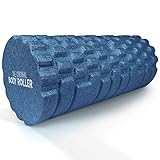
The listing positions this as a high-density foam roller and massager for deep-tissue release of the back and leg muscles, and mentions self myofascial release in its title. It is a conventional cylinder, so it works the same way as other rollers: you place the muscle on top, support yourself with your hands and feet, and roll slowly.
It suits athletes whose main complaint is tight quads, hamstrings, IT-band area or mid-back after hard sessions. Because the listing does not state dimensions in the visible title, check the length and diameter on the product page before ordering, especially if you need a longer roller for back work.
- Type: high-density foam roller
- Marketed for: back and leg muscles, self myofascial release
- Use: deep-tissue massage by body weight
- Surface: confirm texture on listing
- Length and diameter: confirm on listing
Pros
- Straightforward dense cylinder
- Good fit for general back and leg rolling
Cons
- Dimensions need to be confirmed before buying
- No extras included in the name
Use it for the large, forgiving muscles first: sit on it with your hands behind you and roll the quads face down, then flip for the hamstrings. Move to the upper back with arms crossed over the chest so the shoulder blades spread. If the listing shows a shorter model than you expected, a roller of this style still works for single-leg sessions, just with a little more balance effort.
Compared with the Krightlink set, this is a single-purpose roller, while the Krightlink adds accessories.
6. YANSYI 9-Roller Stick (Second Listing) – Best for a Backup Stick (Accessory Pick)

This second listing carries the same product name as the first YANSYI stick: a professional nine-roller deep-tissue massage stick for athletes, marketed for post-workout soreness and leg use. It appears to be a variant or a separate seller listing, so any differences in color, handle length or packaging should be confirmed on the page before choosing between the two.
As with the first stick, this is an accessory, not a foam roller. It makes sense as a second stick for a gym locker, travel bag or training room where several athletes share equipment.
- Type: hand-held roller stick
- Rollers: nine, per the listing name
- Marketed for: athletes, post-workout soreness, leg muscles
- Portability: described as portable
- Differences from the first listing: confirm on listing
Pros
- Portable and hand-controlled
- Useful as a spare for a bag or locker
Cons
- Nearly identical to the first YANSYI listing, so choosing between them requires checking the product pages
- Not a replacement for a foam cylinder
If you buy only one stick, there is no need to buy both. A second one only makes sense when two people train together, when you want one stick at home and one at the gym, or when you want to leave one in the car. Wipe the rollers clean after sweaty sessions so the stick stays pleasant to handle.
Compared with the first YANSYI listing, the only reliable difference is whatever the product page shows, so confirm there.
Specs Compared
| Product | Type | Length / size | Density / surface | Extras |
|---|---|---|---|---|
| Krightlink 5-in-1 Set | Roller kit | Confirm on listing | High density | Massage ball, resistance band, others (confirm on listing) |
| 18-Inch High-Density Roller | Foam cylinder | 18 inches | High density, black | None listed |
| YANSYI 9-Roller Stick | Hand-held stick | Confirm on listing | Nine rollers | Portable design |
| TriggerPoint Grid 1.0 | Foam cylinder | 13 inches long, about 5.5 inch diameter | Multi-density, hollow core with EVA wrap | None listed |
| The Original Body Roller | Foam cylinder | Confirm on listing | High density | None listed |
| YANSYI 9-Roller Stick (second listing) | Hand-held stick | Confirm on listing | Nine rollers | Portable design |
How We Chose These
This guide is a research-based comparison built from the six listings supplied for the topic. We compared each listing’s stated type, density, length and included extras, then cross-checked well-known products against manufacturer and retailer specification pages. We looked for features that matter to athletes: a density that holds its shape under body weight, a length that suits the muscles you train, and whether a ball, band or stick adds practical value. Where a listing does not state a measurement, the guide says to confirm it on the product page rather than guessing. This guide relies on documented specifications and published guidance, not on our own performance trials, and the rankings reflect fit for use rather than lab results.
What to Look For
Density and firmness
Foam rollers come in soft, medium and firm builds. Softer foam compresses easily and is a gentler place to start if you are new to rolling or are sore after a hard block. Firm, high-density foam and hollow-core designs keep their shape under heavy bodies and give more intense pressure. A reasonable rule: if you can stay relaxed and keep breathing normally while you roll, the firmness is about right. If you tense up, brace or hold your breath, move to a softer roller or take weight off with your hands and feet.
The Grid 1.0 is described by retailers as firm to extra firm, while the plain high-density rollers sit in the middle of the range. Treat these as classes, not exact hardness numbers, since manufacturers rarely publish a standard scale.
Length and diameter
Length decides what you can do with a roller. An 18-inch or 36-inch cylinder lets you lie along it to roll the spine with both shoulders supported, and roll both quads at once. A 13-inch roller is lighter and fits bags, but you will mostly use it on one leg or one side of the body at a time. Diameter matters too: larger rollers are easier to balance on, while smaller diameters dig in deeper but are harder to control. Check both numbers on the product page, because listing titles often skip them.
Surface texture
Smooth rollers spread pressure evenly and are best for broad areas like the thighs and upper back. Textured or ridged rollers concentrate pressure in narrower bands and can feel sharper on calves and IT-band regions. If a textured roller feels painful rather than relieving, switch to a smooth one for a few weeks.
Extras and sticks
A ball is useful for glutes, the base of the skull, the chest and the soles of the feet. A resistance band helps with warm-up and mobility work. A roller stick gives you hand control for calves and quads but cannot support your body weight, so it complements rather than replaces a cylinder.
Dose and timing: a worked example
Research on rolling after hard exercise suggests that about 60 to 120 seconds per muscle group is a common range, with 90 seconds often cited as a minimum for short-term soreness relief, though the best dose is not settled. A practical post-training routine: 90 seconds on each quad, 90 on each hamstring, 60 on each calf, 60 on the glutes and 90 on the upper back. That is roughly 12 to 14 minutes in total, which fits straight after a session. Roll slowly, about an inch per second, pause on tender spots for 20 to 30 seconds, and avoid rolling directly on joints, bones or the lower back. If you have a recent injury, swelling, numbness or sharp pain, stop and consult a clinician instead of pushing through.
Match the roller to your sport
Different sports load different tissues. Runners and cyclists mostly want calves, quads, hamstrings and the outer thigh, which any cylinder or a stick can reach. Lifters tend to carry tightness in the upper back, lats and pecs, where a longer roller and a ball help. Court and field athletes who change direction often benefit from glute and hip work, which a ball or a firm short roller handles well. Swimmers and throwers care more about the shoulder blades and thoracic spine, so a longer roller is the better bet. Think about the two or three areas that bother you most, then pick the tool that reaches those areas comfortably.
A good first-month plan is to roll three to four times a week, on non-consecutive days if you are sore, and to keep the pressure at a level you would rate about six out of ten. Increase the time before you increase the firmness, and keep a short log of how you feel the next morning. If one area stays sore for more than a couple of weeks, or if soreness comes with swelling, bruising or loss of strength, that is a signal to see a clinician rather than to roll harder.
Questions
Is a foam roller or a stick better for athlete recovery?
A foam cylinder is better when you want to use body weight and roll large areas such as the back and thighs. A stick is better for hand-controlled pressure on calves and quads, and for travel. Many athletes use both.
How long should I foam roll after training?
Studies commonly use between about 45 seconds and a few minutes per muscle group, and 60 to 120 seconds is a typical range. Ten to fifteen minutes in total is enough for most sessions. More is not necessarily better.
Should I choose a soft or a firm roller?
Beginners and people who are very sore usually do better with a softer or medium roller. Experienced athletes who feel nothing on soft foam can move to a firm, high-density or hollow-core option. Choose the firmness that lets you stay relaxed.
Can I roll my lower back?
It is better to roll the upper and mid back and to work on the glutes and hips instead. The lower spine has little muscular protection, and pressing a hard roller into it can feel uncomfortable. If your lower back is tight, try a ball on the glutes or ask a clinician for guidance.
Does foam rolling replace stretching or a warm-up?
No. Rolling is one tool for managing tightness and soreness. It works best alongside a proper warm-up, mobility work and enough sleep.
How do I clean and store a foam roller?
Wipe the surface with a damp cloth and mild soap, let it dry, and store it away from direct heat and sunlight. Foam can lose shape if compressed for long periods, so avoid stacking heavy items on it.
Update History
- October 20, 2026 – Initial publication; product set drawn from current catalog listings.
- Check the product page for current specifications and availability before buying.
Sources
- Manufacturer and retailer specification pages for the TriggerPoint Grid 1.0 foam roller
- Retailer listing titles and specification fields for each product
- Published research summaries on foam rolling and delayed-onset muscle soreness, including open-access papers indexed by the National Library of Medicine




Write Your Review
No reviews yet. Be the first to share your experience!