

Our Short List of 3

- Best for: hobbyists, students and anyone who wants four channels and FFT analysis on a first bench scope.
- Bandwidth: 50 MHz
- Channels: 4 analog channels
- Sample rate: 1 GSa/s
- Memory depth: up to 24 Mpts
- Best for: embedded developers and serious hobbyists who want 100 MHz bandwidth, four channels and decoding in one scope.
- Bandwidth: 100 MHz
- Channels: 4 analog channels
- Sample rate: 1 GSa/s
- Serial decoding: standard decoder included

- Best for: high-frequency measurements, fast clocks and anyone who needs 200 MHz on a two-channel budget.
- Bandwidth: 200 MHz
- Channels: 2 analog channels
- Sample rate: 1 GSa/s
- Memory depth: 24 Mpts
All 4 Picks at a Glance
| Product | Specs | Action |
|---|---|---|
| 1. Rigol DS1054Z |
| Check price on Amazon |
| 2. Siglent SDS1104X-E |
| Check price on Amazon |
| 3. Rigol DS1202Z-E |
| Check price on Amazon |
 4. Hantek DSO5072P |
| Check price on Amazon |
Key takeaways
- Compare the 4 best digital storage oscilloscopes with FFT analysis for November 2026, with bandwidth, sample rate, memory depth and FFT features explained.
A digital storage oscilloscope turns invisible electrical signals into waveforms you can measure, and its FFT analysis mode turns those waveforms into a frequency spectrum. That spectrum view reveals harmonics, noise, interference and distortion that stay hidden in the time domain, which makes FFT one of the most useful tools for audio work, power supply debugging, radio projects and embedded design. The scopes below all include FFT analysis, so the choice comes down to bandwidth, channel count, sample rate and memory depth.
This guide compares four bench oscilloscopes that cover the range from a first bench instrument to a serious debugging tool. Each one captures signals in the time domain and converts them to the frequency domain on screen, with controls for span, center frequency and window type. Read the buying criteria first, then match the shortlist to the work you actually do.
Quick Picks
As an Amazon Associate we earn from qualifying purchases.
| Product | Best for | Key spec from title |
|---|---|---|
| Rigol DS1054Z | Four-channel hobby and education work | 50 MHz bandwidth, 4 channels |
| Siglent SDS1104X-E | Four-channel debugging with serial decode | 100 MHz bandwidth, 4 channels |
| Rigol DS1202Z-E | High-frequency two-channel measurements | 200 MHz bandwidth, 2 channels |
| Hantek DSO5072P | Budget two-channel bench work | 70 MHz bandwidth, 2 channels |
How to Choose
Bandwidth and the signals you measure
Bandwidth sets the highest frequency a scope can measure without losing amplitude, so it should sit above the fastest signal in your work. A 50 MHz scope handles audio circuits, microcontroller projects, Arduino boards and most switching power supplies with room to spare. Move to 100 MHz when you work with faster digital edges, USB signals or radio front ends, and to 200 MHz for high-speed clocks and fast rise-time pulses. Buying far more bandwidth than your signals need adds cost without improving results, while too little bandwidth rounds off square waves and hides ringing. Match the number to your fastest signal, then add a margin for the harmonics you want to see in the FFT view.
FFT depth: points, windowing and span control
FFT quality depends on more than a menu entry, so check how each scope implements the transform. More FFT points give finer frequency resolution, which separates two close tones and makes small spurs visible next to a strong carrier. Window choice matters too: a rectangular window suits transient signals, a Hanning window suits general sine work, and a Blackman window helps when a weak signal hides beside a strong one. Check that the scope lets you set the span and center frequency directly, so you can zoom into a narrow band instead of viewing the whole spectrum at once. A deep record length feeds the FFT more samples, which keeps the spectrum detailed even at slow timebase settings.
Sample rate and memory depth
Sample rate decides how faithfully a scope digitizes fast waveforms, and memory depth decides how long a capture can run at that rate. A 1 GSa/s sample rate is the common baseline here and captures signals up to several hundred megahertz when bandwidth allows. Memory depth is the quiet partner: a 24 Mpts record captures a long burst at full sample rate, then lets you zoom into a short section without losing detail. Shallow memory forces a trade-off: the scope lowers its sample rate to stretch a short memory across a long window. For FFT work this matters twice over, since a longer record means more points in the transform and a cleaner spectrum.
Channels, decoding and everyday usability
Channel count shapes what you can compare at once, and decoding turns raw waveforms into readable data. Four channels let you watch a clock, a data line, a chip-select signal and an analog output side by side, which two channels and repeated captures cannot match. Built-in serial decoding for UART, I2C and SPI converts bus traffic into hex values on screen, saving hours of manual bit counting. Everyday usability counts too: a large bright display, responsive knobs, a clear trigger menu and a USB port for saving screenshots and waveform data all make long sessions easier. A scope that is pleasant to operate gets used more often, and that alone improves the quality of the measurements you take.
The 4 Best Options
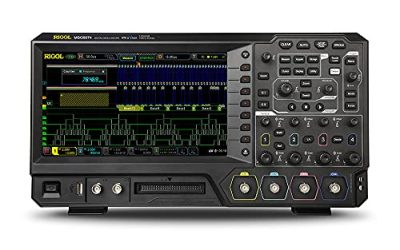
1. Rigol DS1054Z
- Best for: hobbyists, students and anyone who wants four channels and FFT analysis on a first bench scope.
- Bandwidth: 50 MHz
- Channels: 4 analog channels
- Sample rate: 1 GSa/s
- Memory depth: up to 24 Mpts
hobbyists, students and anyone who wants four channels and FFT analysis on a first bench scope.
the 50 MHz bandwidth limits work on fast digital edges and high-frequency radio signals.
The Rigol DS1054Z is the classic entry point into four-channel bench oscilloscopes, and it remains a sensible pick for hobbyists, students and repair benches. Its four analog channels cover multi-signal work that two-channel scopes cannot, and the built-in serial decoding reads UART, I2C and SPI traffic directly on screen. The FFT math function turns any captured waveform into a spectrum view for hunting harmonics and interference, while the deep memory keeps captures detailed at slow timebase settings. A large color display and the familiar UltraVision interface make it easy to learn, and the four included probes mean it is ready to measure straight out of the box.
Watch out for: the 50 MHz bandwidth limits work on fast digital edges and high-frequency radio signals.
2. Siglent SDS1104X-E
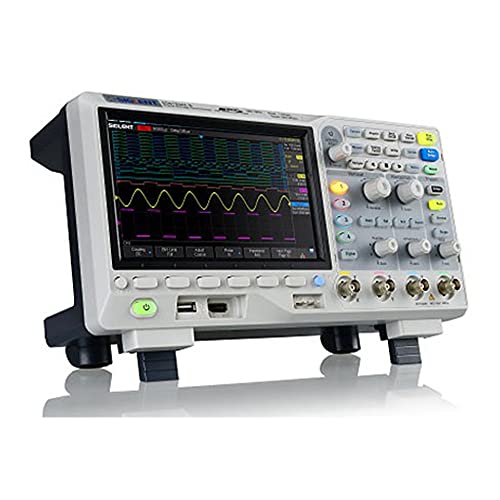
- Best for: embedded developers and serious hobbyists who want 100 MHz bandwidth, four channels and decoding in one scope.
- Bandwidth: 100 MHz
- Channels: 4 analog channels
- Sample rate: 1 GSa/s
- Serial decoding: standard decoder included
embedded developers and serious hobbyists who want 100 MHz bandwidth, four channels and decoding in one scope.
it takes up a full bench footprint, so measure your workspace before ordering.
The Siglent SDS1104X-E steps up to 100 MHz while keeping the four-channel layout that makes multi-signal debugging practical. Its standard serial decoder handles the common embedded buses without extra option keys, and the FFT function gives a clear spectrum view for tracking down noise sources and harmonics. The interface is responsive, the display is crisp, and the triggering stays stable on complex waveforms with mixed analog and digital content. For anyone moving from a first scope to a daily driver, this model covers microcontroller work, audio electronics, power supply debugging and general lab measurements in one instrument.
Watch out for: it takes up a full bench footprint, so measure your workspace before ordering.
3. Rigol DS1202Z-E
- Best for: high-frequency measurements, fast clocks and anyone who needs 200 MHz on a two-channel budget.
- Bandwidth: 200 MHz
- Channels: 2 analog channels
- Sample rate: 1 GSa/s
- Memory depth: 24 Mpts
high-frequency measurements, fast clocks and anyone who needs 200 MHz on a two-channel budget.
two channels cannot watch a clock, data line and analog output all at once.
The Rigol DS1202Z-E is the pick when raw bandwidth matters more than channel count, offering 200 MHz in a two-channel bench instrument. That bandwidth captures fast edges and high-frequency clocks cleanly, and the FFT analysis view shows harmonics and spurs that lower-bandwidth scopes would miss entirely. Deep memory and a fast capture rate keep long records detailed, while the record and playback mode lets you step back through thousands of frames to find a rare glitch. Serial decoding for UART, I2C and SPI is included, so it still handles embedded debugging work alongside its high-frequency strengths.
Watch out for: two channels cannot watch a clock, data line and analog output all at once.
4. Hantek DSO5072P
- Best for: beginners and budget benches that need a simple two-channel scope with FFT analysis.
- Bandwidth: 70 MHz
- Channels: 2 analog channels
- Sample rate: 1 GSa/s real-time, 25 GSa/s equivalent
- Memory depth: 40K
beginners and budget benches that need a simple two-channel scope with FFT analysis.
the 40K memory depth is shallow, so long captures lose sample rate and FFT detail.
The Hantek DSO5072P is a straightforward two-channel bench scope for a first workbench or a second station, with 70 MHz bandwidth and a fast 1 GSa/s sample rate. Its FFT math function produces a usable spectrum view for checking harmonics in audio circuits and switching noise in power supplies, and the large display keeps traces easy to read across the room. The controls follow the familiar bench-scope layout, so anyone who has used an oscilloscope before can start measuring within minutes. It covers the common tasks of learning electronics, repairing boards and checking microcontroller signals without the cost of a four-channel instrument.
Watch out for: the 40K memory depth is shallow, so long captures lose sample rate and FFT detail.
Which One Fits Your Situation
First bench scope for learning electronics
Start with the Hantek DSO5072P if the budget is tight and the work is mostly audio circuits, Arduino projects and board repair. Its two channels and 70 MHz bandwidth cover the signals a beginner actually meets, and its FFT view teaches frequency-domain thinking early. Move to the Rigol DS1054Z when the budget allows four channels, because watching several signals at once speeds up understanding a circuit. Either scope is easy to learn, and both leave room to grow.
Debugging serial buses and embedded boards
Choose the Siglent SDS1104X-E for embedded work, since four channels plus built-in decoding let you watch a clock, data, chip select and an analog signal together. The 100 MHz bandwidth handles fast edges on modern microcontroller boards, and the FFT view helps trace noise coupling from digital lines into analog measurements. The Rigol DS1054Z is the fallback when the budget is lower, as it decodes the same buses and still gives four channels for multi-signal comparisons.
Audio, power and switching-noise analysis
Pick the Rigol DS1054Z or the Siglent SDS1104X-E for power and audio work, where the FFT spectrum matters more than extreme bandwidth. Use the spectrum view to find switching harmonics from a power supply, mains hum in an audio stage, or interference coupling into a sensitive analog front end. Deep memory keeps the spectrum detailed at the slow timebase settings that power measurements need, and four channels let you compare input and output ripple at the same time.
High-frequency work on a two-channel budget
Take the Rigol DS1202Z-E when the signals themselves demand 200 MHz, such as fast clocks, high-speed data lines or radio circuits. Two channels are enough when the measurement is about one signal and its spectrum, not several lines at once. The deep memory and frame recording help catch rare glitches, and the FFT view shows harmonics that confirm whether a fast edge is clean or ringing. Accept the two-channel limit in exchange for bandwidth you cannot get elsewhere.
Common Mistakes
- Choosing bandwidth from the headline number alone instead of checking the fastest edge and harmonic content in the actual signals.
- Ignoring memory depth, then finding that long captures drop the sample rate and blur the FFT spectrum.
- Using the wrong FFT window, which smears a strong tone across the spectrum and hides the weak signals beside it.
- Leaving probes on the 1X setting, which loads the circuit and distorts the waveform before the scope ever sees it.
- Forgetting to check that the scope includes serial decoding, then paying extra later for an option that other models include as standard.
Frequently Asked Questions
What does FFT analysis do on an oscilloscope?
FFT analysis converts a time-domain waveform into a frequency spectrum, showing which frequencies are present and how strong each one is. That view reveals harmonics, noise, interference and distortion that a normal waveform display hides. Use it to find switching noise in a power supply, hum in an audio circuit, or a spur beside a radio carrier.
How much bandwidth do I need for FFT work?
Bandwidth should sit above the highest frequency you want to see in the spectrum, including harmonics. A 50 MHz scope covers audio and microcontroller work, 100 MHz handles faster digital edges, and 200 MHz suits high-speed clocks and radio signals. If the scope cannot pass a harmonic, the FFT view cannot show it either.
Is a two-channel scope enough for FFT analysis?
Two channels are enough when the job is one signal and its spectrum, such as checking harmonics or hunting a noise source. Four channels become valuable when you need to compare several signals at once, for example a clock, data line and analog output during embedded debugging. Match the channel count to how many signals you compare.
Does memory depth affect FFT quality?
Yes, because a longer record feeds more samples into the transform, which improves frequency resolution and lowers the noise floor in the spectrum. Shallow memory forces the scope to lower its sample rate on long captures, and the FFT view loses detail as a result. Deep memory keeps the spectrum sharp even at slow timebase settings.
More from Amazon
Programs that pair well with the guide above. Offers and eligibility are set by Amazon and may change.
Free shipping on eligible items, Prime Video and more. Eligible new members can start with a free trial.
Start a Prime free trialAudiobooks and podcasts to listen to on the go. Eligible new members can start with a free trial.
Try Audible freeAd-free music streaming. Eligible new subscribers can start with a free trial.
Try Music Unlimited freeA free business account with business pricing and bulk-buying tools for work, shop or home office.
Create a business accountAs an Amazon Associate we earn from qualifying purchases.


Write Your Review
No reviews yet. Be the first to share your experience!