

Key takeaways
- Compare the best ankle braces for basketball: lace-up Med Spec ASO sizes, a slim-fit WHCOOL and reinforced wraps, with sizing and care advice.
The best ankle brace for basketball for most players is the Med Spec ASO Ankle Stabilizer, a lace-up brace with figure-8 straps that mimic athletic taping and fit inside a basketball shoe. Players who want something slimmer and faster to put on can look at the WHCOOL Slim-Fit brace, and anyone watching their budget can consider the reinforced lace-up wrap. An ankle brace for basketball is a wearable support that limits the ankle from rolling inward during cuts, landings and jumps, which is how most court sprains happen. It does not replace medical care for an injured ankle.
Quick List
- Med Spec ASO Ankle Stabilizer, Large, Black – best for players with larger feet who want a proven lace-up with straps
- Med Spec ASO Ankle Stabilizer, Medium, Black – best for average-size feet and a low-profile fit under dark shoes
- Reinforced Lace-Up Ankle Brace (first listing) – best for a wrap-style brace for basketball, volleyball and running
- WHCOOL Slim-Fit Ankle Brace – best for players who want a slim, quick-lace brace with side pads
- Med Spec ASO Ankle Stabilizer, Medium, White – best for teams and shoes that call for a white brace
- Reinforced Lace-Up Ankle Brace (second listing) – best for a second size or color of the reinforced wrap (confirm on listing)
Which One Is Right for You?
| If you… | Choose |
|---|---|
| want a slim brace you can lace up quickly between plays | WHCOOL Slim-Fit |
| want the figure-8 strapping that mimics athletic tape | Med Spec ASO (Large or Medium, Black) |
| wear size large and need a bigger brace | Med Spec ASO, Large, Black |
| play in white shoes or uniform socks | Med Spec ASO, Medium, White |
| want a wrap-style brace that also works for volleyball and running | Reinforced Lace-Up Ankle Brace (either listing) |
| already know the reinforced wrap fits and want another size or color | Second Reinforced Lace-Up listing |
Choose by size and how quickly you need to put it on before deciding on brand. Lace-up braces with figure-8 straps are common among basketball players because they are low profile and adjustable. If you have a current injury, a recurring instability or severe swelling, see a doctor or physical therapist first, because the right brace depends on the diagnosis. If you are healthy and want extra support, a lace-up in the right size is a sensible starting point.
All 6 Picks in Detail
1. Med Spec ASO Ankle Stabilizer, Large, Black – Best for Larger Feet and a Proven Lace-Up
As an Amazon Associate we earn from qualifying purchases at no extra cost to you.

The ASO is a long-established lace-up ankle stabilizer, and this listing is the Large size in black. Manufacturer and retailer descriptions explain its design: a ballistic nylon boot, a lace-up front, an elastic cuff and non-stretch figure-8 straps that wrap around the ankle to imitate taping. It is described as low profile and bilateral, meaning each size fits either foot, and the listing names it as a brace for sprains and instability.
- Size: Large, color: black
- Lace-up design with figure-8 strapping per the product line
- Ballistic nylon construction and elastic cuff per manufacturer descriptions
- Bilateral, fits either foot
- Exact size chart (shoe size range): confirm on listing
Basketball players with larger feet often struggle to find a brace that fits without cramping the toe box, which is why a Large matters. Larger braces also have longer laces and straps, so expect to spend a little more time adjusting them. Practice putting the brace on at home so that on game day you can lace it in the locker room without rushing, and keep a spare pair of laces in your bag in case one snaps before tip-off.
Pros:
- Adjustable lace closure lets you tune the fit
- Straps provide taping-style support without re-taping
Cons:
- Lacing takes time compared with a hook-and-loop brace
- May require sizing up in your basketball shoe
Compared with the Medium Black, this is the same design for a bigger foot; compared with the WHCOOL, it is more traditional and adjustable but slower to put on.
2. Med Spec ASO Ankle Stabilizer, Medium, Black – Best for Average Feet
This is the same ASO in Medium, and it will fit a broad group of players. The lace-up plus strap system is meant to hold the ankle in a neutral position and limit the inward rolling motion that causes inversion sprains. Many players slide it on over a thin athletic sock, lace it up, wrap the straps and then put on their basketball shoes, a routine that takes a minute or two once you know it.
- Size: Medium, color: black
- Same lace-up, figure-8 strap design
- Low-profile fit inside a shoe
- Machine washable per manufacturer care guidance
- Shoe size range for Medium: confirm on listing
In practice the Medium suits the widest range of players, from high school guards to recreational adults. A common routine is to put on a thin sock, step into the brace, pull the laces snug from the toes to the top, close the elastic cuff and then wrap each strap in turn. Do a few lateral shuffles before lacing your shoes to check that the brace stays put, and re-snug the laces at halftime if they have loosened.
Pros:
- Common size, so it suits many players
- Black hides dirt and wear
Cons:
- Needs a few sessions to break in the nylon and laces
- Padding is minimal, so check pressure points
It is the mid-size sibling of the Large above and the black counterpart to the white Medium below.
3. Reinforced Lace-Up Ankle Brace, First Listing – Best for a Wrap-Style Brace Across Sports
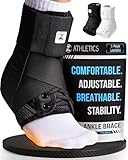
This listing calls itself a reinforced lace-up brace for men and women, with a wrap that supports a sprained ankle, designed for basketball, volleyball and running. The title says it fits inside shoes and mentions Achilles support, which suggests a design that wraps the heel and lower leg. It does not name a brand, so check the product page for the fabric, strap layout and size chart before buying.
- Lace-up wrap design for men and women
- Marketed for basketball, volleyball and running
- Fits inside shoes per the listing name
- Achilles support mentioned in the listing
- Size chart, strap style and material: confirm on listing
Because the listing covers basketball, volleyball and running, it is a flexible choice for athletes who play more than one sport. Wrap-style braces are also easier to adjust around mild swelling, since you can loosen the lacing at the top without changing the whole fit. On the court, make sure the heel section does not bunch under your foot, which can create pressure points inside the shoe. Look at the product page for the exact fabric and strap layout.
Pros:
- Designed for multiple court sports
- Wrap-style fit can be adjusted to suit swelling or different shoes
Cons:
- Brand and detailed specifications are not named
- Bulk around the heel may affect shoe fit
Next to the Med Spec ASO, it is the more generic option, with less information in the title about the strapping system.
4. WHCOOL Slim-Fit Ankle Brace – Best for a Slim, Quick-Lace Fit

The WHCOOL brace is the slim-fit option in this list. The listing describes a quick lace-up system with two auto-shaped pads and air fabric, intended for sprain recovery, running and sports. Retailer details mention hook-and-loop straps in a figure-8 pattern, which makes it faster to put on than a fully laced brace, and side pads that are described as contoured to the ankle bones. It is also the one aimed at players who find traditional braces too bulky inside tight basketball shoes.
- Slim-fit design with quick lace-up closure
- Two auto-shaped side pads per the listing
- Air fabric for breathability
- Marketed for men and women
- Size chart and strap details: confirm on listing
A slim brace helps in tight-fitting shoes, where bulk can change how the shoe feels. Quick-lace systems also appeal to players who change braces between games or pass a brace around a team. Since the listing describes side pads rather than rigid stays, think of this as moderate support. Players with a history of severe sprains should ask a clinician whether a firmer brace is a better match, then use the slim style for lower-risk situations.
Pros:
- Slim profile fits easily in a shoe
- Faster to put on than a fully laced brace
Cons:
- Side pads are not a rigid support, so it may be less stabilizing for severe instability
- Fit depends on correct sizing, so measure carefully
Compared with the ASO, it is lighter and quicker to put on, while the ASO has a longer record as a laced, taping-style brace.
5. Med Spec ASO Ankle Stabilizer, Medium, White – Best for White Shoes and Team Looks
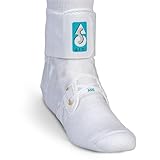
This listing is the Medium ASO in white. The brace is the same, so the difference is purely cosmetic: white blends in with white socks and shoes and with school or team uniforms that require matching gear. Because it is lighter in color it can show dirt and sweat sooner, which means you will want to wash it according to the care instructions. The listing names it as an ankle brace for sprains, instability and bilateral orthopedic support.
- Size: Medium, color: white
- Lace-up with figure-8 straps per the product line
- Low-profile, bilateral design
- Same specifications as the Medium Black
- Washing instructions: confirm on listing
Some leagues and school programs ask for uniform gear, and a white brace avoids a visual mismatch with white socks. If appearance is not a concern, the black version is more practical for the long run, since it hides wear. Either way, treat the brace like a piece of equipment: rinse it after sweaty games, let it dry fully, and store it flat so the straps do not tangle.
Pros:
- Matches white socks and shoes
- Same design as the black version
Cons:
- Shows dirt more readily
- Same lacing time as other ASO versions
It is the cosmetic twin of item 2, so pick it only if you need the color.
6. Reinforced Lace-Up Ankle Brace, Second Listing – Best for an Alternate Size or Color
The second reinforced lace-up listing shares its name with the first and appears to be another size or color of the same brace. The same cautions apply: the title does not name a brand, so read the product page for sizing and strap details. Choose it if the first listing is out of stock in your size, and keep in mind that wraps like this can feel different from one wearer to another depending on how the straps are routed.
- Lace-up wrap with reinforcement per the listing
- Marketed for basketball, volleyball and running
- Fits inside shoes per the listing
- Same title as item 3
- Variant details: confirm on listing
Because the two reinforced listings read the same, take a moment on the product page to find the actual differences: size options, color and any stated materials. If the sizing chart is based on foot length or ankle circumference, measure at home before ordering. Keep the packaging details in case you need to exchange for a different size, and try the brace with the shoes you intend to wear before game day.
Pros:
- Gives you another way into the same brace design
- Useful across several court sports
Cons:
- Hard to tell apart from the first listing without opening both pages
- Brand information is limited
It is functionally the same family as item 3.
Specs Compared
| Brace | Closure | Straps | Size | Color |
|---|---|---|---|---|
| Med Spec ASO, Large, Black | Lace-up with elastic cuff | Figure-8 straps | Large | Black |
| Med Spec ASO, Medium, Black | Lace-up with elastic cuff | Figure-8 straps | Medium | Black |
| Reinforced Lace-Up (first) | Lace-up wrap | Confirm on listing | Confirm on listing | Confirm on listing |
| WHCOOL Slim-Fit | Quick lace-up | Hook-and-loop straps per listing | Confirm on listing | Confirm on listing |
| Med Spec ASO, Medium, White | Lace-up with elastic cuff | Figure-8 straps | Medium | White |
| Reinforced Lace-Up (second) | Lace-up wrap | Confirm on listing | Confirm on listing | Confirm on listing |
How We Chose These
This guide is based on research into the six listed braces, not on wearing them. We read each listing name and description, compared them with manufacturer information for the Med Spec ASO and retailer specification fields for the others, and sorted the products by closure type, strapping, size and how clearly the listing states these details. For basketball we looked at profile inside a shoe, adjustability and whether the design limits inward rolling. Where a listing does not state a value, we say to confirm it on the product page. This is shopping information, not medical advice, and the order follows the product list.
What to Look For
Brace Types: Lace-Up, Strap and Semi-Rigid
Lace-up braces, like the ASO, use laces and often figure-8 straps to mimic athletic tape. They are adjustable and low profile. Hook-and-loop strap braces are quicker to put on and can be slim, but they depend on the strap layout for stability. Semi-rigid stirrup braces use side shells for lateral stability and are often used after a sprain. For general basketball use, lace-up and strap braces are the most common because they fit inside a normal shoe. If you have had a severe sprain or recurring instability, ask a clinician which type suits you.
Sizing and Shoe Fit
Size by the manufacturer’s chart, which is often based on shoe size or ankle circumference. A brace that is too big slides and loosens during play, while one that is too small can pinch or cut off comfort. A brace adds volume inside the shoe, so many players go up half a size in shoes or choose a low-profile brace. High-top shoes can cover the brace, while low-tops leave the cuff visible. Try the brace with the shoes you actually play in before game day. Leave the shoe’s insole in place, and check that the laces and tongue sit comfortably over the brace without squeezing the top of the foot. If the shoe now feels tight, try loosening the shoe laces at the ankle rather than loosening the brace.
Putting It On Correctly
Sit with your foot flat and your knee bent, lace the brace snugly from the toes up to the ankle and finish with the straps. It should feel firm but not painful, and your toes should not tingle or turn pale. Wear a thin sock under the brace to reduce rubbing. After lacing, walk around and do a few side-to-side steps to check that it holds. Re-tie if it loosens during warm-ups. Check for rubbing at the heel and on top of the foot after your first session, and if the brace leaves marks, add a thin sock or adjust the straps. Many players prefer to put the brace on before lacing their shoes, then tighten the shoes over it rather than trying to slide a brace in afterward.
Strength, Warm-Up and Footwear
A brace is one layer of protection, not the only one. Balance work on one leg, calf and hip strengthening and a proper warm-up all help the ankle handle cutting and landing. Shoes matter too: worn-out outsoles and compressed midsoles reduce stability, so replace basketball shoes when the tread is smooth or the cushioning feels flat. Ask a coach, athletic trainer or physical therapist for exercises suited to you, especially if you are returning from an injury.
Care and Replacement
Follow the washing instructions, usually a gentle cycle and air drying, because heat can break down elastic and straps. Replace a brace when the straps stretch out, the laces fray or the fabric thins. A worn brace may feel supportive but no longer holds the ankle in the right position.
Worked Example: Choosing a Size and Style. Say you wear a men’s size 10 and play in mid-top shoes. A Medium or Large depends on the chart, so check which shoe-size range includes size 10. If you want taping-style stability, the ASO’s lace-up and straps fit that need. If you need a brace that you can put on in the locker room within seconds, the slim WHCOOL may fit your routine better. In both cases, try it with your shoes in advance, and bring the brace to warm-ups. Another way to decide is by routine: a player who arrives early and stretches can afford the extra minutes a full lace-up takes, while a player who changes in a rush before a pickup game may reach for the quicker style. Whichever you choose, wear it in practice for a week before relying on it in a competitive game, so you know how it feels after an hour of cutting, jumping and sprinting.
Questions
Does an ankle brace prevent sprains?
A brace is designed to limit the ankle from rolling inward, which can reduce the chance of a sprain, but no brace eliminates the risk. Strength, balance training and proper footwear also matter. Talk to a clinician if you have had repeated sprains.
Should I wear a brace if my ankle is not injured?
Some players wear a brace as a precaution, especially after a previous sprain. It is a personal and sometimes team-level choice. If you are unsure, ask a doctor, athletic trainer or physical therapist.
Can I wear a brace with basketball shoes?
Yes, low-profile braces are designed to fit inside basketball shoes. You may need a half size up in your shoes, and it helps to try the combination before a game.
How tight should an ankle brace be?
Firm and supportive, but not painful. You should not feel numbness or tingling, and your toes should keep normal color. If it hurts or your foot swells, loosen it and consult a professional.
How do I wash an ankle brace?
Follow the label. Many lace-up braces can be machine washed on a gentle cycle and air dried, and some need hand washing. Avoid heat, which can damage elastic.
Should I use a brace on a sprained ankle?
See a doctor or physical therapist first. A brace can help during recovery, but the right type and timing depend on the severity of the injury.
Update History
- October 20, 2026 – Initial publication; product set drawn from current catalog listings.
- Check the product page for current specifications and availability before buying.
Sources
- Manufacturer and retailer descriptions of the Med Spec ASO Ankle Stabilizer
- Retailer listing titles and specification fields for each listed brace
- Published basketball ankle brace buying guides for general brace-type comparisons



Write Your Review
No reviews yet. Be the first to share your experience!