

Key takeaways
- Compare the best resistance bands for athletes: loop sets, pull-up assist bands and Kbands leg trainers, with resistance ranges and safety tips.
The best resistance bands for most athletes in this group are the 5-level pull-up assist set with a stated 5 to 125 pound range, because heavy loop bands cover lower-body lifts, band-assisted pull-ups, mobility drills and warm-ups with one purchase. Field and court athletes who want speed and agility drills should look at the Kbands leg system instead. A resistance band is an elastic loop or strap that adds tension as it stretches, so you can strengthen muscles, assist bodyweight moves or add load to jumps and sprints without a rack of weights.
Quick List
- 5-Pack Elastic Exercise Bands – best for general strength, stretching and home workouts
- Fit Simplify Loop Bands (Set of 5) – best for a guided, travel-ready set with a carry bag
- 5-Level Pull-Up Assist Bands – best for a wide 5 to 125 pound range and heavy lifts
- Pull Up Assist Bands (Physical Therapy Set) – best for assisted pull-ups and rehab-style work
- 5-Pack Elastic Loop Bands (Pilates and Yoga) – best for lighter mobility and activation work
- Kbands Leg Resistance Bands – best for sprint, speed and agility training
Which One Is Right for You?
| If you… | Choose |
|---|---|
| Want to add resistance to sprint and agility drills | Kbands Leg Resistance Bands |
| Need big resistance for squats, deadlifts or assisted pull-ups | 5-Level Pull-Up Assist Bands |
| Travel often and want an instruction guide and bag | Fit Simplify Loop Bands (Set of 5) |
| Want an assist band set that also works for physical therapy style drills | Pull Up Assist Bands (Physical Therapy Set) |
| Want a basic set for stretching and strength at home | 5-Pack Elastic Exercise Bands |
| Mostly do glute activation, Pilates or yoga-style work | 5-Pack Elastic Loop Bands (Pilates and Yoga) |
Loop bands in packs of five usually step up from light to heavy. The main decision is whether you need light bands for activation and rehab-style work, heavy bands for strength lifts, or a sport-specific system for speed work. Many athletes end up with a heavier set and a lighter set.
All 6 Picks in Detail
1. 5-Pack Elastic Exercise Bands – Best for General Strength and Stretching
As an Amazon Associate we earn from qualifying purchases at no extra cost to you.
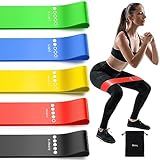
The listing describes a five-pack of elastic exercise bands for strength training, stretching and working out, marketed as home gym equipment for women and men. It is the most general product in the group: a set of loops stepping from light to heavy.
It suits athletes building a basic home kit for warm-ups, glute activation and accessory work. It is a sensible choice if you do not need a specific brand or a sport-specific system.
- Set: five elastic bands
- Marketed for: strength training, stretching, home workouts
- Resistance levels and band length: confirm on listing
- Material: confirm on listing
- Carry bag or guide: confirm on listing
Pros
- Simple and versatile
- Good starter set
Cons
- Few details in the title
- Quality and resistance accuracy depend on the product page
Use the lighter bands for warm-ups and the heavier ones for slow, controlled sets of 10 to 15 repetitions. Avoid overstretching beyond the stated length.
A solid use for a basic set is a full-body warm-up in about six minutes: band pull-aparts, lateral walks, squats with the band above the knees, and standing rows anchored to a door-safe point. Light bands warm the joints, while the heavier bands can be saved for slower strength sets. If the set arrives with only a thin sheet of instructions, look up exercises from a trusted coach or physical therapist rather than improvising with a risky setup.
Compared with the Pilates-oriented five-pack, this one is pitched more at general strength.
2. Fit Simplify Loop Bands (Set of 5) – Best for a Guided, Travel-Ready Set

The Fit Simplify listing is a set of five resistance loop bands that comes with an instruction guide and a carry bag. That combination is useful for athletes who are new to bands or who travel often, because the guide shows exercises and the bag keeps the loops together.
It suits athletes who want a ready-to-go set for hotel rooms, warm-ups before games or a home routine. The title does not state pound values or lengths, so confirm the resistance levels and loop size before relying on it for heavy lifts.
- Set: five loop bands
- Extras: instruction guide and carry bag
- Use: lower-body, upper-body and mobility exercises
- Resistance values and loop length: confirm on listing
- Material: confirm on listing
Pros
- Includes a guide and a bag
- Good for travel
Cons
- Resistance numbers not stated in the visible title
- May be too light for strong lifters
A simple routine is three sets of 12 to 15 lateral band walks, glute bridges and banded rows. Move through the set from lighter to heavier bands as you get stronger.
Instruction guides are most helpful for the first couple of weeks. Work through the suggested exercises once, note which ones feel right, and then build your own short routine of three or four moves. The carry bag is a small thing that makes a real difference, because bands left loose in a drawer tend to tangle and get nicked by keys or zippers. Keep the bag out of a hot car so the elastic lasts.
Compared with the generic five-pack, this one adds a guide and a carry bag.
3. 5-Level Pull-Up Assist Bands – Best for a Wide Resistance Range

This set is described as five levels of resistance spanning 5 to 125 pounds, intended for working out, pull-up assistance and full-body training. A range that high means the heaviest band is suited to assisted pull-ups, banded squats and deadlifts, while the lightest bands handle warm-ups and shoulder prehab.
It suits strength athletes, gymnasts, climbers and anyone chasing their first strict pull-up. Note that the stated pound range is the manufacturer’s nominal figure and actual tension depends on how far the band is stretched, so treat it as a guide.
- Levels: five
- Stated resistance: 5 to 125 pounds
- Marketed for: pull-up assistance, full-body training, stretching
- Material and band width: confirm on listing
- Carry bag or guide: confirm on listing
Pros
- Wide range from warm-up to heavy lifting
- Suitable for assisted pull-ups
Cons
- Stated ranges are nominal, not exact
- Heavy bands can snap back if not anchored well
Anchor heavy loops around a sturdy bar or rack, check for nicks or tears before every session and keep your face out of the line of snap-back. Replace any band that shows cracking or thin spots.
A practical way to use a graded set is to pair bands to exercises rather than owning one favorite. The lightest loop can go on the wrists or forearms for shoulder external rotations and band pull-aparts. The middle bands fit hip thrusts, good mornings and rows. The heaviest band is the one to loop over a bar for assisted pull-ups or dips, or to anchor a banded squat. Because the whole range is in one purchase, it is easy to find the level that matches your day, whether you are fresh or tired.
Compared with the other pull-up assist listing, this one makes its range clearer in the title.
4. Pull Up Assist Bands (Physical Therapy Set) – Best for Assisted Pull-Ups and Gentle Rehab-Style Work

This listing names pull-up assist bands and workout bands for fitness, training and physical therapy. It is a loop-band set positioned for both strength training and rehab-style work. Check the page for the number of bands, their widths and their resistance levels, which are not given in the visible title.
It suits athletes working toward a first pull-up and those who follow a clinician’s guidance for lighter strengthening. The physical therapy wording is a marketing phrase, so ask a professional for advice before using any band on an injury.
- Type: loop band set for pull-up assistance and workouts
- Marketed for: fitness, training, physical therapy
- Band count and widths: confirm on listing
- Resistance values: confirm on listing
- Carry bag or door anchor: confirm on listing
Pros
- Flexible use across strength and gentle rehab-style work
- Works for band-assisted pull-ups
Cons
- Few specifics in the title
- Rehab claims should not replace professional advice
For band-assisted pull-ups, loop the band over the bar and place a foot or knee in the loop. Start with a heavier band and move to lighter ones over weeks.
A useful progression for pull-ups is to start with a band that lets you complete five to eight clean reps, add a repetition every session, and then step down to the next lighter band once you can do three sets of eight. Do not swing or kip to finish a rep. Bands that are very thick can also be hard on the skin where they sit on the foot, so wear socks or shoes and place the foot flat in the loop.
Compared with the 5-level set, this one states fewer specifics, so the other listing is easier to judge.
5. 5-Pack Elastic Loop Bands (Pilates and Yoga) – Best for Light Mobility and Activation Work

This listing is a five-pack of elastic loop exercise bands for strength training and stretching, with Pilates and yoga named in the title. Loops in this style are typically used for activation drills, glute work and flexibility routines.
It suits athletes who want a gentler set for warm-ups, mobility and recovery days. Verify the resistance range before expecting it to handle heavy lower-body lifts.
- Set: five elastic loops
- Marketed for: strength training, stretching, Pilates, yoga
- Resistance levels: confirm on listing
- Loop size and material: confirm on listing
- Bag or guide: confirm on listing
Pros
- Light, portable and versatile
- Fits mobility and activation routines
Cons
- May be too light for heavy lifts
- Specifics hidden behind the product page
Pair it with a heavier set if you also want strength work.
Because mobility work is about range and control, not load, it is fine to work slowly with lighter bands. Try hip openers, hamstring floss with the band around the foot, and shoulder dislocations using a band held wide. Take care not to push into sharp or pinching discomfort at end range, and keep the tempo slow enough that you can feel the muscles working.
Compared with the general five-pack, this one leans toward mobility and lighter use.
6. Kbands Leg Resistance Bands – Best for Speed and Agility

Kbands are not a generic loop set. The listing describes speed and strength leg resistance bands with access to digital training programs, named Speed 101 and Agility FX, in sizes for youth, intermediate and advanced athletes. The bands attach to the legs with straps and add resistance to running, backpedaling and lateral movement while a partner or an anchor provides the pull.
It suits field and court athletes, sprinters and coaches who work with young athletes, since the sizes cover several levels. The manufacturer indicates the intermediate and advanced sets use heavier bands than the youth set, but confirm the exact band counts and resistance values for the size you want.
- Type: leg-strap system for speed and agility drills
- Sizes: youth, intermediate and advanced
- Digital programs: Speed 101 and Agility FX per the listing
- Band count and resistance by size: confirm on listing
- Anchor or partner use: confirm accessories on listing
Pros
- Designed for sport-specific sprint and agility work
- Sizes for different ages and levels
Cons
- Less versatile for general strength training
- Requires space and often a partner or anchor
Use short bouts, such as 10 to 15 yard resisted runs followed by unresisted sprints, and keep volume modest so form does not break down.
Because sprint technique deteriorates when you are tired, plan the work in small blocks: four to six resisted efforts of about ten yards, full rest between runs, then two or three free sprints to feel the carry-over. Younger athletes should stick to the youth size and lighter sessions, and coaches should supervise form. Check the manufacturer’s guidance on age and level for the size you choose.
Compared with the 5-level pull-up assist set, Kbands are narrower in purpose but far more sport-specific.
Specs Compared
| Product | Type | Pieces | Stated resistance | Extras |
|---|---|---|---|---|
| 5-Pack Elastic Exercise Bands | Elastic bands | 5 | Confirm on listing | Confirm on listing |
| Fit Simplify Loop Bands (Set of 5) | Loop bands | 5 | Confirm on listing | Instruction guide and carry bag |
| 5-Level Pull-Up Assist Bands | Loop bands | 5 levels | 5 to 125 lb | Confirm on listing |
| Pull Up Assist Bands (Physical Therapy Set) | Loop bands | Confirm on listing | Confirm on listing | Confirm on listing |
| 5-Pack Elastic Loop Bands (Pilates and Yoga) | Loop bands | 5 | Confirm on listing | Confirm on listing |
| Kbands Leg Resistance Bands | Leg-strap system | Confirm on listing | Confirm on listing; youth, intermediate and advanced sizes | Speed 101 and Agility FX digital programs |
How We Chose These
This guide is a research-based comparison of the six listings supplied for the topic. We compared the stated band counts, resistance claims, intended uses and extras such as guides and bags, and we checked the Kbands system against the manufacturer’s descriptions of its sizes and digital programs. Where the visible listing name does not give a number, we say to confirm it on the product page instead of guessing. This guide relies on documented specifications and published guidance, not on our own performance trials. The order reflects how clearly each listing states its range and how well that range fits athletic use, not measured performance.
What to Look For
Loop bands versus tube bands versus leg systems
Closed loop bands are flat or slightly rounded rings, great for squats, glute work, pull-up assistance and mobility. Tube bands with handles are better for pressing and rowing motions. Leg-strap systems like Kbands attach to the legs and are designed for running, jumping and agility work. Most of the listings here are loops, so make sure the movement you want to train fits the format.
Resistance ranges and how to read them
Stated resistance in pounds is a nominal figure at a particular stretch, and it varies with band length and how far you extend it. Light bands in the 5 to 30 pound zone suit warm-ups, shoulder health and glute activation. Medium bands in the 30 to 70 pound zone fit rows, presses and accessory lifts. Heavy bands, 70 pounds and above, suit squats, deadlifts and assisted pull-ups. A good rule: choose a band that lets you finish a set of 12 to 15 reps with the last two feeling hard but controlled. If you can do 25 clean reps, move up a level.
Material, width and safety
Latex bands stretch well but can degrade with sun, heat and oils, and they are unsuitable for anyone with a latex allergy. Fabric-covered bands grip skin and clothes better. Wider bands spread pressure and roll less. Before every session, inspect the band for nicks, thin spots and cracks. Never stretch a band beyond its stated limit or around a sharp edge, anchor it securely and keep your face out of the line of travel in case it snaps.
Programming a band session: a worked example
Here is a simple lower-body activation block before a lift or run. Place a medium loop above the knees and do two sets of 12 lateral walks each way, then two sets of 15 glute bridges with the band above the knees, then two sets of 10 banded squats. That takes about eight minutes. On heavier days, add a heavy band to a barbell squat, anchoring it under the rack, to increase tension at the top of the lift. For upper body, do band pull-aparts for two sets of 15 and assisted pull-ups for three sets of five to eight. Increase resistance when you can complete the top end of the range with ease for two sessions.
Matching bands to your sport
Sprinters and field-sport athletes get the most from leg-strap systems and light loops used for glute and hip activation before sessions. Lifters tend to want heavy loops for banded squats and deadlifts, which add tension as the bar rises and challenge the lockout. Climbers and gymnasts use heavy assist bands for pull-ups and light loops for shoulder and scapular work. Swimmers and throwers lean on lighter bands for rotator cuff routines, usually at high repetitions. Combat athletes often like medium bands for punching and hip rotation drills. Whatever the sport, buy for the movement you do most, and do not assume one band solves everything.
Storage is easy to overlook. Keep loops flat or loosely coiled in a bag, away from sunlight, heat and sharp edges, and rinse off sweat with mild soap and water now and then. A small dusting of talc, if the manufacturer allows it, can keep latex from sticking together. Replace bands on a regular schedule if you use them heavily; there is no point saving money on a band that fails mid-set.
Questions
Are resistance bands good enough for athletes?
Yes, for many goals. Bands are excellent for warm-ups, activation, rehab-style work, assisted pull-ups and adding variable resistance to lifts. They do not replace heavy free weights for maximal strength, but they complement them well.
How do I choose the right resistance?
Choose a level that makes 12 to 15 reps challenging but controlled. Light bands suit activation, medium bands suit most accessory work and heavy bands suit large lifts and assisted pull-ups.
Can I use bands for pull-up assistance?
Yes. Loop a heavy band over a pull-up bar, place a foot or knee inside and perform the pull-up. Over weeks, switch to lighter bands as you get stronger. Make sure the bar is secure and the band is in good condition.
How long do resistance bands last?
It depends on material, use and storage. Inspect them often and replace any that show cracks, thin areas or tears. Keep them out of direct sun and away from heat and sharp objects.
Are leg bands like Kbands worth it?
They are worth considering if you play a sport that demands acceleration and agility. They are less useful for general strength training. Check the sizes and programs to match the athlete’s age and level.
Are bands safe if I have a latex allergy?
Many bands contain latex. If you have a latex allergy, check the product page for a latex-free statement before buying.
Update History
- October 20, 2026 – Initial publication; product set drawn from current catalog listings.
- Check the product page for current specifications and availability before buying.
Sources
- Manufacturer product information for the Kbands leg resistance system, including its size levels and digital training programs
- Retailer listing titles and specification fields for each product




Write Your Review
No reviews yet. Be the first to share your experience!