

Key takeaways
- Compare the best digital storage oscilloscopes for research laboratories: 4 picks compared on bandwidth, channels, memory depth and serial bus decoding.
A digital storage oscilloscope is the instrument a research laboratory reaches for more than any other, because almost every question in experimental work eventually becomes a question about a waveform: Is the signal clean? Is the timing right? Did that transient actually happen, or was it noise? The right scope for lab work is not simply the one with the highest bandwidth figure on the box. It is the one whose bandwidth, channel count, memory depth and decoding tools match the signals your team actually measures, day after day, without forcing workarounds.


This guide compares four benchtop digital storage oscilloscopes that suit research laboratory benches: two-channel models with higher bandwidth for fast analog work, and four-channel models that make it easier to watch several nodes of a circuit at once. Every pick below was chosen from its Amazon listing name and published specifications — bandwidth, sample rate, memory depth, display and included decoding — so you can match each instrument to the kind of research your lab does before you commit bench space and budget to it.
Quick Picks
Our Short List of 3
- Best for: research benches that want a scope and a basic signal source in one instrument, with decoding for common embedded buses.
- Brand: Hantek
- Model: DSO2D15
- Bandwidth: 150 MHz
- Channels: 2
- Best for: laboratories that routinely compare three or four related signals and value deep memory for long captures over headline bandwidth.
- Brand: Rigol
- Model: DS1054Z
- Bandwidth: 50 MHz
- Channels: 4
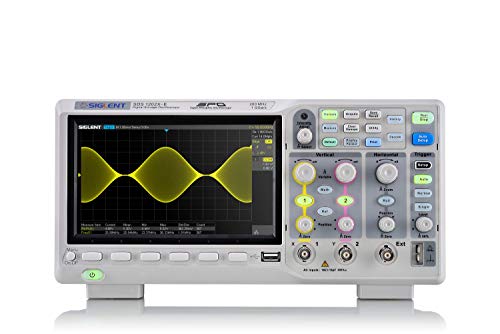
- Best for: labs prioritizing bandwidth headroom for faster analog and embedded signals, with standard serial decoding and acquisition history.
- Brand: Siglent
- Model: SDS1202X-E
- Bandwidth: 200 MHz
- Channels: 2
All 4 Picks at a Glance
| Product | Specs | Action |
|---|---|---|
| Hantek DSO2D15 Digital Storage Oscilloscope |
| Check price on Amazon |
| Rigol DS1054Z Digital Oscilloscope |
| Check price on Amazon |
| Siglent SDS1202X-E Digital Oscilloscope |
| Check price on Amazon |
 Siglent SDS1104X-E Digital Oscilloscope |
| Check price on Amazon |
How to Choose
Bandwidth and sample rate
Bandwidth sets the fastest signal a scope can display faithfully, and it is the first number to settle before comparing anything else. A useful rule of thumb is to choose a bandwidth several times higher than the fastest signal component you expect to measure, because a scope’s response already rolls off at its rated bandwidth. The picks in this guide span 50 MHz to 200 MHz, which covers a wide range of research work: audio and sensor signals, power-supply behavior, microcontroller clocks and general embedded development all sit comfortably inside that span, while faster digital edges and RF-adjacent work push toward the top of it.
Sample rate matters alongside bandwidth. All four scopes here sample at 1 GSa/s in real time, which gives them enough samples per cycle to reconstruct waveforms honestly at their rated bandwidths. Where the models differ is in how that sample rate behaves across channels and record lengths, so check the listing specifications for the configuration you plan to run rather than assuming the headline figure applies in every mode.
Channel count
Two channels are enough for a large share of bench work: one probe on the input, one on the output, and you can compare cause and effect directly. Four channels earn their bench space when the research involves relationships between signals — a clock and its data lines, a gate drive and the switching node it controls, or several sensor outputs that need to be correlated in time. If your lab routinely debugs multi-signal systems, the four-channel Rigol and Siglent models below will save repeated re-probing; if your work is mostly single-signal characterization, a two-channel model with higher bandwidth is usually the better trade.
Memory depth and waveform capture
Memory depth decides how long a record the scope can hold at full sample rate, and that decides whether you can capture a slow event and still zoom into its fast details afterward. The models here range from 8 Mpts on the Hantek to 24 Mpts on the Rigol, with both Siglent models at 14 Mpts. Longer memory is especially valuable in research settings where events are intermittent: you capture a long window once, then pan and zoom through it instead of hoping the fault repeats while you watch.
Waveform capture rate is the related figure worth checking. The Rigol DS1054Z lists up to 30,000 wfms/s, and higher capture rates reduce the dead time between acquisitions, which makes brief glitches and rare transients more likely to appear on screen. Siglent’s Super Phosphor processing on the SDS1202X-E takes a similar approach, adding history recording so you can step back through past acquisitions rather than losing them.
Serial decoding and built-in extras
Modern research benches are full of serial buses, and decoding them on the scope itself is far faster than exporting captures and decoding by hand. Every model in this guide decodes the common low-speed buses — I2C, SPI, UART/RS232, CAN and LIN — either as standard fit or built in, which covers microcontroller peripherals, automotive-style networks and industrial control signals. If your laboratory works with embedded systems, treat decoding as a core requirement rather than an accessory.
Also weigh the extras that replace separate instruments. The Hantek DSO2D15 builds in a 25 MHz waveform generator plus a digital voltmeter and frequency counter, which can free up bench space in a crowded lab. The Siglent SDS1104X-E goes the other direction, offering an optional module path to 16 digital channels and an arbitrary waveform generator, so the scope can grow with the project instead of being replaced by it.
The 4 Best Options
Hantek DSO2D15 Digital Storage Oscilloscope
- Best for: research benches that want a scope and a basic signal source in one instrument, with decoding for common embedded buses.
- Brand: Hantek
- Model: DSO2D15
- Bandwidth: 150 MHz
- Channels: 2
research benches that want a scope and a basic signal source in one instrument, with decoding for common embedded buses.
the 8 Mpts memory depth is the shallowest in this guide, so long captures at full sample rate are shorter than on the other picks; if your work depends on very long records, weigh that before choosing it.
The Hantek DSO2D15 is the pick for a laboratory that wants one instrument to cover both measuring and stimulating a circuit. Its 150 MHz bandwidth and 1 GSa/s sample rate handle general research signals comfortably, and the built-in single-channel 25 MHz waveform generator means you can inject a test signal without wheeling over a separate function generator — a small thing that saves time many times a week on a shared bench.
The supporting tools round it out for routine lab work. Serial decoding covers RS232/UART, I2C, SPI, CAN and LIN, and the built-in 3-digit digital voltmeter and 6-digit frequency counter handle the quick sanity checks that otherwise mean reaching for two more instruments. It is a sensible centerpiece for a teaching-adjacent research bench or a small lab equipping several stations the same way.
Watch out for: the 8 Mpts memory depth is the shallowest in this guide, so long captures at full sample rate are shorter than on the other picks; if your work depends on very long records, weigh that before choosing it.
Rigol DS1054Z Digital Oscilloscope
- Best for: laboratories that routinely compare three or four related signals and value deep memory for long captures over headline bandwidth.
- Brand: Rigol
- Model: DS1054Z
- Bandwidth: 50 MHz
- Channels: 4
laboratories that routinely compare three or four related signals and value deep memory for long captures over headline bandwidth.
the 50 MHz bandwidth ceiling is real — fast digital edges and higher-frequency analog work will outgrow it sooner than the other picks, so choose it for the signals you have now, not the ones a faster project might bring.
The Rigol DS1054Z has become a fixture on research benches because it answers the most common multi-signal problem directly: four channels, so you can watch an input, an output and two internal nodes at the same time. Its 50 MHz bandwidth is the lowest in this guide, but for the audio-frequency, sensor, power and slow digital work that fills many laboratories, it is rarely the limiting factor — and the channel count often matters more than raw speed.
Where the DS1054Z quietly stands out is record length and capture behavior. Its 24 Mpts memory depth is the deepest here, which suits long, slow captures that still need detail when you zoom in, and a waveform capture rate of up to 30,000 wfms/s helps it catch intermittent behavior that slower-updating scopes miss. The 7-inch WVGA display keeps four traces readable without an external monitor.
Watch out for: the 50 MHz bandwidth ceiling is real — fast digital edges and higher-frequency analog work will outgrow it sooner than the other picks, so choose it for the signals you have now, not the ones a faster project might bring.
Siglent SDS1202X-E Digital Oscilloscope
- Best for: labs prioritizing bandwidth headroom for faster analog and embedded signals, with standard serial decoding and acquisition history.
- Brand: Siglent
- Model: SDS1202X-E
- Bandwidth: 200 MHz
- Channels: 2
labs prioritizing bandwidth headroom for faster analog and embedded signals, with standard serial decoding and acquisition history.
it is a two-channel scope, so experiments that need to correlate four signals at once will mean re-probing or a second instrument; count your typical probe points honestly before choosing bandwidth over channels.
The Siglent SDS1202X-E is the high-bandwidth option in this guide, and the natural pick when the research involves faster signals. At 200 MHz with a 1 GSa/s sample rate, it has the headroom to display quicker edges and higher-frequency analog behavior more faithfully than the other models here, which makes it the safest choice for a lab whose projects change from semester to semester.
It pairs that speed with the analysis habits research work rewards. Serial decoding for I2C, SPI, UART/RS232, CAN and LIN comes as standard fit, and Siglent’s Super Phosphor signal processing with history recording lets you review earlier acquisitions — valuable when an anomaly appears once and the question becomes what exactly happened just before it. The 14 Mpts memory depth sits in the middle of this guide, a reasonable balance for a two-channel instrument.
Watch out for: it is a two-channel scope, so experiments that need to correlate four signals at once will mean re-probing or a second instrument; count your typical probe points honestly before choosing bandwidth over channels.
Siglent SDS1104X-E Digital Oscilloscope
- Best for: embedded-focused laboratories that want four channels now and a supported route to mixed-signal measurements later.
- Brand: Siglent
- Model: SDS1104X-E
- Bandwidth: 100 MHz
- Channels: 4
embedded-focused laboratories that want four channels now and a supported route to mixed-signal measurements later.
the mixed-signal and generator capabilities are an optional module rather than built in, so budget and plan for that addition if your research roadmap already includes digital-channel work.
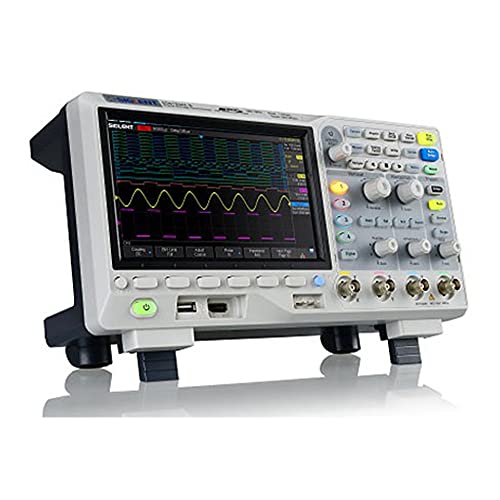
The Siglent SDS1104X-E splits the difference between its stablemates: four channels like the Rigol, at 100 MHz — double the Rigol’s bandwidth — with the same standard serial decoding as the SDS1202X-E. For a research laboratory that debugs embedded systems daily, that combination covers most work: several related signals on screen together, enough bandwidth for typical microcontroller and interface signals, and decoding for I2C, SPI, UART/RS232, CAN and LIN without add-on purchases.
Its longer-term appeal is the expansion path. The scope supports an optional module adding 16 digital channels and a 25 MHz arbitrary waveform generator, which lets a lab start with the analog scope and grow into mixed-signal work when a project demands it. It also arrives ready to use, with four passive probes, a USB cable and a calibration certificate in the box.
Watch out for: the mixed-signal and generator capabilities are an optional module rather than built in, so budget and plan for that addition if your research roadmap already includes digital-channel work.
Which One Fits Your Situation
You share one bench between measurement and signal generation
Choose the Hantek DSO2D15. The built-in 25 MHz waveform generator, voltmeter and frequency counter consolidate three bench roles into one instrument, which matters most in compact or shared laboratories where every instrument competes for the same shelf.
You debug multi-signal systems every week
Choose the Siglent SDS1104X-E. Four channels at 100 MHz, standard decoding for the common buses, and an optional path to 16 digital channels make it the most expandable fit for embedded research that keeps growing in complexity.
Your signals are slow but your captures are long
Choose the Rigol DS1054Z. Its 24 Mpts memory depth is the deepest in this guide, and the high waveform capture rate helps with intermittent faults — a better match for long-window observation than a faster scope with a shorter record.
Your projects keep getting faster
Choose the Siglent SDS1202X-E. The 200 MHz bandwidth gives the most headroom for rising signal speeds, and the history recording in its Super Phosphor processing helps you reconstruct anomalies after the fact.
Common Mistakes
- Buying bandwidth and ignoring channels: a fast two-channel scope still cannot show four related signals at once, and re-probing changes the circuit you are trying to observe.
- Overlooking memory depth: a scope that samples quickly but records briefly forces you to choose between capture length and detail; match memory depth to your longest events.
- Treating serial decoding as an afterthought: decoding I2C, SPI, CAN or LIN by eye from analog traces wastes hours; confirm the buses you use are decoded as standard fit.
- Assuming the headline sample rate applies in every configuration: sample rate can be shared across channels, so check the specifications for the channel setup you actually run.
- Skipping the accessories check: probes, cables and calibration paperwork differ between listings; the SDS1104X-E includes four passive probes and a calibration certificate, which matters for a lab that documents its measurements.
Frequently Asked Questions
How much bandwidth does a research laboratory oscilloscope need?
It depends on the fastest signal you measure, not on the laboratory’s name. Slow analog, sensor and power work is well served by 50–100 MHz, while faster digital edges and higher-frequency analog signals justify 150–200 MHz. A practical approach is to choose bandwidth several times higher than your fastest signal component, then spend the remaining budget on channels and memory.
Is a four-channel oscilloscope worth it for research work?
If your experiments involve relationships between signals — clocks and data, drive signals and outputs, multiple sensors — four channels save substantial time and avoid disturbing the setup by re-probing. If nearly all of your work is one input and one output, a two-channel scope with higher bandwidth is usually the better allocation.
What does memory depth actually change in practice?
Memory depth sets how much time you can capture at full sample rate. Deeper memory means you can record a long event — a startup sequence, an intermittent fault, a slow control loop — and still zoom into fast details afterward. For laboratories hunting rare events, memory depth is often more useful than a small bandwidth increase.
Can these oscilloscopes decode serial buses like I2C and CAN?
Yes. All four models in this guide decode the common low-speed buses: the Hantek lists RS232/UART, I2C, SPI, CAN and LIN, and both Siglent models include I2C, SPI, UART/RS232, CAN and LIN decoding as standard. That covers the buses found in most embedded and control-system research.
Related guides
- Best oscilloscope probes and probe accessories for laboratory benches
- Best logic analyzers for embedded research and development
- Best bench power supplies for electronics laboratories
- Best function generators for signal injection and testing
As an Amazon Associate, we earn from qualifying purchases.
More from Amazon
Programs that pair well with the guide above. Offers and eligibility are set by Amazon and may change.
Free shipping on eligible items, Prime Video and more. Eligible new members can start with a free trial.
Start a Prime free trialAudiobooks and podcasts to listen to on the go. Eligible new members can start with a free trial.
Try Audible freeAd-free music streaming. Eligible new subscribers can start with a free trial.
Try Music Unlimited freeA free business account with business pricing and bulk-buying tools for work, shop or home office.
Create a business accountAs an Amazon Associate we earn from qualifying purchases.
Write Your Review
No reviews yet. Be the first to share your experience!