

Our Short List of 3

- Bandwidth: 70 MHz
- Analogue channels: 4, plus 16 digital channels with the PLA2216 probe
- Sample rate: up to 8 GSa/s
- Memory: 100 Mpts standard analogue memory

- Bandwidth: 100 MHz
- Analogue channels: 4, plus 16 digital channels with a logic probe
- Sample rate: up to 8 GSa/s
- Memory: 100 Mpts standard analogue memory

- Bandwidth: 100 MHz
- Analogue channels: 4
- Digital channels: 16, with optional software and logic probe
- Sample rate: up to 2 GSa/s real-time
All 4 Picks at a Glance
| Product | Specs | Action |
|---|---|---|
| RIGOL MSO5074 |
| Check price on Amazon |
| RIGOL MSO5104 |
| Check price on Amazon |
| SIGLENT SDS2104X Plus |
| Check price on Amazon |
 SIGLENT SDS814X HD |
| Check price on Amazon |
Key takeaways
- Find the best mixed-signal oscilloscopes for research laboratories with 4 analog plus 16 digital channels, deep memory, and serial decoding compared.
A research laboratory rarely works with analogue signals alone. A microcontroller toggles a control line, a sensor produces a small analogue waveform, a serial bus carries a command, and a power rail dips at the same moment. When those events happen together, a conventional oscilloscope shows only part of the picture. The best mixed-signal oscilloscopes for research laboratories bring analogue and digital channels onto one screen, on one time base, so a team can see cause and effect in a single capture.
That shared time base is the whole point of a mixed-signal oscilloscope, often shortened to MSO. Four analogue channels handle voltages and sensor outputs, while sixteen digital channels watch logic lines, buses, and control signals at the same time. When a fault appears once in a thousand cycles, the instrument can trigger on a digital pattern and capture the analogue behaviour around it.
Choosing an MSO for a laboratory differs from choosing one for a hobby bench. A laboratory instrument may be shared by several researchers and expected to stay in service for years, so bandwidth, memory depth, decoding, and digital-channel supply matter more than a single headline figure. This guide compares four bench MSOs to help a research group match one to its experiments.
How to Choose
1. Bandwidth matched to the signals under study
Bandwidth sets the fastest analogue signal an oscilloscope can reproduce without serious loss of amplitude. A 70 MHz instrument suits many embedded, control, and power experiments, where clock rates and switching edges are modest. A 100 MHz instrument gives more headroom for faster edges and higher-frequency serial links. Laboratory buyers should look at the fastest edge in the experiment, not only the clock rate, and choose bandwidth with room to spare.
2. Analogue and digital channel count
Four analogue channels are the practical standard for laboratory MSO work. They allow a team to watch an input, an output, a power rail, and a reference at once. Sixteen digital channels are equally important. They cover a parallel bus, a serial link, and several control and enable lines in one capture. Before ordering, confirm how the digital channels are supplied. On several instruments in this guide, the digital channels need a separate logic probe or an optional software licence, and that accessory must be ordered with the instrument rather than discovered later.
3. Sample rate and memory depth
Sample rate decides how finely a waveform is drawn in time. A high sample rate matters most on fast edges and narrow pulses. Memory depth decides how long a capture can run at that sample rate. Deep memory, measured in Mpts, lets a laboratory record a long start-up sequence, a slow control loop, or a rare intermittent event without losing detail. For research work, memory depth is often more valuable than a small bandwidth increase, because long records reveal behaviour a short capture misses.
4. Serial decoding and triggering
Much laboratory debugging is bus debugging. I2C, SPI, UART, CAN, and LIN appear in embedded systems, sensor nodes, and control hardware. An MSO that decodes those buses on screen turns a stream of pulses into readable addresses, data bytes, and error flags. Pattern triggering and bus triggering let the instrument wait for the exact condition under study, then capture the analogue signals around it.
5. Display, controls, and shared use
A laboratory instrument is often used by people with different levels of experience. A clear display, a responsive touch screen, and logical menus shorten the learning curve and reduce setup mistakes. A 9-inch or 10.1-inch display makes it easier to read four analogue traces and a group of digital traces at the same time.
6. Connectivity and data export
Research results must leave the instrument. USB, LAN, and HDMI connections allow a team to save waveforms, screenshots, and setup files, connect the instrument to a laboratory network, or show a trace on a larger screen during a group discussion. Laboratories that automate measurements should also check that the instrument supports remote control through its standard interfaces.
7. Probe set, accessories, and total configuration
The instrument in the box is only part of the measurement system. Passive probes, a logic probe for the digital channels, and any optional decoding software all form part of the working configuration. A laboratory should list every accessory the planned experiments need, confirm which items are included, and order the rest at the same time.
Top Picks
RIGOL MSO5074
- Bandwidth: 70 MHz
- Analogue channels: 4, plus 16 digital channels with the PLA2216 probe
- Sample rate: up to 8 GSa/s
- Memory: 100 Mpts standard analogue memory
View the RIGOL MSO5074 on Amazon
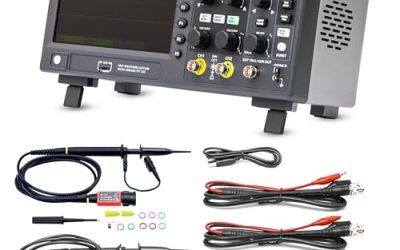
The RIGOL MSO5074 is the entry point into the MSO5000 platform, and it suits a research group that needs genuine mixed-signal capture without stepping up to bandwidth it will not use. Its listing describes a 70 MHz mixed-signal oscilloscope with four analogue channels and sixteen digital channels, a maximum sample rate of 8 GSa/s, and a standard analogue memory of 100 Mpts.
Those figures fit embedded and control research well. Four analogue channels cover a sensor output, a drive signal, a power rail, and a reference. Sixteen digital channels cover a parallel bus or a serial link plus control lines. The 8 GSa/s sample rate gives fine time resolution on fast edges, and 100 Mpts of memory supports long captures of start-up sequences and slow control behaviour.
It also has a 9-inch capacitive touch display and a capture rate stated at up to 500,000 waveforms per second.
One point needs attention before ordering. The listing copy states that the digital channels require the PLA2216 logic probe, which is sold separately. A laboratory that plans to use the digital channels should order that probe with the instrument. Without it, the MSO5074 works as a four-channel analogue oscilloscope, and the mixed-signal capability that justifies the purchase stays out of reach.
Who it is for: Embedded and control research groups adding their first dedicated mixed-signal instrument, and laboratories that need four analogue plus sixteen digital channels at a modest bandwidth.
Caveats: Digital channels need the PLA2216 probe, sold separately. Bandwidth is 70 MHz, so groups working with faster edges should look at the 100 MHz models below.
RIGOL MSO5104
- Bandwidth: 100 MHz
- Analogue channels: 4, plus 16 digital channels with a logic probe
- Sample rate: up to 8 GSa/s
- Memory: 100 Mpts standard analogue memory
View the RIGOL MSO5104 on Amazon
The RIGOL MSO5104 keeps the same MSO5000 platform as the MSO5074 and raises the bandwidth to 100 MHz. Its listing describes a 100 MHz, four-channel, 8 GSa/s mixed-signal oscilloscope with four analogue channels and sixteen digital channels, and a standard memory of 100 Mpts. For a laboratory that already knows the MSO5000 way of working, or that plans to standardise on one platform across several benches, that shared platform is a real advantage. Researchers can move between benches without relearning menus, probe connections, or decoding setups.
The higher bandwidth gives more headroom on faster analogue signals and sharper edges, which matters for communications work and faster embedded hardware. The 8 GSa/s sample rate and 100 Mpts memory match the MSO5074, so the step up is about bandwidth rather than a different capture architecture.
As with the MSO5074, the digital channels need a logic probe, so a laboratory should confirm that the probe is included in the exact configuration ordered or added as a separate line. One listing title for this model also names an MSO5000-BND option bundle, which changes the analysis functions that arrive with that configuration. A buyer should confirm the exact configuration on the listing before relying on a particular bundle function.
Who it is for: Research groups standardising on one MSO platform across benches with differing bandwidth needs, and laboratories whose signals need the extra headroom of 100 MHz.
Caveats: Digital channels need a logic probe. Bundle inclusion varies by listing configuration, so confirm the MSO5000-BND bundle is part of the exact configuration before relying on its functions.
SIGLENT SDS2104X Plus
- Bandwidth: 100 MHz
- Analogue channels: 4
- Digital channels: 16, with optional software and logic probe
- Sample rate: up to 2 GSa/s real-time
View the SIGLENT SDS2104X Plus on Amazon
The SIGLENT SDS2104X Plus suits a laboratory whose experiments produce long, information-dense captures that must be examined after the event. Its Amazon listing states 100 MHz bandwidth across four channels, a real-time sampling rate up to 2 GSa/s, and a record length up to 200 Mpts, shown on a 10.1-inch display. That deep record length is the standout figure here. It lets a team record a long sequence at full detail and then zoom into the section that matters, rather than choosing between a long view and a detailed view.
The listing also documents the mixed-signal path directly. It states sixteen digital channel mixed-signal analysis with optional software and a logic probe, at a digital sample rate up to 500 MSa/s and a record length up to 50 Mpts per channel. That matters because the mixed-signal capability is described on the instrument’s own listing rather than inferred from the series name alone. Serial bus triggering and decoding for I2C, SPI, UART, CAN, and LIN are standard, with further protocols available as options, which fits laboratories that debug embedded buses alongside analogue behaviour.
The large 10.1-inch touch display helps when four analogue traces and a block of digital traces share the screen, and the waveform capture rate reaches up to 500,000 waveforms per second in sequence mode, which helps the instrument catch rare events.
Who it is for: Long-event research, start-up sequences, and post-capture analysis on a shared laboratory bench, where deep memory and a large display matter most.
Caveats: The sixteen digital channels need optional software and a logic probe, so confirm that option is included in the configuration ordered. The maximum sample rate is lower than the Rigol models in this guide, so groups working with very fast edges should weigh that against the deeper memory.
SIGLENT SDS814X HD
- Bandwidth: 100 MHz
- Analogue channels: 4
- Digital channels: 16 mixed-signal analysis channels
- Vertical resolution: 12-bit
View the SIGLENT SDS814X HD on Amazon
The SIGLENT SDS814X HD brings 12-bit vertical resolution to this shortlist, and that is its clearest advantage for a research laboratory. Most oscilloscopes in this class use 8-bit conversion, which divides the vertical range into 256 levels. A 12-bit instrument divides the same range into far finer steps, so small signals sitting on a larger waveform become easier to see and measure. For sensor work, low-level analogue measurements, and signals with a wide dynamic range, that extra resolution can reveal detail that an 8-bit instrument would smooth over.
Its Amazon listing describes a 12-bit mixed-signal oscilloscope with four channels and 100 MHz bandwidth, a real-time sampling rate of 2 GSa/s, and a maximum memory depth of up to 100 Mpts. The listing also states 2 or 4 analogue channels plus 16 digital channels of mixed-signal analysis ability, placing this model firmly in the MSO class rather than among analogue-only instruments. Serial bus triggering is included, with I2C, SPI, UART, CAN, and LIN among the protocols covered, and a built-in FFT function supports frequency-domain examination of a signal.
The combination of 12-bit resolution, 100 MHz bandwidth, and deep memory makes this instrument a strong choice for laboratories that measure small analogue signals alongside digital activity, including sensor outputs and precision analogue circuits.
Who it is for: Research groups measuring small or wide-ranging analogue signals alongside digital lines, including sensor, precision analogue, and mixed-domain work.
Caveats: Confirm the logic probe arrangement for the digital channels in the exact configuration ordered, since the digital capability depends on the probe and the mixed-signal option. The 2 GSa/s sample rate is lower than the Rigol models here, so very fast edge work deserves a careful look at the sample-rate figures.
Comparison Table
| Feature | RIGOL MSO5074 | RIGOL MSO5104 | SIGLENT SDS2104X Plus | SIGLENT SDS814X HD |
|---|---|---|---|---|
| Bandwidth | 70 MHz | 100 MHz | 100 MHz | 100 MHz |
| Analogue channels | 4 | 4 | 4 | 4 |
| Digital channels | 16, with PLA2216 probe | 16, with logic probe | 16, with optional software and probe | 16 |
| Sample rate | Up to 8 GSa/s | Up to 8 GSa/s | Up to 2 GSa/s | 2 GSa/s |
| Memory depth | 100 Mpts | 100 Mpts | Up to 200 Mpts | Up to 100 Mpts |
| Vertical resolution | 8-bit | 8-bit | 8-bit, with 10-bit mode | 12-bit |
| Display | 9-inch touch | 9-inch touch | 10.1-inch touch | Touch display |
| Serial decoding | I2C, SPI, UART, CAN, LIN and more | I2C, SPI, UART, CAN, LIN and more | I2C, SPI, UART, CAN, LIN standard | I2C, SPI, UART, CAN, LIN |
Which One Is Right for You?
Start from the experiment, not from the specification sheet. A group working mainly with embedded controllers, sensor interfaces, and control loops will find the RIGOL MSO5074 covers its needs well. Its 70 MHz bandwidth, four analogue channels, sixteen digital channels, and 8 GSa/s sample rate handle the signals that appear in that work, and the shared MSO5000 platform leaves room to move to a higher-bandwidth model later without relearning the instrument.
Choose the RIGOL MSO5104 when the same workflow must stretch to faster analogue signals. The step from 70 MHz to 100 MHz is modest on paper, but it gives a laboratory headroom on sharper edges and faster links while keeping the platform, channel layout, and operating habits the team has already learned. It is also the natural pick for a laboratory that is standardising on one MSO platform across several benches, with different benches fitted to different bandwidths.
Choose the SIGLENT SDS2104X Plus when captures are long and the detail is buried inside them. Its record length of up to 200 Mpts and its 10.1-inch display make it the strongest pick here for start-up sequences, slow control behaviour, and post-capture analysis. A team that records first and analyses later, or that shares one instrument between several researchers who all need to read the screen, will get the most from this model.
Choose the SIGLENT SDS814X HD when the analogue signal itself is the hard part. Its 12-bit resolution reveals small signals and fine detail that 8-bit instruments smooth over, which matters for sensor work and precision analogue circuits. The 100 MHz bandwidth and sixteen digital channels keep it a full mixed-signal instrument.
Whatever the choice, order the logic probe and any optional decoding software with the instrument. Every model here depends on a probe or an option for its digital channels, and overlooking that accessory leaves a mixed-signal instrument working as an analogue-only oscilloscope when the digital channels are needed.
Frequently Asked Questions
What makes a mixed-signal oscilloscope different from a standard oscilloscope?
A standard oscilloscope shows analogue waveforms. A mixed-signal oscilloscope adds digital channels to the same instrument, on the same time base. That lets a laboratory watch analogue signals and logic lines together, trigger on a digital pattern, and see the analogue behaviour that surrounds a digital event.
How many digital channels does a research laboratory need?
Sixteen digital channels are the practical standard for the instruments in this guide, and they cover most laboratory work. They can watch a parallel bus, a serial link, and several control lines at once. Laboratories debugging wide parallel buses may want to confirm sixteen channels are enough, but for most embedded, sensor, and control experiments, sixteen digital channels alongside four analogue channels are a good balance.
Is 100 MHz of bandwidth enough for research laboratory work?
For many research laboratories, yes. Embedded systems, sensor interfaces, control loops, and power electronics often operate well within 100 MHz, and a 100 MHz instrument gives headroom above those signals. Laboratories working with fast communications links, high-speed digital interfaces, or very sharp switching edges should look at the fastest edge in their experiments and choose bandwidth with room to spare.
Do the digital channels work straight out of the box?
Not always, and this is the detail most often overlooked. On several instruments in this guide, the digital channels need a separate logic probe or an optional software licence. The RIGOL models need the PLA2216 probe, and the SIGLENT SDS2104X Plus needs optional software and a logic probe for its sixteen digital channels. A laboratory should confirm the exact configuration on the listing and order the probe and any needed option with the instrument, so the mixed-signal capability is ready on the first day of use.
Disclosure: As an Amazon Associate, we may earn from qualifying purchases.
More from Amazon
Programs that pair well with the guide above. Offers and eligibility are set by Amazon and may change.
Free shipping on eligible items, Prime Video and more. Eligible new members can start with a free trial.
Start a Prime free trialAudiobooks and podcasts to listen to on the go. Eligible new members can start with a free trial.
Try Audible freeAd-free music streaming. Eligible new subscribers can start with a free trial.
Try Music Unlimited freeA free business account with business pricing and bulk-buying tools for work, shop or home office.
Create a business accountAs an Amazon Associate we earn from qualifying purchases.
Write Your Review
No reviews yet. Be the first to share your experience!