

Our Short List of 3

- Best for: Research teams running automated, high-resolution logging and characterisation work.
- Brand: Rigol
- Model: DM3068
- Display resolution: 6½ digits, 2,200,000 counts
- Fastest measurement speed: 10,000 rdgs/s

- Best for: Careful manual measurement and comparison work on space-limited research benches.
- Brand: GW Instek
- Model number: GDM-9061
- Display counts: 1,200,000
- Item dimensions: 30.2 x 26.7 x 10.7 centimetres

- Best for: Support benches and secondary stations that need a dependable dual-display True RMS meter.
- Brand: B&K Precision
- Model: 5491B
- Type: Bench digital multimeter, dual display
- Measurement: True RMS
All 3 Picks at a Glance
| Product | Specs | Action |
|---|---|---|
| Rigol DM3068 |
| Check price on Amazon |
| GW Instek GDM-9061 |
| Check price on Amazon |
| B&K Precision 5491B |
| Check price on Amazon |
Key takeaways
- Compare digital bench multimeters for research laboratories, from dual-display 5.5-digit meters to 6.5-digit models with GPIB, LAN and fast logging.
Choosing a bench multimeter for a research laboratory is really a decision about how much measurement uncertainty your work can tolerate. A meter that drifts, resolves too coarsely, or slows down a logging run does not just waste time; it quietly undermines results that other people will build on. Digit resolution, reading speed, and remote interfaces therefore matter more here than they do on a service bench.
This guide is for research groups equipping a shared laboratory bench, principal investigators standardising instruments across several workstations, and technicians who log measurements into automated setups. The three meters below were selected from their Amazon listing names and stated specifications: two 6½-digit models with very different count depths and footprints, plus a dual-display True RMS meter for everyday laboratory measurement tasks.
Quick Picks
As an Amazon Associate we earn from qualifying purchases.
| Product | Best for | Key spec |
|---|---|---|
| Rigol DM3068 | Automated logging in a research setup | 6½ digits, 2,200,000 counts |
| GW Instek GDM-9061 | High-count manual measurement on a crowded bench | 1,200,000 display counts |
| B&K Precision 5491B | A second dual-display meter for routine lab work | True RMS dual display |
How to Choose
Resolution and Count Depth
Digits tell only half the story, because two meters with the same digit class can resolve very differently once you compare their full count depth. A 2,200,000-count instrument separates tiny changes in a sensor output that a lower-count display rounds away, which matters when you track drift across an afternoon of measurements. Match the count depth to the smallest change your experiment must reveal: reference and calibration-adjacent work rewards the deepest counts you can get, while routine circuit checks in a teaching or support laboratory rarely justify paying for resolution nobody will read. Always confirm the count figure on the listing rather than trusting the digit label alone, and check it against the ranges your work uses most.
Reading Speed for Logging Work
Research benches increasingly feed measurements into a computer, and there the meter’s reading rate decides how dense your data set can be. A model rated at 10,000 readings per second suits transient capture and automated sweeps, whereas a few hundred readings per second is plenty for slow thermal or chemical processes. Speed claims assume the fastest settings, though, and real runs at full resolution usually settle more slowly. Think about the fastest event you genuinely need to catch, then check that the listing’s stated rate covers it with room to spare instead of buying headline speed you will never switch on.
Interfaces and System Integration
A bench meter in a research laboratory rarely works alone for long. GPIB remains common in older automated racks, LXI and LAN connections suit networked setups, and USB or RS-232 links handle simple one-to-one logging to a bench computer. Before ordering, list every instrument the new meter must talk to and every software routine it must join, because an interface mismatch discovered after delivery means adapters, delays, or a meter that sits outside the automated run entirely. The listings here state their connectivity plainly, so compare those lines against your existing rack rather than assuming a port is present. Command compatibility matters as well, since a meter answering the instruction set your routines use drops in with far less reprogramming.
Display, Footprint, and Bench Reality
Laboratory benches fill up fast, and a meter that is awkward to read or too deep for the shelf becomes the one nobody reaches for. Dual displays earn their keep when you need a secondary reading, such as frequency alongside voltage, without re-ranging the instrument mid-measurement. Check the stated dimensions against your actual shelf depth, including room behind the unit for leads and interface cables. Weight matters too in shared facilities where instruments move between rooms. A clear, high-contrast display that stays legible from a standing position saves more daily frustration than most buyers expect.
The 3 Best Options
Rigol DM3068
- Best for: Research teams running automated, high-resolution logging and characterisation work.
- Brand: Rigol
- Model: DM3068
- Display resolution: 6½ digits, 2,200,000 counts
- Fastest measurement speed: 10,000 rdgs/s
Research teams running automated, high-resolution logging and characterisation work.
Confirm your control software and cabling match its GPIB and LXI interfaces before ordering.
Laboratories building automated measurement routines will find the DM3068 the most capable meter in this group. Its listing highlights 6½-digit resolution with 2,200,000 counts and a fastest rate of 10,000 readings per second, a combination aimed at high-precision lab instruments that must both resolve finely and keep up with a programmed sweep. GPIB and LXI connectivity place it naturally in system racks alongside older and newer instruments alike. For a research group standardising on one meter for demanding characterisation work, this is the specification sheet that asks the fewest compromises. It also leaves headroom for groups whose logging ambitions grow over the next grant cycle.
GW Instek GDM-9061
- Best for: Careful manual measurement and comparison work on space-limited research benches.
- Brand: GW Instek
- Model number: GDM-9061
- Display counts: 1,200,000
- Item dimensions: 30.2 x 26.7 x 10.7 centimetres
Careful manual measurement and comparison work on space-limited research benches.
Measure your shelf depth first; the stated dimensions exclude the extra room leads need behind the unit.
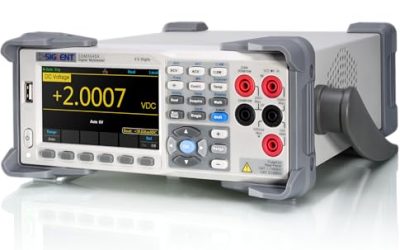
The GDM-9061 suits researchers who want deep resolution in a meter that still behaves like a straightforward bench instrument. The Amazon listing states 1,200,000 display counts, which places it in the 6½-digit class, and gives compact table dimensions of 30.2 x 26.7 x 10.7 centimetres with a weight of 3.5 kilograms, so it fits benches where a full-depth system meter would crowd out samples and fixtures. It is a sensible centrepiece for a measurement station devoted to careful manual work, comparison measurements, and student-supervised research sessions where readability and resolution matter more than raw logging speed.
B&K Precision 5491B
- Best for: Support benches and secondary stations that need a dependable dual-display True RMS meter.
- Brand: B&K Precision
- Model: 5491B
- Type: Bench digital multimeter, dual display
- Measurement: True RMS
Support benches and secondary stations that need a dependable dual-display True RMS meter.
Its resolution class sits below the two 6½-digit models here, so keep it away from your finest comparison work.
Not every seat in a research laboratory needs a flagship meter, and the 5491B fills the supporting role well. It is a True RMS bench digital multimeter with a dual display, so a technician can watch a secondary value while the primary measurement continues, and its listing states AC voltage measurement up to 750 V with frequency measurement up to 1 MHz. Groups that already own one high-end instrument often add a meter like this for preparation benches, incoming checks, and student project stations, keeping the flagship free for the measurements that genuinely need it. Identical support meters also simplify training, since one set of instructions covers every secondary station.
Which One Fits Your Situation
You Run Automated Experiments Overnight
Unattended runs live or die on reading speed and remote control, so the Rigol DM3068 is the natural pick. Its stated 10,000 readings per second and GPIB plus LXI connectivity let it slot into a programmed routine and return dense data by morning. Set the run up once, verify the first files carefully, and the meter becomes part of the experiment rather than a bottleneck in front of it.
Your Bench Is Shared and Space Is Tight
Shared benches reward compact instruments that several people can read at a glance. The GW Instek GDM-9061 brings 1,200,000 counts in a 3.5-kilogram table format, so it delivers research-grade resolution without monopolising the workspace. Colleagues can move it when a rig needs the room, and its count depth still covers the careful comparison measurements a shared facility handles daily.
You Are Equipping Several Student Stations
Outfitting multiple stations calls for consistency more than flagship specifications. The B&K Precision 5491B gives each station the same dual-display True RMS layout, which simplifies supervision and makes student results easier to compare across benches. Reserve the laboratory’s high-resolution meter for final verification, and let these units carry the everyday measurement load that teaching and project work generate.
You Mostly Verify Other Instruments’ Readings
Verification work is about trust in a single number, so resolution depth comes first. Either 6½-digit model serves here, with the DM3068 ahead on counts and speed when the queue of instruments is long. The GDM-9061 suits a calmer verification corner where each check is manual and deliberate. Either way, keep the verification meter’s own calibration schedule written down where the whole team can see it.
Common Mistakes
- Buying on digit count alone and ignoring the actual count depth stated on the listing, which is what sets real resolution.
- Assuming a GPIB, LAN, or USB port is fitted without checking the listing’s connectivity line against your rack.
- Placing the meter where its display cannot be read from a normal standing position, then blaming the instrument for slow work.
- Skipping warm-up time before fine measurements, even though bench meters settle as their internal references stabilise.
- Letting the laboratory’s reference meter drift past its calibration interval while every other instrument gets checked against it.
Frequently Asked Questions
How many digits does a research laboratory bench multimeter need?
Most research benches work comfortably at 6½ digits, which covers fine comparison and characterisation measurements. Groups doing only routine checks can manage with less, while metrology-leaning work benefits from the deepest counts available. Match the class to the smallest change your experiments must resolve, and confirm the count depth on the listing, since digit labels alone can mislead.
Is a dual display actually useful in a laboratory?
Yes, whenever a secondary value informs the main reading. Watching frequency beside voltage, or a second measurement beside the primary one, removes repeated re-ranging and reduces the chance of recording the wrong quantity. On shared benches it also helps a supervisor follow what a student is measuring without interrupting the setup to ask.
Can one bench meter serve an entire research group?
It can, provided the group schedules access and the meter’s interfaces suit everyone’s routines. In practice, a single flagship becomes a queue during busy periods, which is why many laboratories pair one high-resolution instrument with a simpler dual-display meter for preparation and routine stations. That mix keeps demanding work moving without overspending on every seat.
How often should a laboratory bench multimeter be calibrated?
Follow the interval the manufacturer and your institution’s quality procedures specify, and treat that date as fixed rather than approximate. A meter used as the laboratory’s reference deserves the strictest adherence, because every comparison made against it inherits its drift. Record each calibration where the whole team can see it, and plan cover for the bench while the instrument is away.
More from Amazon
Programs that pair well with the guide above. Offers and eligibility are set by Amazon and may change.
Free shipping on eligible items, Prime Video and more. Eligible new members can start with a free trial.
Start a Prime free trialAudiobooks and podcasts to listen to on the go. Eligible new members can start with a free trial.
Try Audible freeAd-free music streaming. Eligible new subscribers can start with a free trial.
Try Music Unlimited freeA free business account with business pricing and bulk-buying tools for work, shop or home office.
Create a business accountAs an Amazon Associate we earn from qualifying purchases.
Write Your Review
No reviews yet. Be the first to share your experience!