

Key takeaways
- Find the best tennis nets for home courts and club play, from a regulation doubles net with a steel cable to portable systems and braided picks.
A tennis net is the hardest-working part of a court. It takes ball impact on every rally, holds tension through heat, rain and cold, and its headband and cable carry the load that keeps the middle at height. Small build details decide how long a net lasts outdoors: whether the netting is braided or twisted, how thick the cord is, how the headband is stitched, and whether the top cable is coated steel or plain cord. Home courts and small clubs replace nets more often than any other court equipment, so those details are worth reading before you order.
The five nets below cover the main formats sold for home and club courts. There is a regulation doubles net with a steel cable as the top pick, a true singles net sized for singles post spacing, a portable system with its own frame for courts without posts, a heavy-duty braided net for hard-used courts, and a straightforward replacement net for permanent posts. Each section sticks to the specs the maker or listing publishes and notes where each format falls short.
As an Amazon Associate, we earn from qualifying purchases.
Quick answer
For most home courts and club courts, the MacGregor Varsity 300 is the pick: a regulation 42-foot doubles net with a 5mm vinyl-coated steel cable, a heavy-duty vinyl headband and 2.5mm twisted polyethylene netting. Singles players should look at the Vermont 3.5mm DT Championship, and anyone without permanent posts should choose the portable Tourna 18-foot system instead.
MacGregor Varsity 300 Tennis Net, 42-Feet
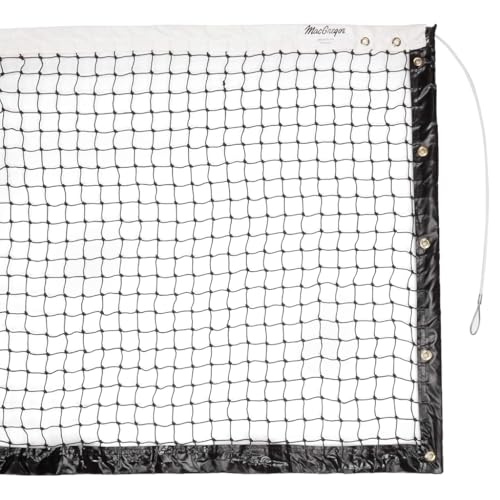
The MacGregor Varsity 300 is a regulation doubles net built around a coated steel cable, which is why it leads this list. It measures 42 feet long, the full span for a doubles court, and hangs at the standard profile of 3 feet 6 inches at the posts. The netting is 2.5mm twisted polyethylene with a listed break strength of 225 lb, and the heavy-duty vinyl headband is rated at 320 lb, lock-stitched with four rows of thread so the top edge holds its shape under tension.
The headline cable is 5mm vinyl-coated steel with a listed tensile strength of 3,000 lb. The cable is what the winch pulls against, and a coated steel cable resists the stretching and fraying that make lesser nets sag in the middle after a season outdoors. The side pockets are made to hold fiberglass dowels, which keep the net ends vertical and flush against the posts.
The honest trade-off is the netting itself. Twisted polyethylene at 2.5mm is a midweight build, fine for home courts and club courts with regular play, but it is not the heavy braided cord found on championship nets, and hard daily use will wear it sooner. The listing also focuses on the net, headband and cable, so confirm exactly which fitting hardware is in the box before ordering, and plan on a center strap if your court does not already have one.
Vermont 3.5mm DT Championship Tennis Net, 33 ft

Most nets sold as singles nets are really doubles nets with singles sticks added. The Vermont 3.5mm DT Championship is the genuine article: a true singles net measuring 33 feet wide by 3.5 feet high, the official singles regulation size, built to hang between standard singles posts and made to conform to ITF tournament regulations. If your home court is lined and posted for singles only, this is the net that fits it properly, with no excess length bunched at the posts.
The netting is 3.5mm braided HDPE twine in a 45mm knotted mesh, a step up in thickness from the twisted cord on midweight nets, and the top six meshes are double layered. That Double Top design puts extra material where balls strike most and where nets usually wear first. The twine is UV treated and rot-proof, the headband is vinyl-coated polyester, quad-stitched, in optic white, and a PVC-coated steel headline cable is included. The edges are overlocked rope, which makes lacing easier and helps prevent fraying. At about 20.7 lb, it is a substantial net, closer to a club fitting than a casual backyard accessory.
The trade-offs are about fit and commitment. A 33-foot net cannot span a doubles court, so it only suits a court that will stay singles-only. The championship build is also more net than a lightly used home court strictly needs, and its weight makes it slower to hang and take down than a basic twisted-cord net.
Tourna 18-Foot Portable Tennis Net

The Tourna 18-Foot Portable Tennis Net solves a different problem: no posts, no problem. It is a complete portable system with its own frame, spanning 18 feet, which matches the width of a 36-foot junior court, and it is built to comply with USTA junior standards for that court size. For a home setup on a driveway, a patio or a shared court where nothing can be installed permanently, this is the format that works.
The practical specs are the appeal. The whole system weighs 7 lb and packs into the included nylon carrying case, so one person can carry it, store it in a garage corner and bring it out when needed. Setup needs no tools, and the frame breaks down just as quickly after play. That suits junior coaching at home, family rallies and drill sessions where the net goes up and down on the same day.
The trade-offs follow from the format. An 18-foot span is a junior and practice format, not a substitute for a 42-foot regulation net on a full court, and adult players drilling at full pace will find it limiting. A 7 lb freestanding system is also easier for wind to move than a cable-hung net under winch tension, so it suits sheltered spots better than exposed ones. Treat it as a portable training tool and it does its job well; expect it to behave like a permanent net and it will disappoint.
Aoneky Professional Tennis Net, 42 ft

The Aoneky Professional is the heavy-duty braided option in this group, built for courts that see hard, frequent play. It measures 42 feet long and 3.5 feet high, and the netting is 4mm double-braided polyethylene. That is a thick cord by court net standards, and the double braid gives the mesh more resistance to fraying and ball wear than the twisted or single-braid builds elsewhere in this list.
The top cable matches the heavier build: a 6mm vinyl-coated steel cable with a listed break strength of 800 lb. Aoneky also bundles the fitting pieces that many nets leave you to source yourself, including lacing rods, a center strap and a carrying bag for off-season storage. For a club or busy home court where the net stays up all season, that combination of thick braided mesh, a heavy cable and a complete hardware set is the point of this model.
The trade-offs are weight and necessity. A 4mm braided net is heavier to handle, hang and take down than a lighter net, and the build is more than a lightly used backyard court needs. It is also a replacement net only, so your court still needs sound posts and a working winch. Buyers replacing a worn net on an active court get the most from it; occasional players will not notice the extra durability enough to justify the heavier handling.
PROGOAL Professional Tennis Net, 42FT

The PROGOAL Professional Tennis Net (model D-TN-1) is a standard replacement net for permanent posts, and its listing keeps the pitch simple: a heavy-duty double-layer nylon net, 42 feet long, compatible with all standard tennis posts. The double-layer construction puts extra material through the net body, helping it keep its shape under tension and repeated ball contact.
Two fiberglass dowels are included, so the net ends can be held straight against the posts without a separate purchase. Where the posts, winch and center strap are already in place and only the net has worn out, this is the drop-in format: unhook the old net, hang the new one, tension the cable and play.
The trade-offs are in the details the listing leaves open. The product data does not spell out the headline cable type or its length, so if your posts need a specific cable, confirm that on the product page before ordering. Nylon is also a different material choice from the polyethylene nets above; it is strong, but it behaves differently in wet weather, and the listing does not list a separate center strap among the included items. Check your existing hardware first and this net fills its role cleanly.
How to choose
Match the length to your post spacing first, because no other spec can fix a net that does not fit. A doubles court needs a 42-foot net, a singles court takes a 33-foot net, and a court with no posts at all needs a portable frame system rather than a hanging net. Measure between your posts before ordering if you are unsure which court you have.
Then look at the netting. Thickness runs from about 2.5mm on midweight nets to 4mm on heavy-duty ones, and braided cord generally outlasts twisted cord under ball impact because the braid absorbs contact and resists fraying. Double-layer or double-mesh top rows add material where balls strike most, which suits busy courts.
Check the headband and cable next. A vinyl or vinyl-coated polyester headband with multiple rows of lock-stitching holds the top edge straight, and a vinyl-coated steel cable holds tension better than a plain cord headline. Note the cable diameter and its listed break or tensile strength, and confirm the cable suits your winch.
Finally, check what is in the box. Fiberglass dowels, lacing cord or rods and a center strap are included with some nets and sold separately for others, and a carrying bag matters if the net comes down for winter. Adding the missing pieces to your order up front is easier than discovering the gap on fitting day.
Who should skip
Skip the full-size hanging nets if your court has no permanent posts; a cable net has nothing to hang from, and the portable Tourna system above is the right format instead. Skip the Vermont singles net if there is any chance your court will be used for doubles, because a 33-foot net cannot be stretched to cover a doubles span. Skip the MacGregor Varsity 300 if your court hosts heavy daily play and you want the longest possible net life; its twisted 2.5mm netting is a midweight build, and the braided Aoneky Professional is the better fit for that workload. And skip every net on this list if your posts or winch are damaged, because a new net cannot fix hardware that will not hold tension.
Frequently Asked Questions
What size tennis net does a doubles court need?
A doubles court needs a 42-foot net. It should stand 3 feet 6 inches high at the posts and 3 feet high at the center, where a center strap holds it down to height. A singles court uses a shorter 33-foot net between its own post spacing.
What is the difference between braided and twisted netting?
Twisted netting is made by twisting fibres into a cord, while braided netting weaves the cord into a tighter, more uniform mesh. Braided nets generally absorb ball impact better, fray less and last longer outdoors, while twisted nets are lighter and common on midweight court nets.
Does a replacement tennis net include posts and a center strap?
No. A replacement net is the net itself, sized to hang on posts you already have. Some models include fiberglass dowels, lacing cord or rods, and occasionally a center strap, but posts and winches are always separate purchases, so check the included items on each listing.
How do I keep an outdoor tennis net in good condition?
Keep the net at proper tension so it does not flap or sag, rinse off dirt with plain water and let it dry before storing, and bring portable nets indoors after play. Before each season, check the headband stitching, the cable coating and the side dowels, since those parts show wear first.
Final verdict
For a home court or club court with doubles posts, the MacGregor Varsity 300 is the most complete package here: regulation length, a vinyl headband with four rows of stitching and a 5mm coated steel cable that holds tension season after season. Singles courts should go straight to the Vermont 3.5mm DT Championship, the one true 33-foot net in the group. The Tourna 18-foot system is the answer when there are no posts at all, the Aoneky Professional is the heavy-duty braided upgrade for hard-used courts, and the PROGOAL is a clean drop-in replacement when your hardware is sound and only the net has worn out.
Product and ASIN Reference
| Product | ASIN |
|---|---|
| MacGregor Varsity 300 Tennis Net, 42-Feet | B0000BYRSP |
| Vermont 3.5mm DT Championship Tennis Net, 33 ft | B0HLZWDP5K |
| Tourna 18-Foot Portable Tennis Net | B06WWFCZYJ |
| Aoneky Professional Tennis Net, 42 ft | B07FR6PVYS |
| PROGOAL Professional Tennis Net, 42FT | B0F2T184XM |
More from Amazon
Programs that pair well with the guide above. Offers and eligibility are set by Amazon and may change.
Free shipping on eligible items, Prime Video and more. Eligible new members can start with a free trial.
Start a Prime free trialAudiobooks and podcasts to listen to on the go. Eligible new members can start with a free trial.
Try Audible freeAd-free music streaming. Eligible new subscribers can start with a free trial.
Try Music Unlimited freeA free business account with business pricing and bulk-buying tools for work, shop or home office.
Create a business accountAs an Amazon Associate we earn from qualifying purchases.




Write Your Review
No reviews yet. Be the first to share your experience!