

Key takeaways
- Programmable DC electronic loads for technical training labs compared: CC, CV, CR and CP modes, student-bench protection, PC control and logging picks.
As an Amazon Associate we earn from qualifying purchases
A teaching lab asks more of an electronic load than a development bench does. The instrument has to survive beginners wiring it up wrong, cover the constant current, constant voltage, constant resistance and constant power concepts in the syllabus, and produce data students can put in a lab report. It also has to do all of that on a training budget, often for a whole room of benches at once. This guide compares programmable DC electronic loads for technical training, focusing on the four operating modes instructors teach, the protection features that forgive student mistakes, the PC control and logging options that coursework needs, and power ratings matched to the bench supplies used in teaching. Every model below is a dedicated programmable DC electronic load instrument, the type of unit a class would use to characterise power supplies, chargers and battery packs.
Quick Picks
| Product | Best for | Key spec |
|---|---|---|
| Siglent SDL1020X-E | Structured coursework and scripted logging | 150 V / 30 A / 200 W, USB, RS-232 and LAN built in |
| Korad KEL103 | Networked benches on a training budget | 120 V / 30 A / 300 W, LAN as standard |
| East Tester ET5410A+ | Battery capacity and discharge exercises | 150 V / 40 A / 400 W, battery test with capacity counting |
| East Tester ET5420A+ | Paired experiments and shared benches | Dual channel, 150 V / 20 A / 200 W per channel |
Choosing Programmable DC Electronic Loads for Technical Training
Match the power rating to the teaching supplies
A load only needs to absorb what the lab’s bench supplies can deliver. Most training power supplies top out well under 200 W per output, so a 200 W to 400 W load covers general electronics coursework comfortably, including 12 V and 24 V supply testing and small battery pack discharge. Higher voltage headroom matters more than raw watts for courses that touch industrial rails, while automotive and LED driver modules reward higher current at low voltage. Check the full rating together: a load reaches its power limit long before its current limit at higher voltages, so the wattage figure is the one that decides whether a 24 V exercise runs at full current.
Cover the four modes the syllabus teaches
Constant current (CC) is the mode students meet first, for load regulation and battery discharge work. Constant voltage (CV) supports charger and solar panel exercises, constant resistance (CR) behaves like a real resistive load for Ohm’s law demonstrations, and constant power (CP) mimics a downstream converter drawing fixed power. All four loads in this guide provide CC, CV and CR, plus CP or the equivalent constant wattage setting. Combined modes such as CC+CV, offered on the East Tester units, are a bonus for charger testing rather than a requirement for core coursework.
Protection that forgives beginner mistakes
Student benches see reversed leads, shorted outputs and setpoints typed a decade too high. Look for over-voltage, over-current, over-power and over-temperature protection that shuts the input down before damage occurs, plus reverse-voltage warning where available. A load that protects itself and the device under test saves the department money and keeps a class running when a wiring error happens in week two. Adjustable current slew and soft behaviour at turn-on also help, because they let an instructor demonstrate transients deliberately instead of accidentally.
PC control and logging for coursework
Modern lab reports need data, not readings copied from a display. A USB, RS-232 or LAN interface lets students log voltage and current over time, plot discharge curves, and repeat an experiment with identical settings. List and program functions, which step the load through a stored sequence, turn a manual exercise into a repeatable assessment: every student runs the same profile, and the results are directly comparable. LAN-equipped loads add flexibility in rooms where benches are reconfigured often, because the instrument can sit anywhere on the network.
Resolution and low-voltage behaviour
Teaching supplies are mostly low-voltage devices, so readback resolution at small values decides whether a measurement exercise teaches anything. Resolution of 1 mV and 1 mA is adequate for most coursework, and finer low ranges help with small-signal regulator work. Minimum operating voltage matters too: a load needs some voltage across its input to sink its rated current, which is why four-wire remote sense, fitted to the Siglent below, keeps readings honest when leads and clips add resistance at high current.
The Loads in Detail
Siglent SDL1020X-E

The SDL1020X-E is the most coursework-ready instrument in this group. It is a single-channel programmable DC electronic load rated at 150 V, 30 A and 200 W, with the four static modes CC, CV, CR and CP, a CC dynamic mode up to 25 kHz for transient response exercises, and readback resolution of 1 mV and 1 mA. RS-232, USB and LAN interfaces are built in rather than optional, and the load supports SCPI control, a list function of up to 100 steps and a program function of 50 groups, so instructors can store a standard test sequence and have every student run it unchanged. Four-wire sense compensation, a battery test function and five protection types (OCP, OVP, OPP, OTP and reverse-voltage warning) round out a feature set that maps closely onto a structured syllabus. The 3.5-inch TFT-LCD shows multiple parameters at once, which helps a class read setpoint and measurement together.
- Strength: Built-in LAN alongside USB and RS-232, list and program sequencing, and dynamic mode make it the strongest fit for logged, repeatable coursework.
- Trade-off: The 200 W ceiling is the lowest here, so high-power supply testing at 24 V and above runs into the power limit sooner than with the 300 W and 400 W alternatives.
Skip it if your course centres on high-power discharge work above 200 W, where the Korad or East Tester units offer more headroom.
Korad KEL103

The KEL103 is a 300 W programmable DC electronic load rated at 120 V and 30 A, with CC, CV, CR and constant wattage modes. Its defining feature for a training environment is connectivity: USB, RS-232 and LAN are all fitted, which is unusual at this level and makes the KEL103 easy to place on a networked bench for scripted logging of discharge curves and load steps. Fine resolution in its low ranges, quoted at 0.1 mV and 0.1 mA, suits measurement exercises on small regulators and cells. The front panel and firmware are simpler than the Siglent’s, with a more basic display, but the operating concept is the same four-mode model the syllabus teaches, and the generous 300 W rating covers the 12 V and 24 V supplies used in most practical classes.
- Strength: LAN, USB and RS-232 as standard with 300 W of capacity, a practical combination for networked teaching benches that log data to a PC.
- Trade-off: The interface and display are plainer than the Siglent’s, and sequencing features are less developed, so highly structured scripted assessments are easier on the SDL1020X-E.
Skip it if your assessments depend on stored multi-step test programs and dynamic transient modes rather than straightforward logged measurements.
East Tester ET5410A+
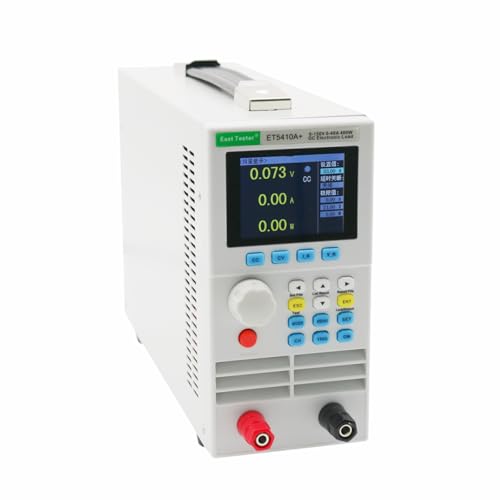
The ET5410A+ is a single-channel programmable DC electronic load rated at 150 V, 40 A and 400 W, the highest power figure in this guide. It provides CC, CV, CR and CP modes plus combined CC+CV and CR+CV modes, with 1 mV and 1 mA resolution and a 2.8-inch colour TFT display. A standard USB interface supports PC control, and the battery test function measures capacity and internal resistance with automatic cut-off, which makes it a natural fit for the battery characterisation exercises common in energy and automotive courses. The combined modes are also useful in charger testing, where a load that holds current and then folds back at a voltage limit behaves more like a real battery. The compact case, roughly 90 mm wide, suits crowded teaching benches where several instruments share the workspace.
- Strength: 400 W and 40 A capacity with a proper battery capacity test, covering discharge exercises that would overload a 200 W instrument.
- Trade-off: PC connectivity is USB only, with no LAN option, and there is no four-wire remote sense, so high-current measurements carry more lead-resistance error than on the Siglent.
Skip it if your lab workflow depends on network control or remote logging from a central instructor PC.
East Tester ET5420A+

The ET5420A+ takes the same operating concept and doubles it: two independent load channels in one case, each rated at 150 V, 20 A and 200 W. Each channel offers CC, CV, CR and CP modes plus the combined CC+CV and CR+CV modes, a 2.8-inch TFT display presents both channels, and USB provides PC control. For technical training the appeal is practical. Two students can run separate exercises on one instrument, a single student can load two rails of a dual-output supply at once, or a class can compare two battery cells side by side under identical conditions. Battery discharge testing is built in, supporting the same capacity measurement exercises as the single-channel model. Per-channel ratings are lower than the ET5410A+, which is the expected exchange for getting two channels in a single bench footprint.
- Strength: Two independent channels double bench throughput for paired practical work and dual-rail supply testing without buying a second instrument.
- Trade-off: Each channel is limited to 20 A and 200 W, so a single high-current exercise cannot use the whole instrument the way it can on the ET5410A+.
Skip it if your exercises regularly need more than 200 W or 20 A on one channel.
Which One Fits Your Situation
A first load for a general electronics course
The Siglent SDL1020X-E fits best. Its four modes, protection set and built-in interfaces cover the standard load regulation, charger and battery exercises, and its stored list and program functions let an instructor standardise practical assessments across a whole cohort.
Battery and charger coursework
Choose between the East Tester units. The ET5410A+ gives one channel the full 400 W for larger packs and higher discharge currents, while the ET5420A+ runs two smaller discharge tests at once, which suits classes where every pair of students characterises a cell in the same session.
Networked benches and remote logging
The Korad KEL103 is the natural pick when the room is wired for data. LAN control means the load can be logged and driven from any PC on the network, and its 300 W rating still covers the supplies a training lab typically owns.
Tight budgets equipping several benches
The East Tester models spread funds furthest, because their capacity figures are high for the class and the dual-channel ET5420A+ effectively equips two workstations at once. Equipping a room with one model throughout also simplifies lesson plans, spares and student familiarity.
Common Mistakes
- Sizing a load by current alone and ignoring the power limit, then finding a 24 V exercise cannot reach the planned current.
- Buying loads with no PC interface for a course whose reports require logged discharge curves and plotted data.
- Overlooking protection features, even though reversed leads and shorted outputs are routine events on student benches.
- Mixing instrument types: a power supply, multimeter or oscilloscope cannot substitute for a load, because only a load sinks a controlled, programmable current.
- Ignoring minimum operating voltage and lead resistance, which skew low-voltage, high-current measurements unless remote sense is used.
- Choosing different models for every bench, which complicates lesson plans and makes student results harder to compare.
FAQ
What size electronic load does a training lab need?
Size it from the largest supply the course tests. Multiply that supply’s maximum voltage by its maximum current to get the watts the load must absorb, then leave headroom. Most teaching supplies fall under 200 W per output, which is why the loads here span 200 W to 400 W.
Which operating modes matter most for teaching?
CC mode is the workhorse for load regulation and battery discharge. CV supports charger and solar exercises, CR demonstrates resistive loading, and CP simulates a downstream converter. A load offering all four covers a typical syllabus without gaps.
Why does PC control matter in a teaching lab?
It turns readings into evidence. Logged voltage and current data lets students plot discharge curves, calculate capacity and efficiency, and include real measurements in reports. Stored test sequences also make practical assessments repeatable and fair across a class.
Can one load serve two students at once?
Only a dual-channel instrument such as the ET5420A+ can run two independent tests simultaneously. A single-channel load serves one exercise at a time, although students can share it in rotation for short measurements.
Is a battery test function worth having?
For any course covering cells and packs, yes. A battery mode discharges at a set current and stops at a cut-off voltage, recording capacity in ampere-hours. Doing the same job manually in CC mode is possible but ties up supervision and invites cells being discharged too far.
More from Amazon
Programs that pair well with the guide above. Offers and eligibility are set by Amazon and may change.
Free shipping on eligible items, Prime Video and more. Eligible new members can start with a free trial.
Start a Prime free trialAudiobooks and podcasts to listen to on the go. Eligible new members can start with a free trial.
Try Audible freeAd-free music streaming. Eligible new subscribers can start with a free trial.
Try Music Unlimited freeA free business account with business pricing and bulk-buying tools for work, shop or home office.
Create a business accountAs an Amazon Associate we earn from qualifying purchases.








Write Your Review
No reviews yet. Be the first to share your experience!