

Key takeaways
- Find the best pitching machines for backyard batting practice, from two-wheel and manual arm models to softball, junior and auto feeder picks.
A good backyard pitching machine turns a spare half hour into a full round of batting practice, with no tired arm on the other end. The machines below cover the main designs a family is likely to buy: a two-wheel model that throws real baseballs and breaking balls, a spring-powered arm machine that needs no electricity, a convertible softball model, a gentle junior machine for the youngest hitters, and an affordable wheel machine with an automatic feeder in the box.
They differ in speed, ball type and how much help the hitter needs during a session, so the right choice depends on who is swinging and where the machine will run. Each pick lists the speed range, ball types and power source from its product page, along with the trade-offs that matter once the machine is set up in a yard or cage.
As an Amazon Associate, we earn from qualifying purchases.
Quick answer
The Heater Sports Deuce 75 is the top pick for most backyards: its two wheels throw real baseballs from 15 to 75 mph, mix in curveballs, and a 12-ball feeder keeps rounds moving. Families on a tighter budget, softball players, young beginners and solo hitters will find a better fit among the four picks below.
Heater Sports Deuce 75 Two-Wheel Pitching Machine

The Deuce 75 is the wheel-style machine to beat for a backyard cage. Two wheels grip the ball, and because each wheel can run at its own speed, the machine throws fastballs and genuine curveballs rather than one straight pitch on repeat. That pitch mix is what separates it from single-wheel machines, and it is why it suits hitters who have moved past basic machine pitch and need to read spin.
- Speed range: 15 to 75 mph with real baseballs, and up to 85 mph with lite balls
- Ball types: regulation baseballs and pitching machine balls
- Pitch types: fastballs and curveballs from the dual wheel setup
- Feeder: automatic feeder holds 12 balls for solo rounds
- Power source: standard household AC power
The honest trade-offs are size and complexity. A two-wheel machine costs more than the single-wheel and manual options here, and dialing in a curveball takes some trial pitches before a round. It also needs an outlet within cord reach, so a field with no power means adding a generator or battery station. For a committed hitter from Little League through high school, though, one machine covers the whole span.
Louisville Slugger Blue Flame Pitching Machine

The Blue Flame takes the opposite approach: a spring-powered throwing arm, worked by a lever and foot pedal, with no motor at all. That arm action gives the hitter a visible motion to time, much like a coach pitching by hand, and the machine is the official pitching machine of both Babe Ruth League and Pony Baseball and Softball.
- Speed range: hard balls from 18 to 45 mph, and light flight or plastic balls up to 60 mph
- Ball types: hard balls, fast pitch softballs, dimple balls, light flight balls and plastic balls
- Power source: completely manual, with no electricity or batteries required
- Weight: under 25 pounds, so one person can carry it from field to field
- Extra duty: throws slowpitch softballs with an arc, plus grounders and fly balls for fielding work
The trade-off is labor and ceiling. Someone has to load every ball and work the pedal, so a solo hitter cannot take a long round alone. The 45 mph top speed with hard balls also caps how far it grows with a player, and speed changes come from adjusting the spring rather than turning a dial. In return, it works anywhere, stores easily and never needs a cord, a charged battery or a repair to a motor.
Heater Sports Combo Baseball and Softball Pitching Machine
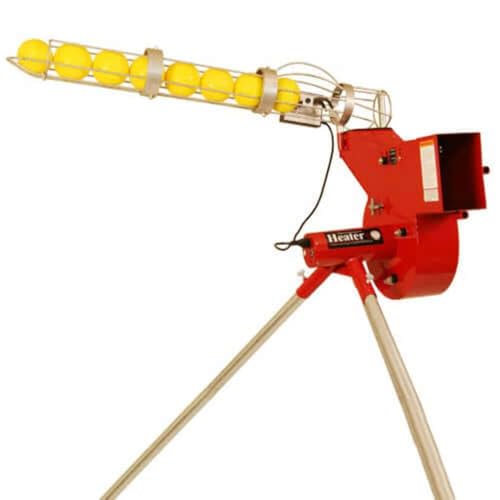
Softball families often end up buying a second machine, and the Heater Sports Combo exists to prevent that. It converts between baseball and softball setups, and in softball trim it pitches both slow-pitch and fast-pitch softballs, which makes it the softball pick in this group even though it covers baseball too.
- Speed range: softballs up to 56 mph and baseballs up to 60 mph, with variable speed control
- Ball types: 11-inch and 12-inch softballs, regulation baseballs and lite balls
- Adjustments: pitch height adjusts, and the head tilts for grounders and pop-flys
- Feeder: a bonus ball feeder is included in the box
- Best fit: households with both baseball and fastpitch or slowpitch softball players
The compromise is that a convertible rarely matches a dedicated machine at either job. Fastpitch hitters who need speeds well beyond the mid-50s will outgrow it, and the first few changeovers between the baseball and softball setups take some patience while the parts become familiar. The included feeder is a welcome bonus, though it is a simple unit rather than a high-capacity system. For a two-sport household, one Combo still beats storing and maintaining two machines.
Franklin Sports MLB Electronic Pitching Machine

For the youngest hitters, the goal is contact and confidence rather than game speed, and this Franklin machine is built for exactly that stage. It pitches a lightweight ball every 7 seconds on a steady rhythm, and a flashing red indicator light warns the hitter that the next pitch is on its way, which helps a child time a swing without a coach calling out each pitch.
- Pitch interval: one pitch every 7 seconds, with a flashing red indicator light
- Ball types: the included white aero-strike balls only, with six in the box
- Capacity: the ball chute holds up to 9 balls
- Adjustments: pitch height and angle adjust for different hitters
- Power source: battery powered, so it sets up anywhere in the yard
The limits are firm ones. Franklin does not publish a top speed for this machine, and it only works with its own lightweight balls, so regulation baseballs and tee balls are off the table. Battery power keeps it portable but means keeping fresh batteries on hand during heavy use, and Franklin recommends pairing it with a plastic bat. Treat it as a first machine for tee ball and coach-pitch ages, and it does that job well.
Heater Sports Base Hit Pitching Machine

The Base Hit is the feeder pick because the automatic feeder is not an add-on here: a 12-ball feeder comes in the box and delivers a ball every 10 seconds, so one hitter can take a full round alone while a parent watches from behind the screen. The machine itself is a single-wheel design in a high-impact composite housing on tubular steel tripod legs.
- Speed range: real baseballs up to 45 mph, and lite balls up to 60 mph
- Ball types: real baseballs, lite-baseballs and plastic practice balls
- Feeder: 12-ball automatic feeder included, delivering a ball every 10 seconds
- Power source: plugs into an electrical outlet, and the listing notes a 200 watt draw for portable power stations
- Model: BH199, with quick-attach knobs for the pitching housing
The ceiling is the thing to accept up front. At 45 mph with real baseballs, this is a youth machine, and older teens will find it slow even from a shortened distance. The listing also notes the feeder opening is sized just over a standard baseball, and Heater dimpled balls are recommended for the most consistent feeding. Within those limits, it is a simple, honest route to hands-free practice at home.
How to choose
Match the machine to the hitter first. Young beginners need low speeds and soft balls, so the junior Franklin or the Base Hit covers them. Players in machine-pitch and coach-pitch leagues need real baseballs at honest speeds, which points to the Deuce 75 or the Blue Flame. Softball players should confirm the machine throws 11-inch or 12-inch softballs from a realistic delivery, as the Heater Combo does.
Next, think about power and help. The Blue Flame runs anywhere because it needs no electricity, while every electric machine here needs an outlet, a generator or a battery station within reach. A feeder changes who has to attend practice: the Deuce 75 and Base Hit feed themselves, while the Blue Flame needs a person on the pedal for every pitch.
Finally, check ball compatibility before ordering. Wheel machines wear fastest on the balls they were designed for, and several of these machines only accept certain ball types, from lite balls to one brand of plastic ball. Buying the right balls with the machine avoids jams, wild pitches and a worn wheel.
Who should skip
Skip the junior Franklin if your hitter already faces real baseballs in games, because its lightweight balls and gentle pace will feel like a step backward. Skip the Blue Flame if nobody wants to work the pedal, since a manual machine with no operator is just yard furniture. Skip the Base Hit if the hitter is an older teen, because 45 mph with real baseballs will not challenge them for long.
Skip the Deuce 75 if the budget is firm and the hitter is young, since its speed range and curveball ability will go unused for several seasons. And skip the whole category for now if your yard has no safe backstop or net, because even the softest machine here sends balls toward fences, windows and neighbors.
Frequently Asked Questions
Can a pitching machine throw real baseballs?
Yes, if it is built for them. The Deuce 75 and the Base Hit both pitch regulation baseballs, and the Blue Flame throws hard balls at its listed speeds. Lighter machines are different: the Franklin junior model only accepts its own plastic balls, and feeding a real baseball into a machine rated for lite balls can damage the wheel and void the warranty.
How fast should a backyard pitching machine throw?
It depends on the hitter and the distance. Young players often work between 25 and 45 mph, while older youth and high school hitters train anywhere from 50 to 75 mph. A wide range, like the 15 to 75 mph span of the Deuce 75, lets one machine grow with a player, and moving the machine closer makes a slower pitch react faster.
Do pitching machines need a power outlet?
Most electric models do. The wheel machines in this guide run on household AC power, and their listings describe generator or battery station options for fields without outlets. The exceptions are the manual Blue Flame, which needs no power at all, and the battery powered Franklin junior machine, which trades a cord for a set of batteries to keep fresh.
How many balls should I buy with a pitching machine?
Buy enough to fill the feeder and keep a round moving, which usually means at least a dozen of the correct ball type. Feeder machines like the Base Hit hold 12 balls, and hand-fed machines go faster with a bucket beside the operator. Stick to the ball types the listing names, since the wrong size or surface can jam a feeder or wear a wheel.
Final verdict
For most families, the Heater Sports Deuce 75 is the machine to buy once: real baseballs, real curveballs and a feeder, in one two-wheel unit. The Blue Flame is the pick for fields without power and for coaches who like an arm action. Softball households should look at the Heater Combo, young beginners at the Franklin, and solo hitters on a budget at the Base Hit.
Product and ASIN Reference
| Product | ASIN |
|---|---|
| Heater Sports Deuce 75 Two-Wheel Pitching Machine | B001704URG |
| Louisville Slugger Blue Flame Pitching Machine | B000VZ2Q5G |
| Heater Sports Combo Baseball/Softball Pitching Machine | B000XT8AJQ |
| Franklin Sports MLB Electronic Pitching Machine | B0007DHT8Q |
| Heater Sports Base Hit Pitching Machine | B001704UO4 |
More from Amazon
Programs that pair well with the guide above. Offers and eligibility are set by Amazon and may change.
Free shipping on eligible items, Prime Video and more. Eligible new members can start with a free trial.
Start a Prime free trialAudiobooks and podcasts to listen to on the go. Eligible new members can start with a free trial.
Try Audible freeAd-free music streaming. Eligible new subscribers can start with a free trial.
Try Music Unlimited freeA free business account with business pricing and bulk-buying tools for work, shop or home office.
Create a business accountAs an Amazon Associate we earn from qualifying purchases.

Write Your Review
No reviews yet. Be the first to share your experience!