

Key takeaways
- Compare the best stereo power amplifiers with balanced xlr inputs, from high-output rack amps to a compact Class D pick and a budget Crown model.
A dedicated stereo power amplifier does one job: it takes a line-level signal from a preamp, DAC, or processor and drives a pair of passive speakers with clean, controlled power. Balanced XLR inputs are the connection that makes that job easier in real rooms. A balanced line rejects hum and interference picked up along the cable run, so long cables between a processor rack and an amplifier rack stay quiet, and the higher signal level of a balanced source gives the amplifier more headroom to work with before noise becomes audible.
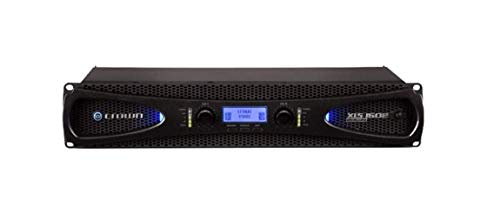

This guide covers five buying slots for stereo power amplifiers with balanced XLR inputs. Three are rack-mount designs from Crown, a brand whose amplifiers anchor countless live and installed systems, one is a dual-mono design from NAD, and one is a compact desktop Class D unit from Fosi Audio.
As an Amazon Associate, we earn from qualifying purchases.
Quick answer
The Crown XLS 1502 is the pick for most buyers: it pairs balanced XLR inputs with 300 watts per channel into 8 ohms, built-in crossover filters and limiters, and a chassis that weighs under 9 pounds. The XLS 2502 adds output for demanding speakers, the Fosi Audio ZA3 covers compact desktop rigs, and the Crown XLi800 keeps costs down.
Crown XLS 1502 — Best overall
The XLS 1502 sits in the middle of Crown’s DriveCore 2 series, and that middle position is exactly why it earns the top slot. It delivers 300 watts per channel into 8 ohms and 525 watts into 4 ohms, which is enough clean output for the large majority of passive speakers used in home listening rooms, small venues, and houses of worship. Because the amplifier is built on Crown’s DriveCore platform, that power comes from an efficient Class D design in a 2U chassis that weighs only 8.6 pounds, so a single person can rack it, move it, and reconfigure a system without help.
Each channel accepts balanced XLR, balanced 1/4-inch TRS, and unbalanced RCA inputs, and the input sensitivity can be switched between 1.4 Vrms and 0.775 Vrms. That second setting matters more than it might seem: many home preamps and AV processors output lower levels than pro consoles, and the 0.775 Vrms option lets the amplifier reach full power from those sources instead of sounding strained. Balanced XLR runs from a processor stay quiet over long distances, which is the entire reason this category exists.
The built-in signal processing is the other half of the appeal. Crown’s PureBand crossover system applies Linkwitz-Riley filters per channel, so the same amplifier can run full-range tops, cross over to subwoofers, or band-pass a channel for a dedicated duty, all without an external crossover. Peakx limiters guard speakers against clipping damage, and a backlit LCD with a menu lock keeps settings from being changed accidentally once a system is dialed in. For a single amplifier that can cover stereo listening, small PA work, and bi-amped or subwoofer-assisted setups, the XLS 1502 is the most complete package in this guide.
- Amplifier type: Stereo power amplifier, DriveCore Class D
- Output power: 300 W per channel at 8 ohms; 525 W at 4 ohms; 775 W at 2 ohms; 1,050 W bridged at 8 ohms
- Inputs: Balanced XLR, 1/4-inch TRS, and RCA per channel
- Input sensitivity: Selectable 1.4 Vrms or 0.775 Vrms
- Processing: PureBand crossover filters, Peakx limiters, LCD display
- Signal-to-noise ratio: Above 103 dB
- Damping factor: Above 200
- Dimensions and weight: 19 × 3.5 × 7.7 in (2U rack), 8.6 lb
Crown XLS 2502 — Most power output
When speakers are inefficient, rooms are large, or program material is demanding, the answer is more amplifier, and the XLS 2502 is the most powerful model in the DriveCore 2 line. It is rated at 440 watts per channel into 8 ohms, 775 watts into 4 ohms, and 1,200 watts into 2 ohms, with bridged output reaching 2,400 watts into 4 ohms for a single hard-working channel. Headroom is what keeps bass transients clean and prevents the clipped, harsh sound that appears when a smaller amplifier runs out of voltage swing on a musical peak.
Everything that makes the XLS 1502 easy to live with carries over: the same balanced XLR, TRS, and RCA input set, the same switchable input sensitivity, the same PureBand crossover filters and Peakx limiters, and the same fan-cooled 2U format. The 2502 is deeper and slightly heavier at 10.8 pounds, a fair trade for the larger power supply and output stage. It also handles low-impedance loads gracefully, which matters for speakers whose impedance dips well below their nominal rating in the bass region.
Choose the 2502 over the 1502 when the speakers are known power-hungry models, when one amplifier must cover a large space, or when bridged subwoofer duty is part of the plan. For typical two-channel listening with reasonably sensitive speakers, the smaller model in this guide is the smarter buy; the 2502 exists for systems where running out of power is a genuine risk rather than a theoretical one.
- Amplifier type: Stereo power amplifier, DriveCore Class D
- Output power: 440 W per channel at 8 ohms; 775 W at 4 ohms; 1,200 W at 2 ohms; 2,400 W bridged at 4 ohms
- Inputs: Balanced XLR, 1/4-inch TRS, and RCA per channel
- Input sensitivity: Selectable 1.4 Vrms or 0.775 Vrms
- Processing: PureBand crossover filters, Peakx limiters, LCD display
- Signal-to-noise ratio: Above 103 dB
- Damping factor: Above 200
- Dimensions and weight: 19 × 3.5 × 10.7 in (2U rack), 10.8 lb
NAD C 298 — Best dual-mono design

The NAD C 298 brings the dual-mono layout into the Class D era. Inside its single chassis sit two separate Purifi Eigentakt amplifier modules, one dedicated to each channel, built by NAD under license from Purifi. With a module of its own per channel, channel separation is rated above 110 dB at 1 kHz and the signal-to-noise ratio above 120 dB at full output into 8 ohms.
The output figures suit demanding home systems. NAD rates the C 298 at 185 watts per channel into 8 ohms and 340 watts per channel into 4 ohms with both channels driven, with dynamic power reaching 570 watts into 2 ohms on short musical peaks and peak output current above 25 amps. A rear-panel bridge switch turns the same chassis into a monoblock rated at 620 watts into 8 ohms, so a second C 298 can be added later to run one amplifier per speaker.
Connectivity is the reason it belongs in this guide. Balanced XLR and single-ended RCA inputs are fitted per channel, with a selector switch per channel. Gain can be left fixed at 28.6 dB for a conventional preamp pairing, or set to a variable mode adjustable from 8.5 to 28.5 dB when the amp is driven directly by a DAC or another high-output source. A line output allows daisy-chaining another amplifier, 12 V trigger connections handle system power control, and an auto-sense circuit with a selectable threshold wakes the amplifier when a signal arrives.
- Amplifier type: Stereo power amplifier, Class D with Purifi Eigentakt modules, one per channel
- Output power: 185 W per channel at 8 ohms; 340 W at 4 ohms; 620 W bridged at 8 ohms
- Dynamic power: 260 W at 8 ohms; 490 W at 4 ohms; 570 W at 2 ohms
- Inputs: Balanced XLR and RCA per channel, switchable
- Gain: Fixed 28.6 dB, or variable from 8.5 to 28.5 dB
- Signal-to-noise ratio: Above 120 dB at rated output
- Channel separation: Above 110 dB at 1 kHz
- Extras: Bridge mode switch, line output for daisy-chaining, 12 V trigger in and out, auto-sense with selectable threshold
- Dimensions and weight: 17.1 × 4.7 × 15.4 in, 24.7 lb
Fosi Audio ZA3 — Best compact class D

The Fosi Audio ZA3 shrinks the balanced-input power amplifier down to desktop scale. Built around a Texas Instruments TPA3255 Class D chip, it measures roughly 6 × 7 × 2 inches and weighs under two pounds, yet Fosi rates it at up to 180 watts per channel into 4 ohms in stereo mode with the included 48 V power supply. A front-panel switch converts the same unit to mono operation at up to 235 watts into 4 ohms, so a second ZA3 can be added later to run one amplifier per speaker, a tidy upgrade path for a growing system.
The balanced input is a combined XLR and 1/4-inch TRS socket, which accepts either connector type, and there is an RCA input as well for sources without balanced outputs. A 12 V trigger input lets a preamp or DAC switch the amplifier on and off with the rest of the system, and a subwoofer output simplifies a 2.1 desktop or small-room setup. The volume control is a simple front knob; in a fixed system it can be set once and left, with level controlled upstream by the preamp or DAC feeding it.
Expectations should match the format. The ZA3 cannot match the sustained output, load tolerance, or protection suite of the rack amplifiers in this guide, and its ratings are quoted at 4 ohms rather than 8. What it offers instead is a genuinely balanced input, honest Class D efficiency, and a footprint that fits a desk or shallow shelf where no rack amplifier would go. For nearfield systems, office setups, and compact two-channel rigs built around a balanced DAC, it is the natural pick.
- Amplifier type: Stereo power amplifier, Class D (TI TPA3255)
- Output power: Up to 180 W per channel at 4 ohms in stereo mode; up to 235 W at 4 ohms in mono mode (manufacturer figures with 48 V supply)
- Inputs: Balanced XLR/TRS combo and RCA
- Extras: Stereo/mono mode switch, 12 V trigger input, subwoofer output, external 48 V power supply
- Signal-to-noise ratio: 108 dB
- Dimensions and weight: About 6.1 × 7.2 × 2.0 in, under 2 lb
Crown XLi800 — Best budget

The XLi800 is the entry model in Crown’s XLi series, a line of conventional rack amplifiers built for musicians, DJs, small venues, and installed systems that need dependable power without DSP menus or premium pricing. It delivers 200 watts per channel into 8 ohms and 300 watts into 4 ohms, and bridges to 600 watts into 8 ohms for single-speaker or subwoofer duty. Those are honest, usable numbers for small rooms and portable rigs, and they come from a design that has been in production long enough for its behavior to be well understood.
Inputs are balanced XLR and unbalanced RCA, with Speakon and binding-post outputs, and the amplifier can run in stereo, parallel, or bridge-mono mode. Input sensitivity is selectable between 0.775 V and 1.4 V, so it pairs sensibly with both pro consoles and lower-output home sources. Forced-air cooling with protection against shorts, no-load faults, and overheating keeps the amplifier working through long events, and front-panel indicators report power, fault, and signal presence per channel at a glance.
The trade-offs are weight and refinement. At about 25 pounds in a 2U chassis, the XLi800 is far heavier than the DriveCore models, and it offers no crossover filters or limiters of its own. What it gives back is simplicity and value: balanced inputs, proven Crown engineering, and enough power for the majority of small-system jobs, at the lowest cost of entry in this guide.
- Amplifier type: Stereo power amplifier, conventional rack design
- Output power: 200 W per channel at 8 ohms; 300 W at 4 ohms; 600 W bridged at 8 ohms
- Inputs: Balanced XLR and RCA
- Outputs: Speakon and binding posts
- Modes: Stereo, parallel, and bridge-mono; selectable 0.775 V or 1.4 V input sensitivity
- Cooling and protection: Forced-air cooling; short-circuit, no-load, and thermal protection
- Dimensions and weight: 19 × 3.5 × 12.4 in (2U rack), about 25 lb
How to choose
Begin with the speakers, not the amplifier. Check their sensitivity and impedance ratings: efficient speakers in a small room need surprisingly little power, while low-sensitivity speakers, or models whose impedance dips toward 2 or 3 ohms in the bass, reward the larger amplifiers in this guide. As a working rule, an amplifier that can deliver clean peaks well above your average listening level will sound relaxed where a marginal one sounds strained, even at the same measured volume.
Next, confirm the balanced connection end to end. XLR inputs deliver their noise-rejection benefit when the source is also balanced, so pair these amplifiers with a preamp, DAC, or processor that offers balanced outputs. If the source is unbalanced only, the RCA inputs on every model here work fine, and the balanced inputs can wait for a future upgrade. Cable length matters too: the longer the run between source and amplifier, the more a balanced line earns its keep.
Then weigh format against features. Rack amplifiers such as the Crown models bring processing, protection, and load tolerance that suit permanent installs and portable rigs alike. Compact Class D units such as the ZA3 trade some of that capability for a footprint that fits real furniture. Finally, look at operating modes: bridging and mono switches change what one chassis can do, and a system planned around them can grow without replacing its amplifier.
Who should skip
Skip this entire category if your speakers are powered models with their own built-in amplification, since a power amplifier has nothing to drive there. Skip it as well if you need source switching, tone controls, a phono stage, or a remote in the same box: those are integrated-amplifier features, and every product in this guide expects a preamp, DAC, or processor upstream to handle them.
The rack-mount Crown models are poor fits for a living-room shelf where a fan-cooled 2U chassis would look and sound out of place at low volume; the compact ZA3, or the dual-mono NAD C 298, suits that setting better. Conversely, desktop amplifiers should be skipped for large rooms, low-sensitivity speakers, or subwoofer duty, where sustained current delivery matters more than footprint. And if balanced cabling is not part of the system at all, some of what these amplifiers charge for goes unused, even though each one still performs well on its RCA inputs.
Frequently Asked Questions
Why use balanced XLR inputs on a power amplifier?
A balanced connection carries the signal on two conductors with opposite polarity, and the receiving input rejects noise that both conductors picked up equally along the way. In practice that means long cable runs stay free of hum from power wiring and lighting dimmers, and the connection is more secure than a friction-fit RCA plug. Systems with a processor or preamp in one rack and amplifiers in another benefit the most.
How much power do my speakers actually need?
Less than headline figures suggest, most of the time. Doubling amplifier power adds only a modest increase in maximum volume, so the practical question is headroom: enough clean power that peaks in music and film soundtracks never push the amplifier into clipping. Efficient speakers in a small room are well served by the smaller models here, while inefficient speakers, large rooms, or low-impedance loads justify stepping up to the XLS 2502 class of output.
What does bridge-mono mode do?
Bridging combines both channels of a stereo amplifier into a single mono channel with substantially higher output, 1,050 watts into 8 ohms in the case of the XLS 1502. It is the standard way to drive one demanding speaker or a subwoofer from a stereo chassis. The speaker must be connected to the designated bridged terminals, the load should not fall below the bridged minimum impedance, and the second channel is no longer available for stereo use while bridged.
Can a compact Class D amplifier replace a rack amplifier?
For a desktop or small-room system, yes: the ZA3 in this guide offers balanced inputs, useful power into typical bookshelf speakers, and a trigger input for system integration. For large rooms, low-sensitivity or low-impedance speakers, and subwoofer duty, a rack amplifier’s power supply, protection circuitry, and sustained output remain the safer choice. The deciding factors are speaker demands and listening distance, not the amplifier’s size alone.
Final verdict
For most systems built around balanced sources, the Crown XLS 1502 is the amplifier to buy first: verified balanced XLR inputs, ample power for typical speakers, useful built-in processing, and a light, shallow chassis that fits almost any rack. The XLS 2502 is the step up for demanding speakers and large spaces, the Fosi Audio ZA3 is the compact Class D answer for desks and small rooms, and the Crown XLi800 covers the budget slot with simple, proven power. The NAD C 298 covers the dual-mono slot, with separate amplifier modules per channel and a bridge mode for monoblock use.
Product and ASIN Reference
| Product | ASIN |
|---|---|
| Crown XLS 1502 | B011X2HTZC |
| Crown XLS 2502 | B0129IKF32 |
| NAD C 298 | B08MVC8LXC |
| Fosi Audio ZA3 | B0CLP4T5L7 |
| Crown XLi800 | B00AR0A3V4 |
More from Amazon
Programs that pair well with the guide above. Offers and eligibility are set by Amazon and may change.
Free shipping on eligible items, Prime Video and more. Eligible new members can start with a free trial.
Start a Prime free trialAudiobooks and podcasts to listen to on the go. Eligible new members can start with a free trial.
Try Audible freeAd-free music streaming. Eligible new subscribers can start with a free trial.
Try Music Unlimited freeA free business account with business pricing and bulk-buying tools for work, shop or home office.
Create a business accountAs an Amazon Associate we earn from qualifying purchases.



Write Your Review
No reviews yet. Be the first to share your experience!