

Key takeaways
- Compare the best massage guns for athletes by amplitude, speeds, heads and motor type, with safe-use tips and notes on what to confirm on each listing.
The best massage gun for most athletes in this group is the Mebak 3, because its listing states a 12 mm amplitude, the spec that matters most for reaching larger muscles like quads and glutes, in a simple five-speed layout. The Elefor, with eight heads and 20 speeds, suits athletes who like to fine-tune intensity, and the TOLOCO guns add ten heads and a brushless motor described as silent. A massage gun is a handheld percussive device that pulses a head into the muscle, and athletes use it as a warm-up and recovery tool, not as a treatment for injury.
Quick List
- Elefor 20-Speed Gun – best for fine control of intensity with eight heads
- TOLOCO Massage Gun (first listing) – best for a quiet brushless motor and ten heads
- TOLOCO Massage Gun (second listing) – best for a backup or alternate TOLOCO variant
- APHERMA Massage Gun (first listing) – best for a straightforward handheld deep-tissue gun
- APHERMA Massage Gun (second listing) – best for an alternate APHERMA variant
- Mebak 3 – best for a clearly stated 12 mm amplitude and a simple five-speed setup
Which One Is Right for You?
| If you… | Choose |
|---|---|
| Care most about how deep the head travels | Mebak 3 |
| Want many speed settings to dial in pressure | Elefor 20-Speed Gun |
| Use a gun in shared spaces and want a quieter motor | TOLOCO Massage Gun (first listing) |
| Want ten heads for different body areas | TOLOCO Massage Gun (second listing) |
| Prefer a simple handheld electric massager | APHERMA Massage Gun (first listing) |
| Want to compare a second APHERMA variant before buying | APHERMA Massage Gun (second listing) |
The TOLOCO and APHERMA brands each appear twice with nearly identical visible names. Their listings may differ in battery size, speed count, heads or color, so check the product page before choosing between them. Amplitude, battery life and noise are the three specs worth confirming.
All 6 Picks in Detail
1. Elefor 20-Speed Massage Gun – Best for Fine Control
As an Amazon Associate we earn from qualifying purchases at no extra cost to you.

The Elefor is described as a percussion deep-tissue massage gun for athletes with eight massage heads and 20 speeds. The wide speed range lets you start at a very gentle level over sore areas and climb gradually, which is helpful if you are sensitive after a hard session.
It suits athletes who prefer to experiment with different heads and intensities, for example a round head for quads, a flat head for the back and a bullet-style head for small knots. The title does not state amplitude, so confirm it before assuming how deep it goes.
- Speeds: 20
- Heads: eight
- Marketed for: athletes, pain relief, deep tissue
- Amplitude: confirm on listing
- Battery and noise level: confirm on listing
Pros
- Large number of speed levels
- Variety of heads for different areas
Cons
- Amplitude not stated in the title
- Many settings can feel like overkill
Twenty speeds help in practice only if the lowest levels are gentle enough for tender muscles. Start at the bottom and work upward over 30 to 60 seconds per area.
The many heads are most useful if you take a minute to learn them. Use the largest, softest head on thighs and glutes, the flat head on the back muscles beside the spine (not on the spine itself), and the smallest head only for brief work on tight spots in the calves or shoulders. Lower speeds with a bigger head are usually gentler than higher speeds with a small head, so combine them with care.
If you share the gun with a partner who prefers a gentler feel, the broad speed ladder makes it easy to set one level for you and another for them. Write the favored speeds on a note inside the case so you do not need to guess each time.
Compared with the Mebak 3, the Elefor offers more heads and speeds, while the Mebak offers a clear depth spec.
2. TOLOCO Massage Gun (First Listing) – Best for a Quiet Brushless Motor

The TOLOCO listing mentions deep-tissue back massage for athletes, ten massage heads and a silent brushless motor. Brushless motors are commonly used in higher-end massage guns because they tend to run quieter and last longer than brushed ones, though how quiet any one unit is depends on the build.
It suits athletes who use a gun at home, in a locker room or near others, and who value a quieter device. Ten heads give plenty of options for different muscle groups.
- Heads: ten
- Motor: brushless, described as silent
- Marketed for: deep tissue back massage, pain relief, athletes
- Speeds and amplitude: confirm on listing
- Battery runtime: confirm on listing
Pros
- Brushless motor aimed at quiet use
- Ten heads for flexibility
Cons
- Amplitude and speed count not shown in the title
- “Silent” is a marketing term; confirm noise details
A quieter motor is not the same as a gentler one, so apply light pressure first. Use the larger heads over big muscle groups and avoid bony areas.
If noise matters in a shared home or training room, run the gun at a medium speed and compare it with other devices you may have used, since any motor gets louder at the top speed. Ten heads also mean more to lose, so keep them in the supplied case. Wipe the heads with a damp cloth after sweaty sessions, and let them dry before putting them away.
Compared with the Elefor, this TOLOCO leans toward quiet operation and more heads rather than a long speed ladder.
3. TOLOCO Massage Gun (Second Listing) – Best for an Alternate TOLOCO Variant
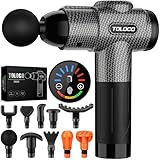
This second TOLOCO listing repeats the same visible description: a deep-tissue, athlete-oriented percussion gun with ten heads and a silent brushless motor. It likely represents a different model year, color or bundle, so it is worth comparing the two product pages for battery capacity, speed levels and case contents.
It suits anyone who likes the TOLOCO approach but wants to choose between configurations. If both pages look identical to you, pick whichever has the better stated battery life and carrying case.
- Heads: ten
- Motor: brushless, described as silent
- Marketed for: athletes, back and muscle massage
- Differences from the first TOLOCO listing: confirm on listing
- Battery capacity and amplitude: confirm on listing
Pros
- Same brushless, ten-head approach as the first TOLOCO
- Gives you a second variant to compare
Cons
- Visible name does not explain how it differs
- Specs need to be confirmed on the page
Whichever variant you choose, charge it with the supplied charger, avoid using it while it is plugged in, and store it away from heat. Lithium batteries need basic care.
Pay attention to the carrying case and the number of included heads when comparing the two pages, because those items sometimes vary between bundles of the same brand. Check whether a charger is included and which charging connector the gun uses, since this affects travel. A gun that charges over a common connector is easier to keep topped up.
Compared with the first TOLOCO listing, any difference is on the product page rather than in the name.
4. APHERMA Massage Gun (First Listing) – Best for a Straightforward Handheld Gun

The APHERMA listing is for a handheld electric deep-tissue percussion massage gun for athletes, aimed at back massage and pain relief. The visible title is lighter on numbers than some others, so the spec details of heads, speeds and amplitude all need to be confirmed.
It suits shoppers who want a conventional percussion gun and are happy to compare the details on the page. Since the name does not state an amplitude, treat it as an unknown until you check.
- Type: handheld electric percussion gun
- Marketed for: athletes, deep tissue, back massage
- Heads and speeds: confirm on listing
- Amplitude: confirm on listing
- Battery runtime: confirm on listing
Pros
- Familiar handheld design
- Marketed directly at athletes
Cons
- Almost no stated numbers in the visible title
- Comparison against others requires research
Before buying, check that the page states a clear amplitude, the number of speeds, the battery runtime and what comes in the box. These four items are what separate one gun from another.
A good rule when specs are missing is to compare the product page with the claims you care about: amplitude of at least 10 to 12 mm for athletic use, a lowest speed that feels gentle, a runtime of an hour or more on a charge, and a head set that includes a round, flat and bullet shape. If a page cannot answer these questions, move on to a listing that can.
Compared with the Mebak 3, this APHERMA is less specific in the title, so the Mebak is easier to judge at a glance.
5. APHERMA Massage Gun (Second Listing) – Best for an Alternate APHERMA Variant

This is the second APHERMA listing with the same visible description. Treat it as an alternative configuration of the first. It may differ in battery, number of attachments, color or the carrying case, and the product page is the only reliable place to find out.
It suits shoppers who have decided on the APHERMA brand and want to pick the version with the setup they prefer. As with the first listing, check the amplitude, speeds and runtime.
- Type: handheld electric percussion gun
- Marketed for: athletes, deep tissue, pain relief
- Differences from the first APHERMA listing: confirm on listing
- Heads, speeds and amplitude: confirm on listing
- Battery details: confirm on listing
Pros
- Offers a second configuration to choose from
- Same athlete-oriented positioning
Cons
- Names alone do not distinguish it from the first listing
- Requires reading the product page for key numbers
Percussion guns should not be pressed into bones, joints or the front of the neck. Keep sessions short, and stop if you feel sharp or radiating pain.
If you buy this variant, take a few minutes on the first day to run it on your forearm at each speed, so you know how it feels before using it on a sore leg. Keep the first sessions short, around 30 seconds per area, and increase gradually over a couple of weeks. This is also a sensible approach with any new device, whatever the brand.
Compared with the first APHERMA, this one is only distinguishable through the product page details.
6. Mebak 3 – Best for a Stated 12 mm Amplitude
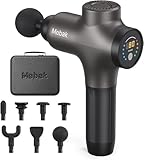
The Mebak 3 listing is the most specific about the spec that determines depth. It states a 12 mm amplitude, five speeds, and use for deep tissue relief, with the shoulder named among suggested areas. Amplitude is how far the head travels with each pulse, and a larger number generally reaches deeper into big muscles.
It suits athletes who want a plain, understandable interface and enough depth for thighs, glutes and the upper back. Five speeds make it quick to pick a setting during a warm-up or cool-down without cycling through dozens of levels.
- Amplitude: 12 mm per the listing
- Speeds: five
- Marketed for: deep tissue relief, shoulders and other muscles
- Heads included: confirm on listing
- Battery capacity and runtime: confirm on listing
Pros
- Amplitude is clearly stated
- Simple five-speed control
Cons
- Fewer speeds than some competitors
- Runtime and head count need checking
Use the lower speeds on tender areas, and keep the gun moving rather than pressing hard into one spot. The device is not a substitute for rest or professional care if something is injured.
Because it has a longer stroke than many entry-level devices, it is worth keeping the head moving across the muscle belly rather than parking on one spot. A good starting pattern for the quads is three slow passes from the knee toward the hip at the lowest speed, then one more at the middle speed if it feels comfortable. Pair it with ordinary stretching and a proper cool-down rather than treating it as the whole recovery plan.
Compared with the Elefor, the Mebak has fewer speeds but states its amplitude, which makes depth easier to judge.
Specs Compared
| Product | Amplitude | Speeds | Heads | Motor / notes |
|---|---|---|---|---|
| Elefor 20-Speed Gun | Confirm on listing | 20 | 8 | Percussion; confirm battery |
| TOLOCO Massage Gun (first listing) | Confirm on listing | Confirm on listing | 10 | Brushless, described as silent |
| TOLOCO Massage Gun (second listing) | Confirm on listing | Confirm on listing | 10 | Brushless, described as silent |
| APHERMA Massage Gun (first listing) | Confirm on listing | Confirm on listing | Confirm on listing | Handheld electric percussion |
| APHERMA Massage Gun (second listing) | Confirm on listing | Confirm on listing | Confirm on listing | Handheld electric percussion |
| Mebak 3 | 12 mm | 5 | Confirm on listing | Deep tissue; confirm battery |
How We Chose These
This is a research-based comparison of the six listings supplied for the topic. We compared the specs that listing titles actually state, such as amplitude, speed count, number of heads and motor type, and we read general guidance on how athletes are advised to evaluate and use percussion devices. Where a listing is silent on a number, we say to confirm it on the product page. Duplicate brand listings are treated as separate entries with the differences flagged. This guide relies on documented specifications and published guidance, not on our own performance trials, and nothing here is medical advice; the ordering reflects clarity of stated specifications and fit for athletic use.
What to Look For
Amplitude: how deep the head travels
Amplitude, also called stroke length, is measured in millimeters. Many everyday guns sit around 8 to 12 mm, while guns designed for athletes and larger muscle groups often go to 12 to 16 mm. A longer stroke reaches deeper into big muscles like quads and glutes, but it can feel too aggressive for calves, forearms and the upper back. Treat 12 mm as a good middle point for general athletic use.
Stall force and speed
Stall force describes how much pressure you can apply before the motor slows or stops. Higher-end guns advertise 30 to 40 pounds or more. Listing titles rarely state it, so look in the specification section. Speed is measured in percussions per minute, often between about 1,700 and 3,200. Higher numbers are not automatically better; lower speeds suit tender muscles and longer warm-up passes.
Heads, noise and battery
Most guns ship with a round or ball head for big muscles, a flat head for broad areas, a bullet head for trigger points and a fork-shaped head for areas around the spine or Achilles. Eight to ten heads is plenty; you will probably use two or three. Noise depends on motor quality and speed, and “silent” claims should be read as “quieter than average”. For battery life, look for a stated runtime, a charging port type and a low-battery indicator.
Safe use and battery care
Use a massage gun on muscle, not on bones, joints, the spine, the front of the neck, or areas with swelling, bruising, open wounds or suspected fractures. Skip it entirely over veins, if you have a clotting condition, or if you take blood thinners unless a clinician approves. Stop if you feel sharp, radiating or numb sensations. For the lithium battery, use the charger supplied, do not charge unattended on soft bedding, do not use a swollen or damaged battery, and keep the unit away from heat.
A worked example for time per muscle
A common recommendation is one to two minutes per muscle group, at a low to medium speed, with light pressure and a slow glide of about one inch per second. For a post-run routine, spend 90 seconds on each quad, 90 on each hamstring, 60 on each calf and 60 on each glute. That is around eight to ten minutes. Before training, reduce this to 20 to 30 seconds per area to wake the muscles up without making them sluggish. Let the gun do the work; pressing harder does not speed up recovery.
Match the gun to the sport and the moment
Before training, short, light passes can make you feel ready to move, particularly on cold mornings. After training, longer, slower passes on large muscles fit better. Endurance athletes tend to focus on calves, quads, hamstrings and glutes, so a larger head and moderate amplitude work well. Strength athletes often need the upper back, lats, pecs and shoulders, where a flat or fork head helps avoid the spine. Team-sport players usually want a bit of everything and a gun small enough for a gym bag. Weight and grip shape matter more than they sound: a heavy gun held at arm’s length for ten minutes gets tiring quickly, so check the weight and handle design on the product page.
It also pays to think about where you will keep the gun. A hard case protects the heads and battery in a bag, and a charging cable that matches your other devices means one less thing to pack. If you share the gun with a teammate or family member, wipe the head with a clean cloth between users.
Questions
Is a massage gun better than a foam roller?
They serve similar goals in different ways. A gun is easier to aim at a specific area and needs less effort, while a roller uses your body weight and covers large areas. Research comparing the two for soreness has found similar benefits, so choose the one you will use consistently.
How often can athletes use a massage gun?
Many people use one daily in short sessions, but there is no universal prescription. Keep each area to a couple of minutes and give sore muscles a break if they feel bruised or tender.
What amplitude is best for athletes?
Around 12 mm or more is common for guns aimed at athletes and larger muscles. Smaller amplitudes are gentler and suit smaller areas and sensitive users.
Can I use a massage gun on an injury?
No. Avoid strains, sprains, bruises, suspected fractures and swollen areas. See a clinician for any injury, and only use the gun once you are cleared.
Do more speeds make a better gun?
Not necessarily. What matters is whether the lowest speed is gentle enough and whether the amplitude and motor suit your muscles. Five well-spaced speeds can be as useful as twenty.
How do I look after the battery?
Use the supplied charger, avoid leaving the device in a hot car and stop using it if it swells, smells or overheats. Do not charge it unattended for long periods.
Update History
- October 20, 2026 – Initial publication; product set drawn from current catalog listings.
- Check the product page for current specifications and availability before buying.
Sources
- Retailer listing titles and specification fields for each product
- Published guidance on massage gun specifications such as amplitude, stall force and percussion rate, and on areas to avoid, from sports-recovery and physiotherapy sites
- Open-access research comparing foam rolling and percussive massage for muscle soreness, indexed by the National Library of Medicine




Write Your Review
No reviews yet. Be the first to share your experience!