

Key takeaways
- Compare the best weighted jump ropes from 1 to 2.8 pounds, with notes on length, handles and bearings, plus a light speed-rope runner-up.
The best weighted jump rope in this group for most people is the 1.5-pound adult rope, because that weight sits in the sweet spot where a rope builds shoulder and forearm endurance without making form fall apart. The Redify 1-pound rope with ball bearings is the easier entry point for beginners, and the HPYGN 2.8-pound rope is for strong, experienced jumpers who want a real shoulder burn. A weighted jump rope is a skipping rope with a heavier cable or handles, usually from about 1 to 3 pounds, so each turn demands more from the arms, shoulders and core than a light speed rope.
Quick List
- Redify 1 lb Rope – best for a beginner-friendly weighted rope with ball bearings
- HPYGN 2.8 lb Rope – best for experienced jumpers who want heavy resistance
- 1.5 lb Adult Weighted Rope – best for a balanced middle weight for home gyms
- Mogold Weighted Rope Set – best for combat-sport conditioning with carbon fiber handles
- KUZARO Heavy Jump Rope – best for strength-focused home workouts
- Tangle-Free Ball Bearing Speed Rope – best as a light speed-rope runner-up (not listed as weighted)
Which One Is Right for You?
| If you… | Choose |
|---|---|
| Are an experienced jumper chasing a strong shoulder workout | HPYGN 2.8 lb Rope |
| Want a middle weight that most adults can use for intervals | 1.5 lb Adult Weighted Rope |
| Train striking sports like Muay Thai or MMA | Mogold Weighted Rope Set |
| Are new to weighted ropes and want a lighter one | Redify 1 lb Rope |
| Want a heavy rope for home strength and conditioning sessions | KUZARO Heavy Jump Rope |
| Also need a light, fast rope for speed work or double-unders | Tangle-Free Ball Bearing Speed Rope |
Weight, length and handle design are the three things that separate one weighted rope from another. Beginners should lean toward the lighter end, while experienced jumpers can start around 1.5 pounds and go heavier for short bursts. The last product in the list is a light speed rope, not a weighted one, and it is included as a runner-up.
All 6 Picks in Detail
1. Redify 1 lb Weighted Jump Rope – Best for Beginners to Weighted Work
As an Amazon Associate we earn from qualifying purchases at no extra cost to you.
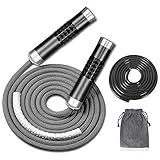
The Redify rope is listed at one pound with a tangle-free, ball-bearing design aimed at rapid skipping, and it is marketed for MMA, boxing and weight loss with aluminum handles. One pound is a modest weight, enough to feel heavier than a light speed rope but low enough that most beginners can keep a steady rhythm.
It suits people who want to try weighted skipping without a steep jump in difficulty, and boxers who want a rope that still turns quickly. The ball bearings help the cable rotate freely in the handles, which reduces tangling.
- Weight: 1 lb per the listing
- Mechanism: ball bearings, tangle-free design
- Handles: aluminum
- Marketed for: MMA, boxing, weight loss, rapid speed skipping
- Cable length and adjustability: confirm on listing
Pros
- Manageable weight for newcomers
- Bearings help smooth rotation
Cons
- Lighter than ropes aimed at strength training
- Length details need confirming
Aluminum handles are durable but can feel slippery when your hands are sweaty, so keep a towel or use chalk if grip becomes an issue.
A simple way to progress with a rope like this is to spend the first two weeks on the basic two-foot bounce, keeping the jumps small and landing softly on the balls of your feet. Once that feels automatic, add alternate-foot steps and a few boxer-style shuffles. When three minutes of steady work feels easy, you have a good indication it is time to try a heavier rope for short intervals.
Because bearings do the spinning, the rope should keep turning smoothly even when your technique is a little rough, which is forgiving when you are learning. Check that the handle ends are tightened and that the cable is secured at both sides before each session.
Compared with the 1.5 lb adult rope, the Redify is lighter, which makes it friendlier for beginners.
2. HPYGN 2.8 lb Heavy Jump Rope – Best for Experienced Jumpers

The HPYGN rope is the heaviest in the group at 2.8 pounds, listed at 9.2 feet and marketed for fitness, boxing and gym training, strength and building. At this weight the rope is a shoulder and core workout, and the rhythm will be much slower than with a light rope.
It suits strong, experienced jumpers who already have good rhythm and want short, intense intervals. Beginners will likely find it too heavy for continuous work, and some people may prefer to build up from a lighter rope first.
- Weight: 2.8 lb per the listing
- Length: 9.2 feet per the listing
- Marketed for: fitness, boxing, gym training, home workouts
- Handle material and adjustability: confirm on listing
- Bearing type: confirm on listing
Pros
- Strong stimulus for shoulders and forearms
- Stated length helps with sizing
Cons
- Too heavy for many beginners
- Fatigue sets in quickly, which can hurt form
Use it for intervals of 20 to 30 seconds followed by an equal rest, and stop when your shoulders start to burn so much that your elbows flare out.
At this weight, rope turns are slow, so the timing feels different. Think of it as a conditioning tool rather than a speed tool: keep the elbows close to the ribs, drive the rotation from the wrists and forearms, and avoid big arm circles that waste energy. Check your shoulders after each session; a little fatigue is expected, but sharp pain or pinching at the front of the shoulder is a signal to stop and get advice.
The stated 9.2-foot length is useful for sizing: it fits many adults of average to tall height, but shorter jumpers may need a smaller rope to avoid the cable dragging on the floor. If you are under about 5 feet 4 inches, look carefully at the length before choosing.
Compared with the KUZARO, the HPYGN is heavier and more specialized.
3. 1.5 lb Adult Weighted Jump Rope – Best Balanced Weight for Home Gyms
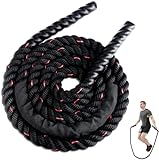
This listing is a 1.5-pound heavy jump rope for adults, positioned for home-gym exercise to improve strength and conditioning. A weight of 1.5 pounds is a common middle ground: heavy enough that your arms and shoulders notice it, light enough that most active adults can use it for intervals.
It suits people who want a single weighted rope to grow with them. Handle design, cable material and length are not in the visible title, so confirm those on the page, particularly if you are very tall or short.
- Weight: 1.5 lb per the listing
- Audience: adults, men and women
- Marketed for: home gym fitness, strength and conditioning
- Cable length and adjustability: confirm on listing
- Handle and bearing details: confirm on listing
Pros
- Versatile middle weight
- Suits many fitness levels
Cons
- Limited details in the title
- Length and construction need verification
Build up with three or four rounds of 30 seconds on and 30 off, then lengthen the work periods over a few weeks.
If you are between sizes, consider that a weighted cable is harder to shorten than a light PVC rope, so err on the side of the length listed for your height rather than buying a much longer rope and hoping to trim it. Keep the rope coiled loosely in a bag, not wrapped tightly around the handles, so the cable does not develop a permanent kink.
It is a useful pick for a household where more than one adult wants to use the same rope, because the middle weight works for a wide range of ability levels. Pair it with a lighter rope for warm-ups so each session starts gently.
Compared with the Redify, this rope is half a pound heavier, which suits people who already skip comfortably.
4. Mogold Weighted Jump Rope Set – Best for Combat-Sport Conditioning
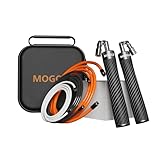
The Mogold listing describes a professional heavy-duty weighted skipping rope set with carbon fiber handles, aimed at high-intensity training, Muay Thai and MMA. The word set suggests extra pieces, such as interchangeable cables or weights, but the exact contents should be checked on the product page.
It suits fighters and conditioning-minded athletes who want a rope that feels solid and can handle regular use. Carbon fiber handles are generally light and stiff, which can help control at higher speeds.
- Type: weighted rope set
- Handles: carbon fiber per the listing
- Marketed for: high-intensity training, Muay Thai, MMA
- Rope weight and length: confirm on listing
- Included extras: confirm on listing
Pros
- Durable-sounding build aimed at combat athletes
- Set may offer flexibility
Cons
- Weight not shown in the visible title
- Set contents need verification
Use it for rounds that mimic a fight clock: three minutes on, one minute off, mixing steady skipping with higher-intensity bursts.
For combat athletes the rope serves two purposes: it builds the calf and shoulder endurance needed for later rounds, and it trains rhythm and footwork. Alternate steady skipping with brief bursts of faster turns, and include a few side-to-side and boxer-step rounds to mimic ring movement. If the set offers interchangeable parts, change one variable at a time so you can tell what works.
Handles that are light and stiff can make it easier to control a heavy cable, because the weight sits in the rope rather than in your hands. That is a general feature of lighter handle materials, so confirm how this particular set distributes its weight on the product page.
Compared with the Redify, the Mogold targets more advanced striking athletes, though the Redify also names MMA and boxing.
5. KUZARO Heavy Jump Rope – Best for Strength-Focused Home Workouts

The KUZARO listing is for a weighted jump rope aimed at women, though it is described as a heavy adult skipping rope for strength and home gym exercise equipment. The visible name does not state a weight, so confirm it before choosing, since heavier ropes require a different level of fitness.
It suits people building up conditioning at home who want a rope that is clearly heavier than a basic speed rope. Check the length and adjustability, which matter for comfortable use.
- Type: heavy weighted jump rope
- Audience: adults, with women named in the title
- Marketed for: strength, home gym exercise
- Weight and length: confirm on listing
- Handle and bearing details: confirm on listing
Pros
- Aimed at home strength and conditioning
- Heavier than a standard speed rope
Cons
- Weight not given in the title
- Specifics hidden behind the product page
As with any heavy rope, start with short rounds and a soft surface or a gym mat to reduce impact on your joints.
Because the title mentions women but the rope is described as a heavy adult skipping rope, the best way to choose is to look at the length chart and weight on the product page rather than the marketing wording. Anyone, whatever gender, can use any weight that matches their fitness and height. Place the rope on a mat in a clear area with plenty of overhead space before your first session.
Heavy ropes magnify errors in timing, so keep the first few sessions short and film yourself or use a mirror to check that your jumps stay low and your elbows stay close to your sides.
Compared with the HPYGN, the KUZARO is probably less extreme, but confirm the weight on the page.
6. Tangle-Free Ball Bearing Speed Rope – Best as a Light Speed-Rope Runner-Up
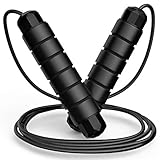
This product does not state a weight in its title and is described as a tangle-free rapid speed jumping rope with ball bearings, adjustable foam handles and a steel cable. That makes it a light speed rope, so it is included as a runner-up and a complement rather than a true weighted rope.
It suits people who want a fast rope for warm-ups, footwork and endurance rounds alongside a heavier weighted rope. The adjustable length is handy for sharing between jumpers.
- Type: speed rope, not listed as weighted
- Mechanism: ball bearings, tangle-free
- Cable: steel, per the listing
- Handles: adjustable foam
- Audience: women, men and kids per the title
Pros
- Fast rotation for speed work
- Adjustable length
Cons
- Not a weighted rope
- Steel cables can sting if they hit skin or wear on hard floors
Use it for warm-ups before a heavy rope session, and wear shoes. Replace worn coating as soon as you notice it.
A good pairing is a heavy rope for the main strength-endurance block and this lighter rope for the warm-up and the cool-down. Spend two or three minutes on it before your weighted rounds to get the shoulders and calves moving, and use it again for a couple of easy minutes at the end. Because steel cables are thin, be careful not to whip the rope across your ankles.
Kids and teens can use a rope like this for school fitness and sports practice, but younger children should always be supervised and should skip on a soft surface. Check the length adjustment instructions on the product page and trim any excess cable according to the manufacturer’s guidance.
Compared with the other five picks, this one is far lighter and is best treated as an accessory.
Specs Compared
| Product | Stated weight | Length | Handles | Notes |
|---|---|---|---|---|
| Redify 1 lb Rope | 1 lb | Confirm on listing | Aluminum | Ball bearings, tangle-free |
| HPYGN 2.8 lb Rope | 2.8 lb | 9.2 ft | Confirm on listing | Heavy skipping rope |
| 1.5 lb Adult Weighted Rope | 1.5 lb | Confirm on listing | Confirm on listing | Home gym adult rope |
| Mogold Weighted Rope Set | Confirm on listing | Confirm on listing | Carbon fiber | Set; Muay Thai and MMA use |
| KUZARO Heavy Jump Rope | Confirm on listing | Confirm on listing | Confirm on listing | Heavy rope for strength |
| Tangle-Free Ball Bearing Speed Rope | Not listed as weighted | Adjustable | Adjustable foam | Steel cable, ball bearings |
How We Chose These
This is a research-based comparison of the six listings supplied for the topic. We compared stated weights, lengths, handle materials, bearings and intended uses, and we read general coaching guidance on weighted rope weights, rope sizing and training structure. Where a listing does not give a measurement, we say to confirm it on the product page. One listing is not described as weighted, so it is placed as a runner-up and labeled plainly. This guide relies on documented specifications and published guidance, not on our own performance trials, and the order reflects how clearly each listing fits weighted-rope training for adults.
What to Look For
Weight: how heavy is heavy
Light speed ropes weigh a few ounces. Weighted ropes typically run from about 1 to 3 pounds. Coaching guides generally treat 1 to 2 pounds as the useful range for strength-oriented jumping, with lighter weights better for continuous cardio. A sensible rule: if you can jump a 1-pound rope for three minutes with steady rhythm, 1.5 pounds is a reasonable next step. If your shoulders burn out before 30 seconds, drop back a level. Heavier ropes are best for short intervals, not long steady sessions.
Length and sizing
A common rule is that the rope should be about three feet longer than your height. Weighted ropes are often fixed in length because the thick cable is hard to cut, so choose the size before buying. One practical check is to stand on the middle of the rope and pull the handles up: for beginners they should reach about armpit height, and for advanced jumpers they can be lower on the chest. A 9-foot rope suits many adults of average height; shorter athletes may find it too long and tall athletes may need more. Also consider ceiling height, because a longer rope needs more clearance.
Handles, bearings and cable
Ball bearings let the cable spin freely so it does not twist, and they usually matter more for speed ropes than for heavy ropes. Handle material affects grip: foam is comfortable, aluminum is durable but can be slippery, and carbon fiber is light and stiff. Cable coating protects floors and extends rope life, while bare steel cables wear quickly on rough surfaces. Check whether the handles or the cable carry the weight, because weighted handles feel different from a weighted cable.
Technique, surface and a worked example
Weighted ropes reward small, controlled wrist circles and a relaxed shoulder. Jump on a forgiving surface such as a gym floor, rubber mat or wooden floor, and avoid concrete. A beginner example: warm up for five minutes, then do six rounds of 20 seconds of jumping and 40 seconds of rest with a 1-pound rope, adding one round a week. A more advanced session is eight rounds of 30 seconds on and 30 seconds off with a 1.5 to 2 pound rope. Stop if you feel sharp pain in the shins, knees or shoulders, and build up gradually because the calves and Achilles tendons take time to adapt.
Who benefits and who should wait
Weighted rope work suits people who already tolerate impact exercise and want more upper-body demand: boxers, martial artists, general fitness athletes and anyone adding variety to cardio. It is less suitable for people with recent lower-leg or Achilles problems, shoulder pain, balance concerns, or those who are very new to exercise. In those cases, start with brisk walking, step-ups or a light rope, and check with a clinician if you have a medical condition.
It also helps to think about space and noise. A heavy rope hitting a hard floor can be loud and can chip a floor, and a long rope needs overhead clearance of roughly its length. Mark out a clear area, jump on a mat if you live above neighbors, and keep pets and children away while you swing. Check the cable and handle attachments before every session; a loose handle at speed can be dangerous.
Questions
Is a weighted jump rope better than a regular one?
It depends on your goal. Weighted ropes build shoulder, forearm and core endurance and add a strength element, while light speed ropes are better for fast footwork and long cardio sessions. Many people use both.
What weight should I start with?
Most beginners do well starting at about 1 pound. If you are already comfortable with basic skipping, 1.5 pounds is a good next level, and ropes near 3 pounds are best left to experienced jumpers.
How long should the rope be?
A good estimate is your height plus about three feet, or a size chart from the manufacturer. Since heavy ropes are often not adjustable, check the length before ordering.
Can a weighted jump rope help with weight loss?
Jumping rope burns energy, and heavier ropes make the work harder, but results depend on overall diet, sleep and consistency. A rope is a tool, not a guarantee.
Will a weighted rope hurt my joints?
Jumping is a high-impact activity, so use a forgiving surface, wear supportive shoes and build up gradually. If you have joint or heart concerns, talk to a clinician before starting.
Do I need ball bearings?
They make rotation smoother and reduce tangling, which is helpful, but a well-made heavy rope can work without them. Check the product page for bearing details.
Update History
- October 20, 2026 – Initial publication; product set drawn from current catalog listings.
- Check the product page for current specifications and availability before buying.
Sources
- Retailer listing titles and specification fields for each product
- Jump rope coaching and equipment guides covering weighted rope weights, rope sizing and technique




Write Your Review
No reviews yet. Be the first to share your experience!