

Key takeaways
- The best mixed-signal oscilloscopes with serial decoding compared: logic channels, bandwidth, sample rates and I2C, SPI, UART, CAN and LIN bus support.
As an Amazon Associate, we earn from qualifying purchases made through links on this page.


Debugging an embedded board usually means watching two kinds of signals at once: the analog waveform on a power rail or sensor line, and the digital traffic moving between a microcontroller and its peripherals. A mixed-signal oscilloscope, or MSO, handles both jobs in one instrument. It pairs conventional analog channels with a bank of digital logic channels, so you can see a clock edge, the data lines it drives, and the decoded contents of an I2C, SPI, UART, CAN or LIN transaction on a single time-aligned display.
That combination matters because serial decoding on analog channels alone only tells half the story. Decoding shows you what a bus said; the logic channels show you exactly when every line changed state relative to the analog signals around it. If you are chasing a missed acknowledgement, a glitching chip-select line or a sensor that answers too late, an MSO with serial decoding is the tool built for the job.
The five instruments below are all true mixed-signal models with manufacturer-published serial decoding support. They differ in how the logic channels are supplied, whether decoding is included in the base instrument or licensed separately, and how much analog performance you get. Read the notes on options carefully: on some models the badge on the front panel is only the start of the shopping list.
What to look for
A real logic input, not just serial triggering. Many ordinary oscilloscopes advertise serial triggering and decoding on their analog channels. That is useful, but it is not an MSO. A mixed-signal model adds a dedicated digital input, typically 16 logic channels, with its own threshold settings and timing. Check whether the logic probe is included in the box, sold as a separate accessory, or activated by a software licence on top of the probe. Two of the models below need an optional probe before a single digital channel works.
Whether decoding is included or licensed. This is the biggest hidden difference between brands. Siglent and GW Instek include the common protocol decoders in the base instrument on the models listed here, and Rigol includes them on the DHO900 series. On the Rigol MSO5000 series, decoding is sold as individual licences or as a bundle. Neither approach is wrong, but the total cost of the configuration you actually need depends on it, so confirm the licence status of each protocol before you buy.
Protocol coverage. I2C, SPI and UART (RS232) decoding covers most bench work with microcontrollers and sensors. Automotive and industrial work adds CAN and LIN. Beyond those, some platforms extend to CAN FD, FlexRay, I2S or MIL-STD-1553, usually as paid options. Match the list to the buses on your boards rather than paying for protocols you will never probe.
Bandwidth and sample rate. Bandwidth should exceed the fastest edge content you need to see, not just the clock frequency. Sample rate is shared on most of these instruments: the headline figure usually applies with half the channels active, and drops when all channels run. Deep memory matters for serial work because a long capture at a high sample rate is what lets you record a full transaction and zoom into individual bits afterwards.
Analog resolution and display. Most models here use 8-bit converters, some with a high-resolution mode that trades bandwidth for extra bits. The Rigol DHO900 entry is a native 12-bit design, which helps when you are examining small signals riding on larger ones. A large touchscreen also speeds up decode setup, event search and navigation through long records.
Siglent SDS2104X Plus
The SDS2104X Plus is the 100 MHz entry point in Siglent’s SDS2000X Plus family, and it is the decoding value of this group because the licence structure is simple. Siglent includes I2C, SPI, RS232/UART, CAN and LIN trigger and decode in the standard instrument, and lists CAN FD, FlexRay, I2S and MIL-STD-1553 as further options. The scope has four analog channels, a maximum sample rate of 2 GSa/s, up to 200 Mpts of memory per channel, and a 10.1-inch capacitive touchscreen.
- View it on Amazon: https://www.amazon.com/dp/B08M9ZYCCD
Mixed-signal capability comes from the optional SLA1016 logic probe, which adds 16 digital channels; the MSO function is an option, so budget for the probe before counting on logic channels. Analog conversion is 8-bit with a 10-bit high-resolution mode, and the bandwidth of this model can be upgraded by licence later, which gives the instrument a longer useful life than its entry specification suggests.
This model suits embedded developers who want decoding active from day one without licence paperwork, and who mainly work below 100 MHz. Its limitations follow from the specification: the sample rate is shared, so it falls when all four analog channels and the logic pod run together, the logic probe is an extra purchase, and teams needing the extended automotive and audio protocols have to add those licences separately.
Rigol DHO924S
The DHO924S is the compact, high-resolution entry. It provides four analog channels at 250 MHz with a 12-bit converter, a maximum sample rate of 1.25 GSa/s and 50 Mpts of memory, in a small chassis with a 7-inch touchscreen. Rigol builds a 25 MHz function and arbitrary waveform generator into the S models, along with Bode plot analysis, which makes this a useful single-box bench for power and embedded work.
- View it on Amazon: https://www.amazon.com/dp/B0CGHTLRHS
The front panel carries a logic analyzer input for 16 digital channels, driven by the optional PLA2216 probe, which is sold separately. Serial decoding is a strength: Rigol includes I2C, SPI, RS232/UART, CAN and LIN decoding on the DHO900 series as standard, so the protocol tools work without licence purchases once the probe question is settled for digital work, and the analog channels decode on their own as well.
Choose this model if vertical resolution matters to your measurements, for example when examining ripple, sensor outputs or slow analog behaviour around digital events, and if bench space is tight. Its limits are equally clear in the specification: the 1.25 GSa/s sample rate is shared across channels, memory is shallower than the Siglent and MSO5000 entries, and the logic probe is an additional accessory rather than an included one.
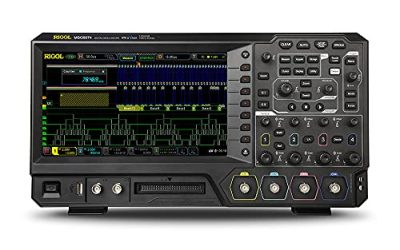
Rigol MSO5074
The MSO5074 is the performance step in this roundup. It combines four analog channels at 70 MHz with an 8 GSa/s maximum sample rate, 100 Mpts of standard memory that can be extended to 200 Mpts by licence, and a waveform capture rate of up to 500,000 waveforms per second on Rigol’s UltraVision II platform. A 9-inch capacitive touchscreen runs the interface, and the bandwidth can be raised through licence upgrades after purchase.
- View it on Amazon: https://www.amazon.com/dp/B07PC2B7CY
Digital capability is 16 channels through the PLA2216 logic probe, again an optional accessory. Serial analysis is where this model demands the closest reading of the options list: decoding is licensed per protocol family. Rigol sells an embedded bundle covering I2C and SPI, a computer serial option for RS232/UART, an automotive option for CAN and LIN, and further options for FlexRay, I2S and MIL-STD-1553, or the MSO5000-BND bundle that combines all of the serial options with the waveform generator and power analysis functions.
This is the pick for engineers who need the deep memory and fast capture for intermittent faults, and who are comfortable speccing licences deliberately. The honest limitations are the 70 MHz base bandwidth, the lowest in this group until upgraded, and the fact that both the logic probe and every decode protocol sit behind additional purchases, so the base instrument alone does not deliver the full mixed-signal workflow.
GW Instek MSO-2074E
The MSO-2074E takes the opposite approach to options: the 16-channel logic analyzer is built into the instrument as standard equipment rather than added through a pod and licence. It provides four analog channels at 70 MHz, a maximum real-time sample rate of 1 GSa/s, 10 Mpts of analog memory and 10 Mpts per channel on the digital side, behind an 8-inch display with conventional bench controls.
- View it on Amazon: https://www.amazon.com/dp/B0714N8TJP
GW Instek also includes the bus tools in the base specification. The standard trigger and decoding set covers I2C, SPI, UART in RS232, RS422 and RS485 forms, and CAN and LIN for automotive communication, plus a parallel bus function that works on the digital channels. The logic input accepts a minimum swing of plus or minus 250 mV according to the manufacturer, which helps with low-voltage logic families.
This model fits teaching labs, service benches and embedded workshops that want the complete mixed-signal feature set working out of the box with nothing else to license. The trade-offs are visible in the numbers: bandwidth and sample rate are the most modest here alongside the MSO5074, the display is smaller and not a touchscreen, and the platform is an older design than the Rigol and Siglent entries, so interface speed and memory depth lag behind them.
Siglent SDS2204X Plus
The SDS2204X Plus is the 200 MHz version of the Siglent platform described above, and it exists in this list for buyers whose signals outgrow the 100 MHz model. It keeps the same architecture: four analog channels, 2 GSa/s maximum sample rate, up to 200 Mpts of memory per channel, the 10.1-inch touchscreen, and the same serial decoding package with I2C, SPI, RS232/UART, CAN and LIN included as standard and the extended protocols available as options.
- View it on Amazon: https://www.amazon.com/dp/B08KJJ5C59
Mixed-signal work again runs through the optional SLA1016 probe for 16 digital channels, and the bandwidth can be licensed upward after purchase in the same way as the rest of the family. Because the two Siglent models share firmware and menus, a lab that standardises on this platform can move between benches without relearning the decode setup.
Pick this one if you want the included decoding of the SDS2104X Plus but work with faster clocks, switching converters or serial links whose edges need the extra bandwidth headroom. Its limitations mirror its sibling: the logic probe is a separate accessory, the shared sample rate drops with every channel active, and buyers who do not need 200 MHz gain nothing over the less powerful model in the pair.
Comparison table
| Model | Analog channels | Logic channels | Bandwidth | Max sample rate | Memory | Serial decoding |
|---|---|---|---|---|---|---|
| Siglent SDS2104X Plus | 4 | 16 via optional SLA1016 probe | 100 MHz | 2 GSa/s | 200 Mpts per channel | I2C, SPI, UART, CAN, LIN included; more as options |
| Rigol DHO924S | 4 | 16 via optional PLA2216 probe | 250 MHz | 1.25 GSa/s | 50 Mpts | I2C, SPI, UART, CAN, LIN included |
| Rigol MSO5074 | 4 | 16 via optional PLA2216 probe | 70 MHz | 8 GSa/s | 100 Mpts, 200 Mpts optional | Licensed per protocol or as a bundle |
| GW Instek MSO-2074E | 4 | 16 built in | 70 MHz | 1 GSa/s | 10 Mpts, 10 Mpts per digital channel | I2C, SPI, UART, CAN, LIN included |
| Siglent SDS2204X Plus | 4 | 16 via optional SLA1016 probe | 200 MHz | 2 GSa/s | 200 Mpts per channel | I2C, SPI, UART, CAN, LIN included; more as options |
FAQ
What makes an oscilloscope a true MSO?
A true mixed-signal oscilloscope has a dedicated digital input with its own logic channels, threshold control and timing, in addition to the analog channels. A standard oscilloscope that decodes serial data on its analog channels is still useful, but it cannot show sixteen digital lines time-aligned with the analog traces, which is the defining MSO capability.
Do I need the logic probe if I only decode I2C or SPI?
Not always. On these models the analog channels can trigger on and decode common serial buses by themselves, which is enough for slow buses with two or three lines. The logic probe earns its place when you need many lines at once, such as a parallel bus, several chip selects, or a full set of control signals watched alongside the decoded data.
Is serial decoding included or an extra licence?
It depends on the brand and series. On the Siglent SDS2000X Plus models, the GW Instek MSO-2000E and the Rigol DHO900 series, the common protocols are included in the base instrument according to the manufacturers. On the Rigol MSO5000 series, decoding is sold as per-protocol licences or as a combined bundle, so check the configuration before ordering.
How much bandwidth does serial decoding need?
Decoding itself works at modest bandwidths because the data rates are low, but triggering reliably and seeing signal integrity problems, such as slow edges, ringing or glitches on a clock line, needs bandwidth headroom above the bus clock rate. Buy bandwidth for the fastest edges on your board, not for the protocol name.
Can these instruments decode CAN FD or automotive buses beyond CAN and LIN?
CAN and LIN are the standard automotive pair across this group. CAN FD, FlexRay, I2S and MIL-STD-1553 exist on the Siglent platform as additional options, and on the Rigol MSO5000 through its automotive, flex, audio and aero licences. Confirm the exact licence for your bus before purchase, because support varies by model and firmware.
Conclusion
The right choice here is mostly a question of how each maker packages the two halves of a mixed-signal instrument. If you want decoding active immediately and a large touchscreen, the Siglent SDS2104X Plus is the straightforward default, and the SDS2204X Plus doubles its bandwidth for faster work. The GW Instek MSO-2074E is the only model in this group with the logic analyzer built in as standard, which suits labs that dislike licence management. Rigol splits its answer in two: the DHO924S pairs included decoding with a 12-bit converter in a compact box, while the MSO5074 trades licence simplicity for the deepest memory and fastest sampling here. Whichever direction you take, verify the logic probe and decode licence status of the exact configuration you are ordering, because that is where the real differences between these five instruments live.
More from Amazon
Programs that pair well with the guide above. Offers and eligibility are set by Amazon and may change.
Free shipping on eligible items, Prime Video and more. Eligible new members can start with a free trial.
Start a Prime free trialAudiobooks and podcasts to listen to on the go. Eligible new members can start with a free trial.
Try Audible freeAd-free music streaming. Eligible new subscribers can start with a free trial.
Try Music Unlimited freeA free business account with business pricing and bulk-buying tools for work, shop or home office.
Create a business accountAs an Amazon Associate we earn from qualifying purchases.



Write Your Review
No reviews yet. Be the first to share your experience!