

Key takeaways
- Compare the best mixed-signal oscilloscopes with FFT analysis for embedded debugging, spectrum checks and logic timing, with real specs and buying guidance.
Buying a mixed-signal oscilloscope for FFT work is not the same as buying a general bench scope. The real decision is whether the instrument can show you a clean, trustworthy spectrum at the frequencies you actually work with, while still capturing the analog and digital signals that produced it at the same time. A scope with weak FFT controls, shallow memory, or too little bandwidth will leave harmonics buried in noise, and a scope without enough digital channels will force you to debug timing problems one signal at a time.


This guide is for embedded engineers tracing noise and clock problems, electronics hobbyists debugging microcontroller boards, students learning signal analysis on a portable setup, and repair technicians who need spectrum views alongside logic timing. The four picks below were chosen from their Amazon listing names and specifications: two Rigol MSO5000 models, a 12-bit Siglent bench scope, and a pocket-sized Digilent instrument that pairs a mixed-signal front end with FFT software.
Quick Picks
As an Amazon Associate we earn from qualifying purchases.
| Product | Best for | Key spec from title |
|---|---|---|
| RIGOL MSO5074 | Embedded debugging on a bench | 70 MHz, 4 channels, 8 GSa/s |
| RIGOL MSO5104 | Higher-frequency mixed-signal work | 100 MHz, 4 channels, 8 GSa/s |
| Siglent SDS1104X HD | High-resolution FFT measurements | 100 MHz, 4 channels, 12-bit |
| Digilent Analog Discovery 3 | Portable learning and field analysis | 125 MS/s, 2 analog plus 16 digital channels |
How to Choose
Bandwidth and sample rate decide what the FFT can see
Bandwidth sets the highest frequency your scope can measure honestly, and the sample rate sets how finely the FFT can resolve the spectrum. A 70 MHz scope can be enough for microcontroller clocks, switching regulators, and audio work, while a 100 MHz model gives more headroom for faster edges and harmonics. Look for a sample rate several times higher than the fastest signal you expect, because FFT math needs enough samples per cycle to place peaks accurately. The Rigol models in this guide sample at up to 8 GSa/s, which leaves generous margin at their rated bandwidths, while the Siglent samples at 2 GSa/s with 12-bit resolution that keeps small spectral details visible.
Check how the FFT itself is implemented
Not every FFT is equally useful. The number of FFT points, the choice of window function, and the way the scope handles span and center frequency all shape what you can learn from a spectrum. More FFT points mean finer frequency resolution, which matters when two tones sit close together, and a rectangular window suits transient signals while Hann or Blackman windows reduce leakage on steady tones. Before buying, confirm the scope offers at least a 1K-point FFT with selectable windows and a way to zoom into a narrow span around a frequency of interest. All four picks here provide FFT views, with the Digilent relying on its WaveForms software for spectrum and spectrogram displays.
Count the digital channels you will actually use
The point of a mixed-signal oscilloscope is watching analog and digital signals together, so the digital channel count matters as much as the analog side. Sixteen digital channels let you capture a full parallel bus or several serial lines at once, while eight channels may be enough for a single SPI or I2C link plus a clock. Check whether the logic probe is included in the box, because several bench models sell it separately and the scope cannot use its digital inputs without it. Also confirm the digital sample rate and whether the logic channels share memory with the analog channels, since that affects how long a capture you can record.
Memory depth and capture rate shape long FFT records
Deep memory lets the FFT work on a long record, which improves frequency resolution without forcing you to slow the time base to a crawl. A 100 Mpts record can hold a long burst of data at a high sample rate, so you can find an intermittent spur and still resolve it in the spectrum. Waveform capture rate matters too: a scope that refreshes tens of thousands of waveforms per second is more likely to catch a rare glitch that a slow scope would miss entirely. If your work involves hunting occasional interference or power-supply noise, favour the deepest memory and the fastest capture rate your budget allows.
The N Best Options
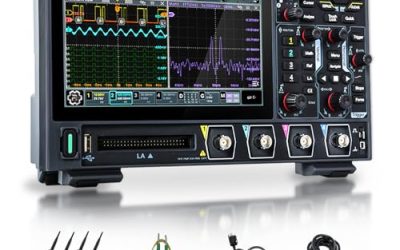
RIGOL MSO5074
The Rigol MSO5074 is the most balanced bench pick for engineers who debug microcontroller boards and switching power supplies every day. Its four analog channels and sixteen digital inputs cover a full mixed-signal setup, and the built-in FFT turns the scope into a basic spectrum analyser for tracking harmonics, clock spurs, and switching noise without moving the board to another instrument. The large touchscreen and UltraVision interface keep the FFT controls close at hand, so changing span or window type does not interrupt the debugging flow.
Specs
- Bandwidth: 70 MHz
- Channels: 4 analog plus 16 digital inputs
- Maximum sample rate: 8 GSa/s
- Memory depth: 100 Mpts analog
- FFT math function with spectrum display
Best for: Embedded engineers who want a full bench mixed-signal scope with FFT for everyday debugging.
Watch out for: The PLA2216 logic probe is needed to use the 16 digital channels, so confirm whether your listing is the base unit or the LA KIT version before ordering.
RIGOL MSO5104
The Rigol MSO5104 takes the same MSO5000 platform as the MSO5074 and raises the analog bandwidth to 100 MHz, which makes it the better choice when faster edges and higher harmonics matter to your FFT measurements. It keeps the four analog channels, sixteen digital inputs, 8 GSa/s sampling, and 100 Mpts of memory, so the upgrade is purely about frequency headroom rather than a different workflow. That makes it a straightforward step up for labs that already know the Rigol interface and want cleaner spectra above 70 MHz.
Specs
- Bandwidth: 100 MHz
- Channels: 4 analog plus 16 digital inputs
- Maximum sample rate: 8 GSa/s
- Memory depth: 100 Mpts analog
- FFT math function with spectrum display
Best for: Labs and engineers who need 100 MHz of bandwidth for faster digital signals and harmonic analysis.
Watch out for: As with the MSO5074, the digital channels need the PLA2216 logic probe, so check whether the listing you choose includes it or sells it separately.
Siglent SDS1104X HD
The Siglent SDS1104X HD stands out in this group because of its 12-bit analogue-to-digital converters, which give its FFT display a lower noise floor and finer detail than typical 8-bit scopes. Small spurs and low-level harmonics that would sink into the noise on a standard scope stay visible here, which matters for power integrity work and sensitive analogue measurements. Its 100 MHz bandwidth and four analog channels cover most embedded and analogue work, and the touchscreen interface makes it easy to adjust FFT span, scale, and window settings while watching the spectrum update.
Specs
- Bandwidth: 100 MHz
- Channels: 4 analog plus 16 digital with option
- Maximum sample rate: 2 GSa/s
- Resolution: 12-bit
- Memory depth: 100 Mpts
- Waveform capture rate: up to 500,000 wfm/s in sequence mode
Best for: Engineers and technicians who need low-noise, high-resolution FFT spectra for power and analogue measurements.
Watch out for: The 16 digital channels require the SDS1000XHD-16LA option and the SLA1016 logic probe, both sold separately, so budget for those if you need logic capture.
Digilent Analog Discovery 3
The Digilent Analog Discovery 3 is a completely different kind of mixed-signal oscilloscope: a pocket-sized USB instrument that turns a laptop into a bench with an oscilloscope, logic analyser, waveform generator, and spectrum analyser. Its WaveForms software provides FFT, spectrogram, and spectrum analyser views, which makes it a strong learning tool for students and a handy second instrument for engineers who work away from the bench. Two differential analogue inputs and sixteen digital channels cover most microcontroller and sensor projects, and the whole kit fits in a bag.
Specs
- Analog channels: 2 differential inputs
- Digital channels: 16
- Maximum sample rate: 125 MS/s per channel
- Resolution: 14-bit
- Bandwidth: 30+ MHz with BNC adapter
- FFT, spectrogram, and spectrum analyser views in WaveForms software
Best for: Students, hobbyists, and field engineers who want portable mixed-signal and FFT analysis on a laptop.
Watch out for: The 30+ MHz bandwidth figure applies with the BNC adapter, and the analogue inputs are differential with a limited input range, so check probe and adapter compatibility with your circuits before ordering.
Which One Fits Your Situation
Everyday embedded debugging on a bench
Choose the RIGOL MSO5074. Its 70 MHz bandwidth covers microcontroller clocks and switching regulators, the four analog channels plus sixteen digital inputs capture a whole bus at once, and the built-in FFT shows harmonics and switching noise without a second instrument. It is the most complete bench setup here for the money spent on a single instrument.
Faster signals and higher harmonics
Choose the RIGOL MSO5104. It shares the MSO5074 platform, including the 8 GSa/s sampling and 100 Mpts memory, but the 100 MHz bandwidth gives cleaner measurements on faster edges and higher harmonics. If your FFT work regularly reaches past 70 MHz, the extra headroom is worth having from the start.
Low-noise spectrum measurements
Choose the Siglent SDS1104X HD. Its 12-bit converters and low noise floor keep small spurs visible in the FFT display, which is exactly what power integrity and sensitive analogue work demand. The 100 Mpts memory also supports long FFT records, so you can resolve closely spaced tones in a single capture.
Portable learning and field work
Choose the Digilent Analog Discovery 3. It packs a mixed-signal oscilloscope, logic analyser, and FFT-capable spectrum views into a USB device that runs from a laptop, which suits students, hobbyists, and engineers who measure away from a bench. The WaveForms software adds spectrogram and network analyser views that no standalone bench scope in this group offers in one package.
Common Mistakes
- Buying a scope whose bandwidth is too low for the harmonics you need to see, then wondering why the FFT shows nothing above a certain frequency.
- Assuming the digital channels work out of the box, when several bench models need a logic probe or a paid option before the logic inputs do anything.
- Running the FFT on too short a record, which spreads spectral energy and hides closely spaced tones that a longer capture would resolve.
- Using the wrong window function, such as a rectangular window on a steady tone, which creates leakage that looks like extra signals in the spectrum.
- Forgetting that the FFT shows the signal as the probe sees it, so a poor probe connection or missing ground lead can create spectral artefacts that are not in the circuit at all.
Frequently Asked Questions
What bandwidth do I need for FFT analysis on a mixed-signal oscilloscope?
Bandwidth needs to cover the highest harmonic you want to see, not just the fundamental frequency of your signal. For microcontroller work at tens of megahertz, a 70 MHz scope is often enough, while faster edges and RF-adjacent signals call for 100 MHz or more. Remember that the FFT can only display frequencies the front end passes cleanly, so a scope that rolls off early will hide the harmonics you are trying to find.
Do I need 16 digital channels, or will fewer be enough?
Sixteen digital channels are worth having when you capture a parallel bus or several serial links at once, because you can watch the whole transaction in one record. For a single SPI or I2C link with a clock line, fewer channels can be enough. Check whether the logic probe is included, since the digital inputs on some bench models stay unusable until you add it.
Why does my FFT look noisy even on a clean signal?
A noisy FFT usually comes from a short record, the wrong window function, or a poor probe connection rather than a noisy circuit. Lengthen the record to improve frequency resolution, try a Hann window on steady tones, and check the probe ground lead first. On an 8-bit scope, small signals also sit closer to the quantisation noise floor, which is one reason the 12-bit Siglent in this guide shows cleaner spectra.
Can a USB oscilloscope replace a bench mixed-signal scope for FFT work?
A USB instrument such as the Analog Discovery 3 can handle learning, hobbyist, and many field measurements, especially since its software adds FFT, spectrogram, and spectrum analyser views. A bench scope still wins for higher bandwidth, deeper memory, faster capture rates, and standalone operation without a laptop. Choose the USB option for portability and value, and the bench option when bandwidth and capture depth decide the measurement.
More from Amazon
Programs that pair well with the guide above. Offers and eligibility are set by Amazon and may change.
Free shipping on eligible items, Prime Video and more. Eligible new members can start with a free trial.
Start a Prime free trialAudiobooks and podcasts to listen to on the go. Eligible new members can start with a free trial.
Try Audible freeAd-free music streaming. Eligible new subscribers can start with a free trial.
Try Music Unlimited freeA free business account with business pricing and bulk-buying tools for work, shop or home office.
Create a business accountAs an Amazon Associate we earn from qualifying purchases.


Write Your Review
No reviews yet. Be the first to share your experience!