

Key takeaways
- Stay clear of the line of fire. A ball can ricochet off the frame or pass through a torn panel. Anyone feeding balls in soft toss should use a protective L-screen, which is a separate product from a hitting net.
- Leave space behind and beside the net. Keep windows, cars and people out of the area behind it, since a miss or a rip can send balls past it.
- Anchor the frame. Use the included stakes on grass or sandbags on hard ground. Pop-up nets catch wind like a sail.
- Inspect before each session. Look for frayed edges, pilled spots near the center and loose seams. Retire a net that is thinning in the impact zone.
- Store dry. Fold the net only when dry and keep it out of long direct sun, which weakens polyester over time. Sun and moisture also shorten the life of cheap fiberglass bows.
- Match ball type to net. Some nets are rated for baseballs, others for softballs or wiffle balls only. Follow the maker’s listed ball types and age guidance.
A 7×7 foot pop-up net with a fiberglass frame and a knotless polyester panel suits most families and youth players, while a heavier steel-frame net with thicker netting suits coaches and daily hitters who go through hundreds of balls a week. The right choice comes down to how often you hit, who is hitting, and whether the net has to travel or can stay in one place all season.
Our top picks



As an Amazon Associate we earn from qualifying purchases at no extra cost to you.
Best Baseball Hitting Nets at a Glance
| Net | Best for | Key stated specs | Limits |
|---|---|---|---|
| Rukket 7×7 Pop-Up | Fast setup, travel, general backyard use | Fiberglass frame, 160-denier knotless polyester, about 8 lb, setup near 90 seconds, lifetime warranty listed | Tight carry bag; moderate wind resistance |
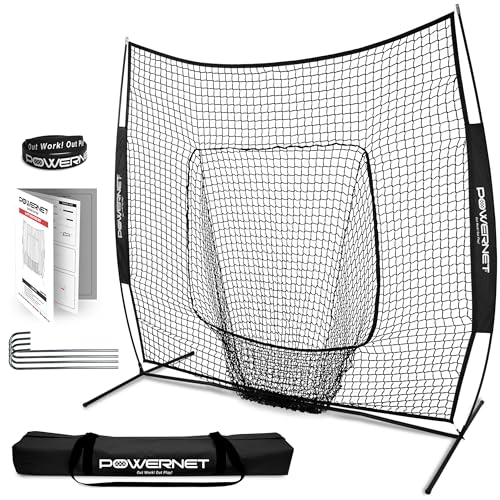
| PowerNet 7×7 DLX | All-round value with a strike zone target | Steel and fiberglass hybrid frame, 160-denier knotted polyester, about 7.5 lb, setup near 3 minutes | More frame pieces to manage; some pilling in the center after heavy use |
| GoSports 7×7 | Backyard players who want a deep ball pocket | 7×7 foot hitting area; reviewers cite roughly 90-second setup and a pocket that gathers balls | Pop-up frames shift in gusts without stakes |
| SKLZ Quickster Sport Net | Light, multi-sport use | Steel frame, about 9 lb, setup near 2 minutes | Thinner material, wear in the center, no target or ball pocket |
| Galileo Heavy Duty | Teams, coaches, high volume | Steel frame, 210-denier polyester, about 11 lb, setup near 5 minutes | Slowest to assemble, heaviest, limited availability |
| Easton Pop-Up Practice Net | Casual, short-season use | Dual-bow fiberglass frame, 150-denier polyester, about 8.5 lb, setup near 60 seconds | Thinnest netting in one comparison; poor wind resistance |
| Bownet Big Mouth X | Serious daily hitters | Wide-mouth design aimed at heavy use; one outlet calls it worth it only for frequent players | Premium tier; overkill for casual swings |
Figures for frame, denier, weight and setup time above come from the Batting Leadoff comparison of five nets; the maker-level details for the GoSports and Bownet entries come from outlets such as Sarah Lee and Johnny and ACFC. Always read the maker’s own listing for exact dimensions before buying, because sizes and kit contents change between production runs.
What Matters Most in a Hitting Net
Net size and the strike zone
Review outlets agree that 7×7 feet is the most common size because it balances coverage and portability. A net that wide catches most mishits from a youth or teenage swing, and it folds down to a size that fits a trunk or garage shelf. Smaller nets are easier to store but reward only clean contact. Larger cage-style frames, such as the 12 by 14 foot models Batting Leadoff rates for permanent installs, are a different category and need real space and ground anchoring.
A printed strike zone target, as found on several PowerNet and Rukket kits, helps young players learn location. It does not change how the net performs, so it is a nice extra rather than a deciding factor.
Netting thickness
Denier measures thread weight. In the Batting Leadoff comparison, the Galileo used 210-denier polyester, the PowerNet and Rukket used 160-denier, and the Easton used 150-denier. That reviewer reported zero tears on the Rukket after more than 2,500 baseballs, mild pilling on the PowerNet after about 2,000 hits, visible fraying in the SKLZ center zone and pilling by week six on the Easton. Treat those as one reviewer’s observations rather than guarantees, but the pattern is consistent: thicker netting lasts longer under repeated baseball impact.
Knotless netting is generally described as gentler on balls and quieter on impact, while knotted netting can be tougher at the stress points. Neither is wrong; match it to your volume of hitting.
Frame type: fiberglass bows versus steel
Pop-up nets use flexible fiberglass bows that spring open and twist closed. They set up in about one to two minutes and weigh little. The trade-off is that they can tip or slide when the wind picks up, and a hard line drive can flex the frame. Steel or steel-hybrid frames take more time to build, but they stay rigid and resist movement. If the net lives in one spot all summer, a steel frame is easier to trust. If it goes to the park and back every week, the pop-up wins.
Ball pocket and collection
A deep pocket at the bottom guides balls toward the center, which cuts the time spent chasing them. Reviewers praise this on the GoSports and note its absence on the SKLZ and Easton. For soft toss or tee work, a pocket noticeably speeds up a session because you can reload without walking across the yard.
Budget Tiers Explained
Budget tier
Budget nets such as the BAGAIL 7×7 appear in ACFC’s roundup as the strongest low-cost option, with a two-year warranty listed. At this tier expect thinner netting, lighter frames and simpler kits. These suit a kid who swings a few times a week, a family that wants to try the habit, or a second net kept at a grandparent’s house.
Mid-range tier
ACFC places the sweet spot for most buyers between the budget and premium extremes, which is where the PowerNet 7×7, Rukket 7×7 and GoSports 7×7 sit. These nets typically include a carry bag, a target, stakes or sandbags, and a warranty. Reviewers consistently name them as the best balance of price, setup speed and durability.
Premium tier
The Bownet Big Mouth family and the Galileo Heavy Duty net sit at the top. ACFC says the Big Mouth X is worth it for serious daily use but that casual players will not notice the difference. Coaches running group sessions or parents of travel-ball players hitting every day are the buyers who benefit.
Safety, Placement and Care
- Stay clear of the line of fire. A ball can ricochet off the frame or pass through a torn panel. Anyone feeding balls in soft toss should use a protective L-screen, which is a separate product from a hitting net.
- Leave space behind and beside the net. Keep windows, cars and people out of the area behind it, since a miss or a rip can send balls past it.
- Anchor the frame. Use the included stakes on grass or sandbags on hard ground. Pop-up nets catch wind like a sail.
- Inspect before each session. Look for frayed edges, pilled spots near the center and loose seams. Retire a net that is thinning in the impact zone.
- Store dry. Fold the net only when dry and keep it out of long direct sun, which weakens polyester over time. Sun and moisture also shorten the life of cheap fiberglass bows.
- Match ball type to net. Some nets are rated for baseballs, others for softballs or wiffle balls only. Follow the maker’s listed ball types and age guidance.
Pick This Net If You Fit This Profile
| Pick this if you… | Choose | Why |
|---|---|---|
| Want the quickest setup for park trips | Rukket 7×7 Pop-Up or Easton Pop-Up | Setup is listed near 60 to 90 seconds with light frames |
| Want a balanced all-round backyard net | PowerNet 7×7 DLX or GoSports 7×7 | Common mid-range picks with targets and pockets |
| Hit hundreds of balls each week | Galileo Heavy Duty or Bownet Big Mouth X | Thicker netting and sturdier construction |
| Need one net for several sports | SKLZ Quickster Sport Net | Light and flexible, but accept thinner material |
| Are on a tight budget | BAGAIL 7×7 | Highest-rated low-cost option in ACFC’s roundup |
| Want a tee included for youth | VIVOHOME 7×7 with tee | Bundle suited to youth teams per reviewers |
| Have room for a permanent setup | A cage-style frame such as the Fortress Pro | Batting Leadoff rates it best overall among cages |
Alternatives to a Standard Hitting Net
Batting cage nets
If you have a long yard or a field to share, a full batting cage lets you hit live pitching or use a pitching machine. Batting Leadoff names the Fortress Pro 12x14x70 foot cage as its overall pick and the Rukket Haack Elite 12x12x55 foot cage as its best value. Cages need anchoring, space and often a local rules check before installation.
Tee plus screen setups
A heavy rubber tee, a few dozen practice balls and a pop-up net in a corner of a field can do the same job as a pricier cage. This approach keeps cost low and teaches mechanics before speed.
Rebounder or pitch-back nets
For players who also need throwing practice, a pitch-back net returns the ball and builds fielding skills. It will not replace a hitting net for line drives, but it complements it.
Common Buying Mistakes
The first mistake is buying on size alone. A large net with thin material tears sooner than a smaller one with heavier netting, so read the denier and frame descriptions instead of just the dimensions. The second is ignoring wind: a pop-up that tips every gust becomes a hazard. The third is expecting a baseball net to survive hard-hit bats designed for adults if it is rated for youth use. Always match the listed ball speed or age range to the hitter. The fourth is skipping the L-screen when a partner is feeding balls; a net protects the yard, not the person throwing.
Frequently Asked Questions
What size hitting net is best for most players?
Reviewers repeatedly point to 7×7 feet as the best balance of coverage and portability. It catches most mishits and still folds into a bag. Larger cage-style frames are better for team practice and permanent installs.
Are pop-up nets durable enough for baseballs?
Yes, within limits. Batting Leadoff reported no tears on a 160-denier pop-up after more than 2,500 baseballs, but thinner 150-denier panels showed pilling sooner. Inspect the center impact area regularly and replace the net when it thins.
Do I need stakes or sandbags?
If the net sits outdoors, yes. Lightweight frames can slide or tip in wind, and an unanchored net is a safety risk. Follow the stake or weight instructions in the maker’s manual.
Can I use real baseballs, or only soft balls?
Many nets are built for real baseballs, but some are rated for softballs, wiffle balls or training balls only. The maker’s product page lists the ball types and impact speeds the net is designed to handle. Follow that guidance, especially for hard-hitting teenagers.
How do I extend the life of a hitting net?
Fold it dry, keep it out of continuous sunlight, and shift its position slightly so the same patch is not struck every time. Replace worn netting or the whole unit as soon as holes appear. A torn panel can let balls through and injure someone nearby.
Is a premium net worth it for a casual hitter?
ACFC says casual players are unlikely to notice the difference from a mid-range net. Premium nets pay off for daily hitters, coaches and teams who run high ball volumes. For everyone else, a well-built 7×7 pop-up or steel-hybrid net covers the need.







Write Your Review
No reviews yet. Be the first to share your experience!