

Key takeaways
- Compare inverter plasma cutters with built-in air pressure gauges and digital pressure readouts, by amps, cut thickness, duty cycle and torch type.
Air pressure decides plasma cut quality as much as amperage does. Too little pressure and the arc cannot blow molten metal clear of the kerf, leaving dross fused to the bottom edge. Too much and the arc gets unstable, chewing through consumables and beveling cuts that should be square. The problem is that many inverter plasma cutters hide pressure control on a regulator at the back of the machine, or leave you guessing with a gauge on the compressor at the other end of the hose. By the time air has travelled down the line, the pressure at the torch is not the pressure you set.

The machines in this guide solve that in one of two ways. Some carry a proper dial gauge on the front panel, paired with a regulator knob, so the pressure you read is the pressure the machine is actually regulating. Others use an internal air sensor that shows a live digital pressure readout on the front display. Either approach beats walking back to the compressor between cuts. All four cutters below are dual-voltage inverter machines with pilot arc torches, and every one of them lets you set and verify air pressure at the machine itself.
As an Amazon Associate, we earn from qualifying purchases.
Quick Picks
| Product | Best for | Key point |
|---|---|---|
| YESWELDER CUT-55DS PRO | Buyers who want a digital pressure readout with low-pressure warnings | 55A non-HF blowback pilot arc, pressure shown in PSI or MPa on the LED screen |
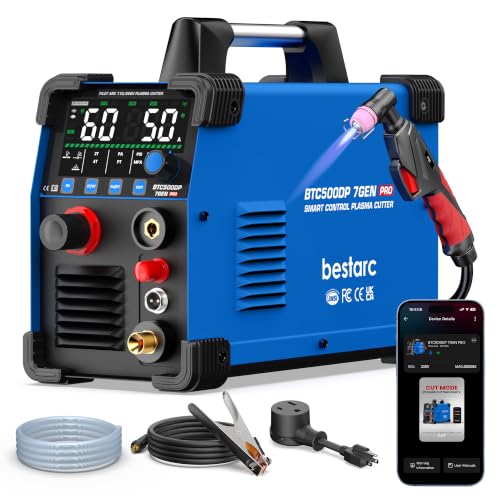
| bestarc BTC500DP 7GEN | Home shops cutting sheet, brackets and moderate plate | 50A with air sensor display, built-in regulator and adjustable post-flow |
| ARCCAPTAIN iControl CUT55 MP | Users who want pressure alerts and app monitoring | Real-time pressure detection with out-of-range alarms and phone control |
| GZ GUOZHI CUT-55NHF | CNC table owners and anyone who prefers a dial gauge | Analog front-panel gauge, built-in filter regulator and THC-ready outputs |
How to Choose
Dial gauge versus digital readout. A mechanical dial gauge, like the one on the GUOZHI below, is simple, always on and easy to read at a glance, but it only shows the pressure the regulator is set to. A digital readout fed by an internal sensor shows measured pressure and lets the machine warn you when pressure drifts out of range, which the YESWELDER and ARCCAPTAIN both do. Neither type is wrong; pick based on whether you value simplicity or active warnings.
Where the regulator sits matters. A regulator and filter mounted on the machine, ideally with the gauge beside it, means one adjustment point and one reading that reflects conditions at the torch. Machines that rely on the compressor’s own regulator force you to compensate for pressure drop along the air hose, which changes with hose length and flow. Every cutter here regulates air on the machine itself.
Match amps to your thickest regular cut. A 50A to 55A dual-voltage machine cleanly cuts around 1/2 inch of mild steel on 220V or 240V input and noticeably less on household 110V or 120V power. If most of your work is sheet and tube under 1/4 inch, any of these is plenty. If you regularly sever plate at the top of the range, look at the severance figures rather than the clean-cut figures, and expect a slower, rougher edge.
Check the duty cycle, not just the amps. Duty cycle tells you how long the machine can cut at full output before it needs to cool. The 50A and 55A machines here sit around 60 percent at maximum output, which suits fabrication and repair work with natural pauses. Long continuous CNC runs are harder on a machine than the headline amperage suggests.
Pilot arc type affects electronics and consumables. Non-high-frequency blowback pilot arc, used by the YESWELDER and the ARCCAPTAIN, fires the arc without a high-frequency burst, so it will not disturb nearby electronics or CNC controls. High-frequency pilot arc, used by the bestarc, is a proven design but can interfere with sensitive equipment. Contactless pilot arc of either kind cuts painted, rusty and expanded metal without cleaning the surface first.
Plan the air supply, not just the cutter. None of these machines includes a compressor. Each needs a supply of clean, dry air at roughly 60 to 70 PSI while cutting, and moisture is the enemy of consumable life. A filter regulator on the machine helps, but a dryer or at least a water separator at the compressor is still worthwhile.
Best Options
YESWELDER CUT-55DS PRO
The CUT-55DS PRO builds its pressure management around a sensor rather than a dial. An air pressure sensor inside the machine feeds the large LED display, which shows air pressure alongside voltage and current, and can switch the pressure reading between PSI and MPa. If pressure falls outside the working range, the machine flags it with an error code instead of letting you ruin a cut and a set of consumables without knowing why. Pressure itself is adjusted with the regulator, and the air filter is mounted at the rear for a quick hose connection.
Cutting is handled by a non-high-frequency blowback pilot arc through an IPT40 torch, so the arc fires without touching the workpiece and without spraying interference into shop electronics. Output runs from 20 to 55 amps on either 110V or 220V input. On 220V the listing rates a 1/2 inch clean cut and a 4/5 inch maximum cut; on 110V those fall to 1/3 inch clean and 1/2 inch maximum, which is the honest trade-off of household power. Post-flow cooling is adjustable, and 2T and 4T trigger modes cover both short cuts and long runs.
Specs
- Output 20–55A; input 110/220V dual voltage; non-HF blowback non-touch pilot arc, IPT40 torch; clean cut 1/3 inch at 110V and 1/2 inch at 220V; maximum cut 1/2 inch at 110V and 4/5 inch at 220V; duty cycle 60 percent at 55A; digital air pressure readout in PSI or MPa from an internal sensor, regulator adjustable, rear-mounted air filter; post-flow adjustable 5–20 seconds; 2T/4T modes; IP21S protection; unit weight 11.1 lbs as listed
Best for: Buyers who want the machine itself to watch air pressure and warn them before a bad cut happens
Watch out for: The pressure readout is digital only, so there is no dial gauge to check when the machine is off; full 55A output and the thicker cuts need a 220V circuit and a compressor that can hold pressure under flow
bestarc BTC500DP 7GEN
The BTC500DP 7GEN takes the same sensor-based approach in a 50A package. Its built-in air sensor displays air pressure on the front panel screen, which also shows voltage and current, so all three values that decide cut quality sit in one place. A built-in regulator handles adjustment, and the listing includes the regulator and sensor as part of the machine rather than accessories you bolt on later.
The torch uses a high-frequency non-touch pilot arc, which cuts through rust, paint and coatings without surface prep, and the pilot arc time itself is adjustable to balance easy firing against electrode wear. Post-flow is adjustable from 3 to 15 seconds. The listing recommends cutting thicknesses of 12 mm at 35A on 110V and 16 mm at 50A on 220V, with a maximum cutting thickness of 18 mm at 220V, and rates the duty cycle at 60 percent at 50A. Recommended working pressure is up to 70 PSI with an air flow of 250 litres per minute, so a mid-size compressor keeps up comfortably.
Specs
- Output up to 50A; input 110/220V dual voltage; IGBT inverter; high-frequency non-touch pilot arc with adjustable pilot arc time; recommended cut 12 mm at 110V and 16 mm at 220V; maximum cutting thickness 18 mm at 220V; duty cycle 60 percent at 50A; built-in regulator with air sensor, air pressure shown on the front panel display with voltage and current; post-flow adjustable 3–15 seconds; 2T/4T modes; weight 15.2 lbs as listed
Best for: Home shops and auto body work on sheet, brackets and moderate plate, where panels are often painted or rusty
Watch out for: The high-frequency pilot arc can interfere with sensitive electronics, so it is not the pick for a CNC table with delicate controls; pressure is shown on the powered display only, with no mechanical gauge as backup
ARCCAPTAIN iControl CUT55 MP

The CUT55 MP goes furthest with pressure monitoring. Its digital air pressure detection system checks incoming air continuously and shows the reading in real time on the LED panel. When pressure moves out of the optimal range, the machine raises an alert, because low pressure causes weak, drossy cuts and excessive pressure shortens torch and consumable life. The recommended working range in the listing is 0.3 to 0.55 MPa, with 0.4 MPa, about 57.5 PSI, as the optimum. An app connection mirrors the monitoring, letting you check air pressure, adjust current and receive error alerts from a phone.
Output reaches 55 amps on 240V input, with 120V input available for lighter work, and the listing rates a maximum cut of up to 1 inch, 26 mm. The non-HF blowback pilot arc fires without contact and without high-frequency interference, and the machine adds modes for gouging, expanded metal and rust removal alongside plain cutting. That mix suits repair work, where the next job is rarely clean new plate.
Specs
- Output up to 55A on 240V input; input 120/240V dual voltage; non-HF blowback pilot arc; maximum cut up to 1 inch (26 mm) as listed; real-time digital air pressure detection on the LED panel with out-of-range alerts; recommended pressure 0.3–0.55 MPa, optimum 0.4 MPa (57.5 PSI); app control with pressure monitoring and error alerts; cutting, gouging, expanded metal and rust removal modes
Best for: Repair and fabrication users who want the machine to flag pressure problems actively and like checking settings from a phone
Watch out for: The pressure information lives on the powered LED panel and in the app, so there is no dial gauge; the listing leads with maximum cut figures, so judge it against your regular thickness rather than the 1 inch ceiling
GZ GUOZHI CUT-55NHF

The CUT-55NHF is the traditionalist of this group, and the only one here with a mechanical gauge. Its front panel carries an air regulator knob and an air pressure gauge side by side, with the amperage knob next to them, so setting up is a single glance-and-turn routine. Behind the panel, a built-in air filter with automatic drainage keeps moisture moving out of the system, and the regulator and filter arrive installed rather than as a separate kit to plumb in.
Current adjusts from 20 to 55 amps on automatic dual voltage, 110V or 220V. The manual rates clean cutting up to 2/5 inch on 110V and 4/5 inch on 220V, with maximum severance up to 1.2 inches. The non-HF non-touch pilot arc keeps firing clean around electronics, which matters because this machine is built with CNC use in mind: it is THC enabled, with arc voltage output and signal control ports on the rear panel for a torch height controller. The NS65 torch comes on a 13-foot lead. At 33.5 lbs as listed it is the heaviest machine here, which fits its bench and table role better than site work.
Specs
- Output 20–55A adjustable; input 110/220V dual voltage with automatic sensing; non-HF non-touch pilot arc; clean cut up to 2/5 inch at 110V and 4/5 inch at 220V; maximum severance up to 1.2 inches per the manual; front-panel air pressure gauge with regulator knob; built-in air filter with automatic drainage; THC enabled with arc voltage output and CNC signal port; NS65 torch, 13 ft; 2T/4T modes; weight 33.5 lbs as listed
Best for: CNC plasma table owners, and anyone who simply trusts a dial gauge more than a screen
Watch out for: The gauge shows regulator pressure, and the machine has no sensor to warn you if supply pressure sags mid-cut; it is also the heaviest pick here, so it suits a fixed bench or table rather than carrying between jobs
Which One Fits
Choose the YESWELDER CUT-55DS PRO if you want a light, full-power 55A machine whose display keeps pressure, voltage and current in front of you, with an error warning when pressure goes wrong. It is the most straightforward all-rounder here for a small fabrication or repair shop.
Choose the bestarc BTC500DP 7GEN if your work is mostly sheet, brackets and auto body panels on a home-shop budget of power, and you want pressure visible on the panel without paying for app features. Pick something else if it will run beside a CNC controller or other sensitive electronics, because of its high-frequency arc firing.
Choose the ARCCAPTAIN CUT55 MP if pressure discipline is your weak point. Its continuous pressure detection and alerts, plus phone monitoring, suit users who cut varied material all day and want the machine to catch setup mistakes. It also covers gouging and expanded metal without a second machine.
Choose the GZ GUOZHI CUT-55NHF if you run, or plan to run, a CNC cutting table, thanks to its THC outputs and non-HF arc, or if you want a real dial gauge and a built-in filter regulator in a heavier bench machine.
Common Mistakes
Setting pressure at the compressor instead of the machine. Pressure drops along the air hose, so a compressor gauge reading of 70 PSI does not mean 70 PSI at the torch. Set and read pressure at the cutter, which is the entire point of the gauges and readouts on these machines.
Judging a cutter by maximum cut alone. Maximum or severance thickness is a slow, rough edge. Buy for the thickness you cut every week using the clean-cut figure, and treat anything above it as occasional work.
Ignoring moisture in the air supply. Wet air destroys electrodes and nozzles and roughens cuts. Drain the compressor tank, use the machine’s filter regulator, and check that automatic drains are actually draining.
Running full amps on household power and blaming the machine. On 110V or 120V these cutters deliver roughly half their headline capacity. Thick plate needs the 220V or 240V circuit the machine was designed around.
Never re-checking pressure when material changes. Thin sheet and thick plate want different pressure as well as different amps. A quick glance at the gauge or readout before each new thickness should be part of the setup routine.
FAQ
Do I still need an air compressor with these plasma cutters?
Yes. All four machines need an external compressor supplying clean, dry air; none has a built-in compressor. Size the compressor to hold roughly 60 to 70 PSI under flow, and favour a unit with a dryer or water separator, because moisture shortens consumable life.
Is a digital pressure readout as good as a dial gauge?
For setting pressure, yes: a sensor-fed readout shows measured pressure and can warn you when it drifts, which a dial cannot. A dial gauge wins on simplicity and works with the machine off. What matters most is that the reading is taken at the machine, not at the compressor.
What air pressure should I run for most cutting?
Follow the range in your machine’s listing or manual. The machines here cluster around 55 to 70 PSI while cutting, with the ARCCAPTAIN listing an optimum of 0.4 MPa, about 57.5 PSI. Set pressure with air flowing through the torch, since static pressure reads higher than working pressure.
Can these cutters handle rusty or painted metal?
Yes. All four use pilot arc torches that fire without the tip touching the workpiece, so the arc establishes through paint, rust and coatings. The non-HF models, the YESWELDER, ARCCAPTAIN and GUOZHI, do this without high-frequency interference, which is safer around CNC controls and vehicle electronics.
Final Verdict
A pressure gauge or readout at the machine is a small feature that fixes the most common cause of poor plasma cuts: air set by guesswork at the wrong end of the hose. For most buyers, the YESWELDER CUT-55DS PRO is the balanced choice, pairing 55A dual-voltage cutting with a clear digital pressure display and low-pressure warnings. The bestarc BTC500DP 7GEN covers the same ground at 50A for home shops, the ARCCAPTAIN CUT55 MP adds the most active pressure monitoring plus app control, and the GZ GUOZHI CUT-55NHF is the pick for CNC tables and for anyone who wants an honest dial gauge on the panel. Match the machine to your thickest regular cut and your power supply, keep the air dry, and read the pressure where the cutting happens.
More from Amazon
Programs that pair well with the guide above. Offers and eligibility are set by Amazon and may change.
Free shipping on eligible items, Prime Video and more. Eligible new members can start with a free trial.
Start a Prime free trialAudiobooks and podcasts to listen to on the go. Eligible new members can start with a free trial.
Try Audible freeAd-free music streaming. Eligible new subscribers can start with a free trial.
Try Music Unlimited freeA free business account with business pricing and bulk-buying tools for work, shop or home office.
Create a business accountAs an Amazon Associate we earn from qualifying purchases.
Write Your Review
No reviews yet. Be the first to share your experience!