

Key takeaways
- Three benchtop DC electronic loads for training compared by voltage, current, power, operating modes and interfaces, with picks for teaching labs.
Choosing a DC electronic load for a training bench is really a decision about which exercises your students will be able to run. The instrument has to sink current from power supplies, battery packs and chargers in a controlled, repeatable way, and it has to survive being reconfigured by beginners several times a day. A load that looks strong on headline numbers can still fall short if its power ceiling, operating modes or interfaces do not match the coursework you have planned.
The three models below suit different teaching setups: an instructor building scripted lab exercises, a program equipping several benches at once, and a trainer whose syllabus leans on higher-power supplies and battery work. Each one was chosen from the product name and specifications published on its Amazon page, and the sections that follow compare those published figures rather than impressions, so you can line the numbers up against your own exercise sheets.
Quick Picks
As an Amazon Associate we earn from qualifying purchases
| Product | Best for | Key spec from title |
|---|---|---|
| Rigol DL3021 | Scripted lab exercises with stepped load profiles | 150 V / 40 A / 200 W |
| East Tester ET5410A+ | Higher-power supply and battery capacity exercises | 400 W / 150 V / 40 A |
| Korad KEL103 | Teaching benches tied into a classroom network | 300 W / 120 V / 30 A |
How to Choose
Voltage, Current and Power Ceilings
Every load publishes three ceilings: maximum voltage, maximum current and maximum power, and the power figure is the one that binds in daily use. A unit rated at 150 V and 40 A cannot hold both extremes at once if its power ceiling is 200 W. For training, list the largest supply, battery pack or charger your exercises will connect, then choose a load whose power ceiling clears that device with room to spare. The three picks here span 200 W to 400 W, which covers common coursework supplies, small battery packs and bench chargers without forcing students to derate every exercise to stay inside the envelope.
Operating Modes and Dynamic Behavior
Constant current mode is where most teaching begins, because it lets students draw a set current while they watch a supply respond. A fuller mode set adds constant voltage, constant resistance and constant power, which support exercises on battery discharge curves, charger behavior and source impedance. Dynamic modes go further by switching the load between levels, showing how a supply handles sudden changes in demand. The Rigol DL3021 lists CC, CV, CR and CP alongside three dynamic modes, while the Korad KEL103 lists CC, CV, CR and CW. If your syllabus includes transient response, confirm the mode list on the product page before ordering.
Programmability and Built-In Test Routines
Programmable loads earn their place in a training lab when exercises need to run the same way for every student group. A list function steps through a stored sequence of load points, so a discharge curve or a load-regulation sweep can be repeated without manual knob work between steps. The DL3021 offers a list function of up to 512 steps, plus dedicated battery, OCP and OPP test routines named in its listing. Those built-in routines shorten setup time for protection-behavior exercises, where the point of the lesson is the supply’s response rather than the configuration of the instrument itself.
Interfaces and Readback Resolution
How a load connects to the rest of the bench shapes how instructors collect results. USB suits a single bench with a laptop, RS-232 remains common on established lab instruments, and a LAN port lets several benches report into one classroom network. The KEL103 carries USB, RS-232 and LAN, while the DL3021 provides RS-232 and USB. Readback resolution matters when students record small changes: both of those models resolve 0.1 mV and 0.1 mA, the Korad in its low ranges, which is fine enough to make millivolt-level regulation visible in student data instead of burying it in rounding.
The 3 Best Options
Rigol DL3021 Programmable DC Electronic Load

The DL3021 fits courses built around defined, repeatable exercises. Its listing pairs a 150 V, 40 A, 200 W envelope with four constant modes and three dynamic modes, so one instrument covers steady-state lessons and transient work alike. The list function runs sequences of up to 512 steps, and the dedicated battery, OCP and OPP routines give instructors ready-made structures for discharge and protection exercises. Readback resolution of 0.1 mV and 0.1 mA keeps student measurements meaningful at low levels, and RS-232 plus USB cover the connections most teaching benches already have in place.
Specs
- Single channel, 150 V / 40 A / 200 W
- CC, CV, CR and CP operating modes, plus 3 dynamic modes
- List function with up to 512 steps
- Battery, OCP and OPP test functions
- RS-232 and USB interfaces built in
- Readback resolution 0.1 mV / 0.1 mA
Best for: Instructors who run scripted, repeatable lab exercises across many student groups.
Watch out for: The 200 W ceiling is the lowest of these three, so high-power supply exercises reach its limit sooner.
ASIN: B074P7MTSS
East Tester ET5410A+ Programmable DC Electronic Load
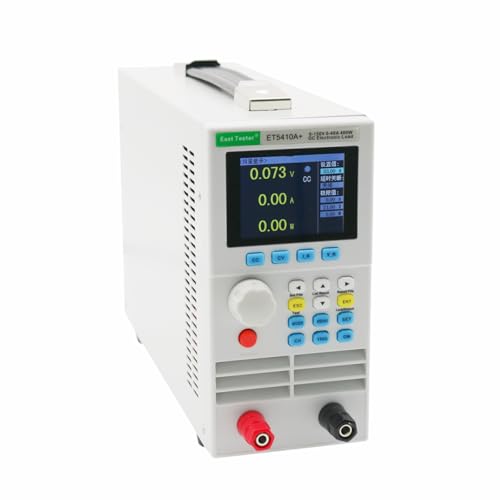
The ET5410A+ is the pick when the exercises themselves demand headroom. Its listing leads with a 400 W power ceiling alongside 150 V and 40 A, the highest power figure in this group, which leaves space for stronger bench supplies and longer battery capacity runs without turning the lesson down. The product name describes it as a programmable load for power supply, switch and charger work, with battery capacity measurement among its stated uses. For a training bench where the syllabus keeps pushing toward bigger supplies, that extra ceiling is the specification that decides whether exercises run as written.
Specs
- Single channel, 400 W / 150 V / 40 A
- Programmable DC electronic load
- Listed for power supply, switch and charger work
- Battery capacity load measurement named in the listing
- Model ET5410A+, manufacturer HZZC
Best for: Training benches whose exercises use higher-power supplies, chargers and battery capacity runs.
Watch out for: The listing publishes fewer operating details than the other two, so confirm the exact mode set your syllabus needs on the product page.
ASIN: B0C9LVZ8WK
Korad KEL103 Programmable DC Electronic Load

The KEL103 suits programs that run several benches as one classroom. Its 300 W, 120 V, 30 A envelope sits between the other two picks, and its mode list covers CC, CV, CR and CW for the standard families of load exercises. What separates it is the interface set: USB and RS-232 are joined by LAN, so an instructor can gather results from networked benches instead of walking a USB stick around the room. Readback resolution of 0.1 mV and 0.1 mA in the low ranges keeps small-signal measurements usable for student reports and graded lab write-ups.
Specs
- 300 W / 120 V / 30 A
- CC, CV, CR and CW operating modes
- USB, RS-232 and LAN interfaces
- 0.1 mV / 0.1 mA resolution in low ranges
Best for: Multi-bench teaching labs that collect results over a classroom network.
Watch out for: The 120 V ceiling is lower than the 150 V offered by the other two picks, which matters for high-voltage supply exercises.
ASIN: B07GVNQZQF
Which One Fits Your Situation
You Teach With Scripted, Step-by-Step Exercises
Pick the Rigol DL3021. A list function of up to 512 steps lets you store a discharge profile or regulation sweep once and have every group run the identical sequence, and the built-in battery, OCP and OPP routines remove setup guesswork from protection lessons. Its 200 W ceiling covers typical coursework supplies, and the fine readback resolution keeps the numbers students record worth grading.
Your Syllabus Keeps Outgrowing the Bench Supply
Pick the East Tester ET5410A+. The 400 W ceiling is the highest here, paired with 150 V and 40 A, so stronger supplies and chargers can be exercised as the course intends rather than turned down to protect the load. The listing also names battery capacity work, which suits programs where discharge measurement is a core exercise rather than an occasional demonstration.
You Run a Room Full of Benches at Once
Pick the Korad KEL103. Its LAN interface, alongside USB and RS-232, lets networked benches feed results into one place, which simplifies collection during busy lab sessions. The 300 W ceiling and four operating modes cover the standard exercise families, and low-range resolution of 0.1 mV and 0.1 mA keeps measurements from the quietest benches just as usable as those from the loudest.
Your Students Measure Small Changes in Voltage and Current
Pick the Rigol DL3021 or the Korad KEL103. Both resolve 0.1 mV and 0.1 mA, the Korad in its low ranges, so millivolt-level load regulation shows up clearly in recorded data. Choose the Rigol if your exercises rely on stored step sequences and dynamic modes; choose the Korad if the same data has to travel across a classroom network to reach you.
Common Mistakes
- Sizing a load by voltage and current alone, then discovering the power ceiling cuts exercises short once real supplies are connected.
- Buying for today’s smallest bench supply even though the syllabus adds stronger supplies and chargers in later terms.
- Overlooking the interface list, then finding the load cannot join the network or software the lab already uses.
- Assuming every programmable load includes stored step sequences, when list functions and built-in test routines vary by model.
- Putting one shared load on a demonstration bench and expecting a full class to complete timed exercises through a single queue.
Frequently Asked Questions
What does a DC electronic load actually do in a training lab?
It draws a controlled amount of current from the device connected to it, holding that draw steady or varying it according to its settings. Students use it to exercise power supplies, battery packs and chargers without building a new passive load for every lesson, and instructors get the same conditions for each group that rotates through the bench.
Which operating mode should beginners learn first?
Constant current is the usual first step, because the behavior is easy to predict: set a current, and watch how the source responds as that setting changes. From there, courses typically add constant resistance for discharge-style exercises and constant power for charger work. All three picks here include constant current, and the Rigol and Korad listings add several further modes for later lessons.
How much power capacity does a teaching bench need?
Enough to cover the largest source your exercises connect, with margin left over. Add up the output of the supplies, packs and chargers named in your lab sheets, then compare that figure with each load’s power ceiling rather than its voltage or current alone. In this group the ceilings run from 200 W to 400 W, which spans most coursework equipment.
Can one of these loads handle battery capacity exercises?
Yes. The Rigol DL3021 lists a dedicated battery test function among its built-in routines, and the East Tester ET5410A+ listing names battery capacity measurement in its product description. Either supports discharge-based capacity lessons; the Rigol adds its list function for stepped profiles, while the East Tester offers the higher 400 W ceiling for larger packs and longer runs.
More from Amazon
Programs that pair well with the guide above. Offers and eligibility are set by Amazon and may change.
Free shipping on eligible items, Prime Video and more. Eligible new members can start with a free trial.
Start a Prime free trialAudiobooks and podcasts to listen to on the go. Eligible new members can start with a free trial.
Try Audible freeAd-free music streaming. Eligible new subscribers can start with a free trial.
Try Music Unlimited freeA free business account with business pricing and bulk-buying tools for work, shop or home office.
Create a business accountAs an Amazon Associate we earn from qualifying purchases.



Write Your Review
No reviews yet. Be the first to share your experience!