

Key takeaways
- Compare the best adjustable kettlebells by weight range, adjustment mechanism, handle size and build, from budget plate-loaded sets to premium dial models.
The best adjustable kettlebell for most home lifters is one that covers the weights you actually swing, press, and carry, changes weight without tools scattered across the floor, and keeps a handle shape close to a fixed bell. The REP Fitness Adjustable Kettlebell leads this roundup because its push-and-twist system hides the plates inside a steel shell that looks and swings like a traditional bell, while the Bowflex SelectTech 840 is the fastest changer here thanks to its top dial. Below, five adjustable kettlebells are compared on weight range, adjustment mechanism, handle geometry, and construction so you can match one unit to your training instead of buying a full rack of fixed bells.
As an Amazon Associate, we earn from qualifying purchases.
Table of Contents
- REP Fitness Adjustable Kettlebell
- Bowflex SelectTech 840 Kettlebell
- PowerBlock Adjustable Kettlebell
- Kettlebell Kings Adjustable Competition Kettlebell
- Yes4All Adjustable Kettlebell
- How to Choose an Adjustable Kettlebell
- Frequently Asked Questions
- Conclusion
REP Fitness Adjustable Kettlebell

The REP Fitness Adjustable Kettlebell is the pick for lifters who want an adjustable unit that still feels like a real kettlebell. Instead of stacking exposed plates on the outside, it hides its weight plates inside a steel shell with a matte powder coat finish, so the silhouette, the flat base, and the rack position all behave the way a cast iron bell does. A rubber pad on the base softens set-downs on home gym flooring.
Weight changes use a push-and-twist mechanism: press the button on top, rotate, and the internal plates lock into the next setting. The listing for this model publishes five settings of 20, 25, 30, 35, and 40 pounds, which covers the working range most home lifters use for two-handed swings, goblet squats, presses, and loaded carries. Because the plates sit inside the shell, there is nothing to rattle loose mid-set and no exposed plate edges to dig into the forearm in the rack position, a common complaint with cheaper plate-loaded designs.
The trade-offs are the starting weight and the step size. Twenty pounds is a sensible floor for swings but heavy for a smaller beginner learning presses, and the five-pound jumps are larger than the micro steps competition lifters prefer. REP also sells kilogram versions of the same design in other listings, so check the size selector carefully before ordering. As a premium pick that replaces five fixed bells with one footprint, though, this is the most complete package in the roundup.
Specs
- Weight settings: 20, 25, 30, 35, and 40 pounds
- Adjustment mechanism: Push-and-twist selector with internal plates
- Construction: Steel shell with matte powder coat finish
- Base: Flat base with rubber pad
- Replaces: 5 fixed kettlebells
Bowflex SelectTech 840 Kettlebell

The Bowflex SelectTech 840 is the speed option. A dial on top of the bell selects the weight, and the mechanism engages only the plates needed for that setting while the rest stay behind in the housing. Turning the dial and lifting takes a couple of seconds, which makes the 840 the easiest bell here to use in circuits where the load changes from one movement to the next.
Six settings run from 8 to 40 pounds: 8, 12, 20, 25, 35, and 40. That low starting weight matters, because it opens the bell up to beginners, warm-up work, and higher-rep conditioning that a 20-pound floor would rule out. The footprint is compact for the range it covers, at roughly 8.8 inches long, 7 inches wide, and 12.5 inches tall, and the unit pairs with the JRNY app for guided programming if you want structure alongside the hardware.
The compromises are shape and duty cycle. The housing is wider than a cast iron bell of the same weight, the handle window is not a competition shape, and a dial mechanism with moving parts is not built to be dropped, slammed, or used for kettlebell sport. Bowflex covers it with a two-year warranty. For apartments, shared training spaces, and general fitness work where quick changes beat tradition, the 840 remains the benchmark dial-adjustable design in the mid-range tier.
Specs
- Weight settings: 8, 12, 20, 25, 35, and 40 pounds
- Adjustment mechanism: Top selection dial
- Model number: 100790
- Dimensions: 8.8 x 7.0 x 12.5 inches
- Construction: Steel weight plates in a molded housing
- Warranty: 2 years
PowerBlock Adjustable Kettlebell

PowerBlock applies the selector-pin thinking from its dumbbell line to a kettlebell, and the result is the most compact adjustable bell in this roundup. The steel shell measures just 5.75 inches long, 4.25 inches wide, and 10 inches tall, so it stores in spaces where a traditional bell of the same top weight would not. A steel selection pin with a magnetic lock slides through the nested plates to set the weight.
Four settings cover 18, 22, 26, and 35 pounds. The steps are uneven, with a nine-pound jump at the top, but the lock is positive and fast: insert the pin at the marked slot, and the selected plates stay with the handle while the rest remain nested. The handle diameter is 32.77 millimeters, a competition-style dimension that stays consistent at every setting, and the contoured shell is shaped to sit more comfortably against the forearm than a square block during cleans and presses.
This is a premium, all-steel build with a five-year warranty, and it is sold individually. The limits are the range: an 18-pound floor is too heavy for some beginners, and a 35-pound ceiling is too light for strong lifters working heavy two-handed swings, although PowerBlock sells a heavier sibling model that runs from 35 to 62 pounds under a separate listing. Choose the 18 to 35 pound version when floor space is the binding constraint and your working weights sit inside that window.
Specs
- Weight settings: 18, 22, 26, and 35 pounds
- Adjustment mechanism: Steel selector pin with magnetic lock
- Dimensions: 5.75 x 4.25 x 10 inches
- Handle diameter: 32.77 millimeters
- Construction: Steel shell and steel plates
- Warranty: 5 years
Kettlebell Kings Adjustable Competition Kettlebell
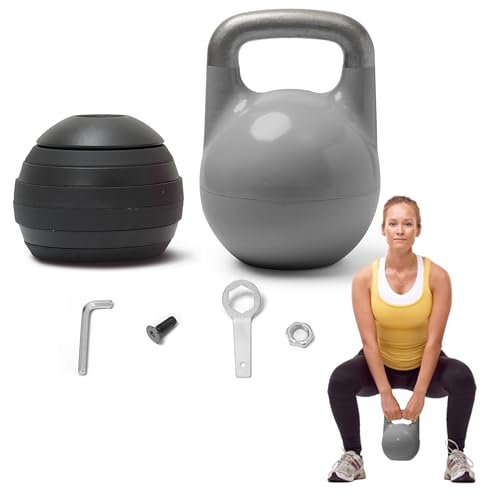
Kettlebell sport lifters train with competition bells because the shell and handle dimensions never change as the weight climbs, and this Kettlebell Kings model brings that idea to an adjustable design. A 12 kilogram steel competition shell holds seven internal cast iron plates, secured with a bolt, and the outside of the bell keeps the same size and the same 35 millimeter handle at every setting.
With the plates combined, the bell adjusts from 12 to 32 kilograms in one-kilogram steps, skipping only the 13 and 31 kilogram settings. That granularity is the point: kettlebell sport progressions for snatches, jerks, and long cycle work depend on small, repeatable jumps, and no other bell in this roundup comes close to this many settings. The trade-off is speed. Adding or removing plates means opening the shell and working the bolt, a job measured in minutes rather than seconds, so this is a bell you set once for a session block rather than one you change between circuit stations.
Build quality is the other draw. The shell is steel, the plates are cast iron, and the locked stack has no dial or pin to wear. For lifters who compete, or who simply want one bell that can follow a kilogram-based program from moderate loads to genuinely heavy work, this premium option replaces the better part of a competition rack in a single unit.
Specs
- Weight range: 12 to 32 kilograms, in 1 kilogram steps except 13 and 31 kilograms
- Adjustment mechanism: Internal plates secured with a bolt
- Plates included: Seven cast iron plates of 2, 2, 2, 3, 3, 4, and 4 kilograms
- Shell: 12 kilogram steel competition shell
- Handle diameter: 35 millimeters
- Part number: KETT-001609
Yes4All Adjustable Kettlebell

The Yes4All Adjustable Kettlebell is the budget route into adjustable training, and it keeps the design deliberately simple. Six cast iron plates slide onto a solid cast iron handle and lock in place, so the whole unit is iron rather than a shell over a mechanism. The handle is textured for grip security, and the flat base keeps the bell upright between sets.
Seven settings run from 7.8 to 40 pounds, stepping through 12.4, 17.9, 23.9, 29.9, and 35.4 pounds along the way. That is more settings, and smaller jumps, than the dial and pin models above, and the low starting weight suits beginners and lighter technique work. Plate changes are the slowest in this roundup, since each change means unlocking, sliding plates on or off, and locking again, and exposed plate edges can press into the forearm during rack holds.
Durability expectations should match the tier: cast iron is hard to kill, but the finish is basic, the lock deserves a check before every set, and Yes4All backs the bell with a one-year warranty. For a first adjustable kettlebell, or a second bell for a garage gym that does not need fast changes, it delivers the widest step ladder here at a budget price tier.
Specs
- Weight settings: 7.8 to 40 pounds in seven steps
- Adjustment mechanism: Lock-and-slide plates
- Plates included: Six cast iron plates
- Model number: JX7N
- Construction: Solid cast iron with textured handle and flat base
- Warranty: 1 year
How to Choose an Adjustable Kettlebell
Start with the weight window, not the mechanism. List the loads you use for your main lifts: a typical home lifter swings more than they press, so a bell that tops out at 35 or 40 pounds covers general training, while anyone following a kilogram sport program needs the wider ladder of a competition shell. A starting weight that is too heavy is the most common buying mistake, because it rules out learning presses, halos, and Turkish get-ups with good form.
Next, match the mechanism to your session style. Dial and selector-pin models change in seconds and suit circuits, supersets, and shared spaces. Push-and-twist designs are nearly as quick and keep a traditional shape. Plate-loaded bells change slowly but reward you with small steps, simple construction, and nothing delicate to break, which is why they dominate both the budget tier and the competition niche.
Handle geometry decides comfort. A window wide enough for two hands matters for swings, and a diameter near 33 to 35 millimeters suits most adult hands for high-rep work. Check how the bell sits in the rack position too: contoured shells and internal plates are kinder to forearms than exposed plate stacks.
Finally, respect the duty cycle. Adjustable bells have mechanisms, and none of them are made to be dropped on concrete or thrown. Train over mats, set the bell down instead of dropping it, and verify the lock before the first rep of every set. If your training is built around heavy ballistic work and drops, a fixed cast iron bell is still the right tool, and an adjustable unit is the space-saving second option.
Frequently Asked Questions
How much weight range do most home lifters need?
A range from roughly 15 to 40 pounds covers the majority of home kettlebell training, including two-handed swings, goblet squats, presses, rows, and carries. Beginners often start lower for skill work, which is why models that begin at 8 or 12 pounds are easier to grow with, while stronger lifters should look at ranges that reach 53 or 62 pounds so the bell does not become obsolete within a year.
Are adjustable kettlebells safe for swings and snatches?
Yes, when the locking system is fully engaged and the weight is within the design limits of the unit. Dial, pin, and internal plate systems are all built to stay locked under ballistic load. The habits that keep them safe are simple: confirm the dial or pin is seated before lifting, never drop an adjustable bell, and inspect plates and locks regularly for wear.
Which adjustment mechanism is fastest for circuit training?
Dial systems, like the one on the Bowflex SelectTech 840, and selector-pin systems, like the PowerBlock, change weight in a few seconds and are the best fit for circuits. Push-and-twist designs are close behind. Plate-loaded bells are the slowest because plates must be unlocked, swapped, and locked again, so they suit straight sets better than timed stations.
Can one adjustable kettlebell replace a full set of fixed bells?
For general fitness training, yes. One adjustable unit replaces four to seven fixed bells and frees up the floor space a rack would take. The compromises are shape and ceiling: adjustable bells are wider than fixed bells of the same weight, the handle geometry is a compromise, and the top weight is lower than a full rack offers. Lifters focused on kettlebell sport usually prefer fixed competition bells or a competition-style adjustable.
Conclusion
An adjustable kettlebell is a space and progression decision. The REP Fitness Adjustable Kettlebell is the best all-around choice here because it pairs a fast push-and-twist mechanism with a steel shell that trains like a fixed bell. The Bowflex SelectTech 840 changes weight fastest and starts lightest, the PowerBlock packs an all-steel build into the smallest footprint, the Kettlebell Kings competition model offers unmatched one-kilogram steps up to 32 kilograms, and the Yes4All covers seven settings on a budget. Match the weight window to your lifts, the mechanism to your session style, and any of the five will serve a home gym well.
More from Amazon
Programs that pair well with the guide above. Offers and eligibility are set by Amazon and may change.
Free shipping on eligible items, Prime Video and more. Eligible new members can start with a free trial.
Start a Prime free trialAudiobooks and podcasts to listen to on the go. Eligible new members can start with a free trial.
Try Audible freeAd-free music streaming. Eligible new subscribers can start with a free trial.
Try Music Unlimited freeA free business account with business pricing and bulk-buying tools for work, shop or home office.
Create a business accountAs an Amazon Associate we earn from qualifying purchases.



Write Your Review
No reviews yet. Be the first to share your experience!