

Key takeaways
- Compare the best blood flow restriction bands for arms, legs, and glutes, from elastic straps to inflatable cuffs, with sizing, fit, and safety guidance.
The best blood flow restriction bands for most lifters are simple elastic straps with a quick-release buckle, because they are easy to tighten consistently, easy to remove between sets, and sized for both arms and legs. If you want measured pressure instead of feel, inflatable cuffs with a hand pump or a built-in gauge are the step up. Below are five current options that cover every style: a versatile strap set for arms and legs, a pneumatic cuff system, a gauge-equipped four-pack, a wide wrap made for leg day, and a cam-buckle strap set built for fast on-and-off between exercises.
As an Amazon Associate, we earn from qualifying purchases.
Table of Contents
- How Blood Flow Restriction Training Works
- How to Choose Blood Flow Restriction Bands
- BFR BANDS PRO
- Dr. Gains BFR Pro 2.0 Inflatable Cuffs
- Mustools BFR Bands 4-Pack with Pressure Gauge
- BFR Bands DoubleWrap
- BFR Bands Elite Model
- Safety Guidelines for BFR Training
- Frequently Asked Questions
- Conclusion
- Product and ASIN Reference
How Blood Flow Restriction Training Works
Blood flow restriction training, usually shortened to BFR or occlusion training, uses a band or cuff placed high on the arm or leg to slow venous blood flow out of the working limb while arterial flow continues in. That pooling effect makes light weights feel far heavier than they are, so muscle fibers fatigue and accumulate metabolic stress at loads of roughly 20 to 30 percent of a one-rep max. Published training guidance commonly pairs the bands with a high-rep scheme of one set of 30 reps followed by three sets of 15 reps, with short rests and the bands left on throughout the exercise.
Because the loads stay light, BFR is popular with lifters working around cranky joints, athletes adding arm or leg volume at the end of a session, and people rebuilding muscle when heavy loading is off the table. The equipment itself is simple, but fit and pressure control decide whether a set feels productive or just uncomfortable, which is why band width, closure style, and sizing matter more than brand names.
How to Choose Blood Flow Restriction Bands
Band or cuff style. Elastic straps are the original format: you pull them tight, lock the buckle, and judge pressure by feel. Inflatable cuffs work more like a blood pressure cuff, using a pump to reach a repeatable pressure. Straps cost less and pack flat in a gym bag; cuffs give more consistent pressure from session to session.
Width. Narrow straps around 1 to 2 inches wide are the standard for arms. Legs respond better to wider bands, roughly 2 to 3 inches, because a wider band distributes pressure over more surface area and reaches the target restriction at a lower perceived tightness. Sets that include both slim and wide bands cover arms and legs without a second purchase.
Closure. A quick-release buckle or cam buckle lets you free a limb in one motion, which matters when a set runs long. Pull-to-tighten designs with marked increments make it easier to repeat the same tightness on both limbs and across workouts.
Pressure feedback. Basic straps rely on a perceived tightness scale. Gauge-equipped sets and inflatable cuffs add a number, which helps beginners stay in a sensible range and helps experienced users log exactly what they did.
Sizing. Measure the circumference at the very top of the arm or thigh, where the band will sit, and match it to the maker sizing chart. A band that is too short will not wrap securely on legs, and excess tail on arms gets in the way during curls and presses.
Strap length and markings. Longer straps suit legs and anyone who prefers a double wrap, while shorter straps are less bulky on arms. Numbered or indexed markings along the strap are worth looking for, because they turn tightness into a repeatable setting: note the number you used on each limb, and the next session starts from the same point instead of a fresh guess. Over time, that small detail does more for consistent training than any other feature on a basic strap set.
Material and care. Most straps are woven elastic, sometimes blended with latex, and they gradually lose tension after months of hard use. Rinsing sweat out after sessions and air drying away from heat slows that wear. Inflatable cuffs avoid stretch fatigue entirely, since pressure comes from air in a bladder rather than elastic tension, which is one reason frequent users eventually move to a cuff system.
BFR BANDS PRO

The BFR BANDS PRO set from Exerscribe is the most complete strap package in this roundup, because the box covers both upper and lower body work. It includes two PRO SLIM bands for arms and two wider PRO bands for legs and glutes, so one purchase handles a full BFR session instead of forcing a compromise size. The straps use a pull-to-tighten design with a quick-release buckle, which makes it simple to match tightness from one limb to the other and to strip the bands off quickly between exercises.
The brand guidance printed with the set suggests a perceived tightness around six or seven out of ten, and the included training eBook walks through basic protocols for common movements. For lifters who want one proven strap system rather than a drawer of mismatched bands, this is the default recommendation.
Specs:
- Brand: BFR BANDS (Exerscribe)
- Model: Pro Edition
- Set contents: 2 PRO SLIM arm bands and 2 PRO leg bands
- Band width: 2 inches (PRO bands)
- Strap thickness: 2.5 mm
- Closure: pull-to-tighten strap with quick-release buckle
- Extras: training eBook included
Dr. Gains BFR Pro 2.0 Inflatable Cuffs

The Dr. Gains BFR Pro 2.0 takes the pneumatic route: instead of stretching an elastic strap and guessing at tightness, these cuffs inflate with a hand pump so pressure is set by air, the same principle used by clinical-style systems. That makes them the premium pick for lifters who train with BFR several times a week and want the same pressure every session, and for anyone who finds elastic straps dig in or slip once a pump builds.
Inflatable cuffs are bulkier than straps and take a little longer to set up, and the same brand also sells simpler nylon strap bands for beginners who are not ready to invest in a full cuff system. As a dedicated occlusion training tool rather than a general gym accessory, the Pro 2.0 is the most training-specific product in this list.
Specs:
- Brand: Dr. Gains
- Model: BFR Pro 2.0
- Type: inflatable pneumatic cuffs
- Pressure method: hand pump inflation
- Intended use: occlusion training for weight lifting
- Positioning: professional-grade cuff system
Mustools BFR Bands 4-Pack with Pressure Gauge

The Mustools set answers the biggest weakness of plain elastic straps, which is not knowing how much pressure you actually applied. This four-pack pairs bands for the arms with wider cuffs for the legs and glutes, and adds a pressure gauge so each session can start from a recorded number instead of a guess. For lifters who like to log their training, that repeatability is the entire point of the design.
The bands use a cuff-style wrap rather than a thin strap, which spreads pressure more evenly on the thigh during squats and leg presses. Sold as a complete arms-and-legs kit in black, it is a practical middle ground between bargain straps and fully inflatable systems.
Specs:
- Brand: Mustools
- Model: Bfr-4pack-black
- Set contents: 4 bands for arms and legs
- Pressure feedback: built-in pressure gauge
- Style: cuff-style occlusion bands
- Color: black
BFR Bands DoubleWrap
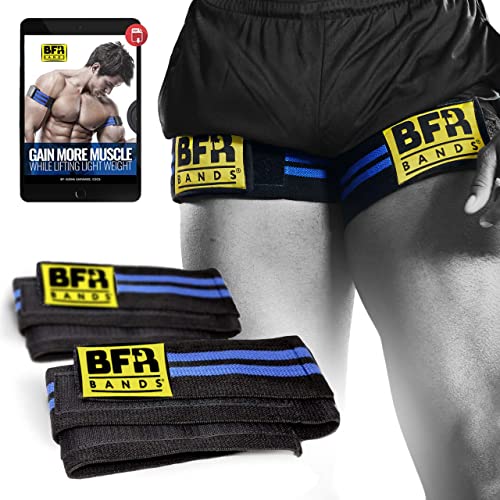
Leg training is where narrow straps fall short, and the DoubleWrap from BFR Bands is built specifically for that job. The straps are 3 inches wide, a full inch wider than standard arm bands, and they wrap twice around the top of the thigh to hold position during squats, leg presses, hip thrusts, and glute work. The wider footprint reaches effective restriction at a more comfortable tightness, which is exactly what most people struggle with when they try arm bands on their legs.
This is a two-pack aimed at legs, booty, and glute training rather than an all-purpose set, so arm-focused lifters should look at the PRO or Elite sets instead. For anyone whose BFR work is mostly lower body, the dedicated width makes this the most comfortable strap option here.
Specs:
- Brand: BFR BANDS
- Model: DoubleWrap
- Set contents: 2 bands
- Band width: 3 inches
- Strap thickness: 2.5 mm
- Designed for: legs, glutes, and thigh training
- Closure: elastic strap with buckle
BFR Bands Elite Model

The Elite Model is the original two-pack from BFR Bands, built around an elastic strap and a quick-release cam buckle. The cam design is the detail that matters: it locks the strap at the tightness you set, then flips open instantly when the set ends, so there is no wrestling with hook-and-loop material while your arms are pumped and fatigued. The straps are sized for arms and legs, and the brand positions this model for lean muscle work at light loads, including biceps, triceps, and shoulder sessions where a slim strap sits best.
Compared with the PRO set above, the Elite keeps things simpler with one strap style instead of separate slim and wide bands. Lifters who mainly train arms with BFR, or who want a compact set that lives in a gym bag, will find this the easiest format to live with.
Specs:
- Brand: BFR BANDS
- Model: Elite Model
- Set contents: 2 bands
- Closure: quick-release cam buckle
- Strap type: elastic
- Designed for: arms, legs, and glutes
Safety Guidelines for BFR Training
BFR is a training technique with real contraindications, and the bands themselves carry manufacturer warnings to consult a medical professional before use. People with a history of blood clots or deep vein thrombosis, uncontrolled high blood pressure, vascular or circulation disorders, sickle cell concerns, or who are pregnant should not use occlusion bands without medical clearance. Anyone returning from surgery should only train with BFR under professional supervision.
In practice, keep perceived tightness moderate, around seven out of ten on arms and slightly less on legs, and never train to numbness or sharp pain. Keep the bands on for one exercise at a time, release them during longer rests, and limit total time under restriction for any single limb. Start with very light loads, learn how a normal BFR pump feels, and progress gradually over several sessions.
Frequently Asked Questions
How tight should blood flow restriction bands be?
A common guideline is a perceived tightness of about seven out of ten on the arms and a little less on the legs. The limb should feel very full and fatigued during high-rep sets, but never numb, tingly, or painful. Gauge and inflatable models replace that guesswork with a set pressure, which is one reason experienced users upgrade.
What weights should you use with BFR bands?
Most published protocols use light loads, roughly 20 to 30 percent of a one-rep max, paired with high reps such as one set of 30 followed by three sets of 15. If the weight feels heavy in a normal strength sense, it is too heavy for BFR work. The bands create the training effect, not the load.
Can you use the same bands for arms and legs?
Only if the set is designed for both. Arms suit narrow straps, while legs need wider bands that distribute pressure across the thigh. Sets like the PRO package include slim and wide bands for that reason. Using a thin arm strap on a leg usually means over-tightening to feel any effect, which is uncomfortable and inconsistent.
Who should avoid blood flow restriction training?
Anyone with a history of blood clots, deep vein thrombosis, uncontrolled high blood pressure, circulation problems, or who is pregnant should skip BFR unless a medical professional clears it. The same caution applies after recent surgery on a limb. When in doubt, get medical advice first and consider supervised sessions to learn the technique.
Conclusion
For most lifters, the BFR BANDS PRO set is the easiest recommendation: it covers arms and legs in one box, tightens consistently, and releases in seconds. The Elite Model suits arm-focused training with its cam buckle, while the DoubleWrap is the leg-day specialist thanks to its 3-inch width. If guessing at tightness is the part you dislike, the Mustools four-pack adds a pressure gauge, and the Dr. Gains BFR Pro 2.0 goes furthest with inflatable cuffs that set pressure by pump. Match the format to how often you train with BFR, size carefully at the top of the limb, and keep the safety guidelines above in view every session.
More from Amazon
Programs that pair well with the guide above. Offers and eligibility are set by Amazon and may change.
Free shipping on eligible items, Prime Video and more. Eligible new members can start with a free trial.
Start a Prime free trialAudiobooks and podcasts to listen to on the go. Eligible new members can start with a free trial.
Try Audible freeAd-free music streaming. Eligible new subscribers can start with a free trial.
Try Music Unlimited freeA free business account with business pricing and bulk-buying tools for work, shop or home office.
Create a business accountAs an Amazon Associate we earn from qualifying purchases.



Write Your Review
No reviews yet. Be the first to share your experience!