

Key takeaways
- Compare the best inversion tables for home use from Teeter, Innova, and Ironman, with notes on ankle locks, capacity, folding frames, and safe setup.
- Top Pick: Teeter FitSpine X1 Inversion Table
- Runner-up: Teeter FitSpine X3 Inversion Table
- Also consider: Innova ITX9600 Heavy Duty Inversion Table
An inversion table only earns its floor space if it feels solid the moment you lean back. Wobble, a flimsy ankle clamp, or a bed that flexes under your weight will end a stretching routine faster than anything, so build quality matters more here than in almost any other piece of home fitness gear. The good news is that the category has matured: the leading brands now use heavy-gauge steel frames, padded beds, and locking systems that hold a set angle without drifting.
This guide compares five inversion tables for home use that stand out for sturdy construction and sensible design. They range from a premium certified table with a contoured bed to a high-capacity workhorse built for heavier users, plus one model that adds heat and vibration to the session. Every pick below is a current, full-size table from an established maker, and each folds for storage between sessions.
As an Amazon Associate, we earn from qualifying purchases.
Quick answer
For most people, the Teeter FitSpine X1 is the inversion table to buy: it pairs a certified steel frame with the most comfortable ankle system in this group and a bed that supports the body evenly. Heavier users should look at the Ironman Gravity 4000 and its higher capacity, while the Innova ITM4800 suits anyone who wants heat and massage built in.
Teeter FitSpine X1 Inversion Table

Teeter is the name most buyers meet first in this category, and the FitSpine X1 shows why. The frame is heavy-duty steel, the table is UL certified for safety, and it carries a 300 lb weight capacity with a height range from 4 ft 8 in to 6 ft 6 in, which covers nearly every adult in a household. The frame arrives partly built, so assembly is quick.
The bed is the highlight. Teeter’s Flex Tech surface is firm but slightly flexible, so it moves with your body as you rotate instead of feeling like a rigid board. Clip-in acupressure nodes and a lumbar bridge are included in the box, and both can be positioned along the bed or removed entirely. The Ergo Embrace ankle supports wrap foam around the front and back of each ankle, spreading pressure more evenly than simple front pads, and the EZ-Reach handle lets you lock and release them without bending all the way down.
Angle control comes from a tether strap you set before mounting, and rotation itself is controlled by shifting your arms, which feels smooth once the height setting is dialed in. The X1 folds for storage, though like every full-size table here it still needs a closet or a spare corner. For buyers who want one table that does everything well, this is the benchmark.
Teeter FitSpine X3 Inversion Table

The FitSpine X3 is the step-up model in the same line, built around the same certified frame and 300 lb capacity as the X1 but with comfort upgrades aimed at people who plan to invert daily. The Deluxe EZ-Reach ankle system uses a longer, spring-loaded handle that is easier to operate, and the ankle cups are shaped to reduce pinch points at the front of the foot.
Its bed is a thicker version of the Flex Tech surface, and it adds Stretch Assist handles mounted at the top of the frame. Those handles give you something solid to grip while you settle into position or add a gentle pull during a stretch. The acupressure nodes and lumbar bridge from the X1 are included here as well, and the table carries the same UL safety certification and FDA registration as the rest of the FitSpine line.
Choose the X3 over the X1 if the table will be shared by several people, since the easier ankle release and extra grip points make the daily routine simpler for beginners. If it will mostly be you, the X1 covers the same fundamentals. Either way, the rotation feel is the most refined here: balanced, quiet, and free of frame creak.
Innova ITX9600 Heavy Duty Inversion Table

The Innova ITX9600 is the straightforward value pick, and it has been a steady seller for years because the basics are right. The frame is heavy-gauge steel tubing with a 300 lb capacity, the height setting adjusts for users from 4 ft 10 in to 6 ft 6 in, and the padded backrest is wider than average, which taller and broader users appreciate. An adjustable headrest pillow is included and can be moved or removed.
Instead of a tether strap, the ITX9600 uses a six-position pin lock system. You pull a pin, choose one of six preset angles, and the table stops there every time. Many beginners prefer this arrangement because the maximum angle is set mechanically before you get on, so there is no guesswork mid-session. The trade-off is less fine-tuning than a strap allows.
The ankle holding system is a padded front bar with a rear foam support, adjusted by a spring-loaded pin. It is functional rather than luxurious, and long sessions at steep angles can make the fronts of the ankles ache, which is common at this level. The frame folds flat enough to lean against a wall. For a first table that feels stable and costs far less than the premium models, the ITX9600 is hard to argue with.
Innova ITM4800 Heat and Massage Inversion Table
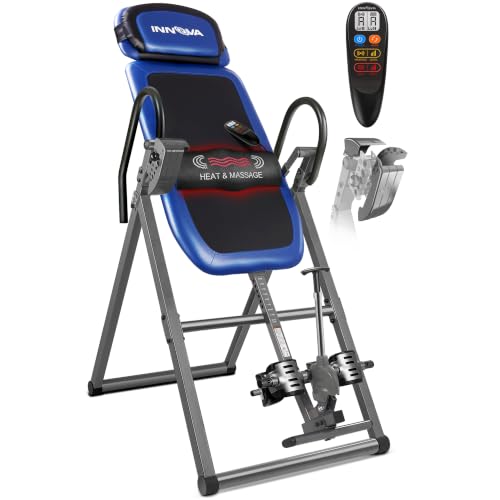
The ITM4800 takes the same basic platform as the ITX9600 and adds the feature its name advertises: a lumbar pad with isolated heat and vibration massage. The pad sits against the lower back, runs from a wall outlet, and lets you switch heat and vibration independently, so you can use warmth alone, vibration alone, or both during a session. For people who use inversion as part of an evening wind-down routine, that combination is the whole appeal.
The rest of the table mirrors the ITX9600’s formula. Capacity is 300 lb, the height range runs from 4 ft 10 in to 6 ft 6 in, and a six-position pin lock sets the inversion angle. The backrest is a large energy-foam pad with an adjustable headrest, and the extended ankle holding system uses a longer release handle than the base model, which makes getting out noticeably easier.
Two practical notes: the massage pad adds a cord to manage, so the table needs to live near an outlet, and the pad itself is removable if you prefer a plain bed. The frame folds for storage like its sibling. If heat therapy is already part of how you loosen up after training, the ITM4800 folds that step into the inversion session instead of adding another device to the room.
Ironman Gravity 4000 Inversion Table
The Gravity 4000 is built for users the other tables cannot hold. Its tubular steel frame is rated to 350 lb, the highest capacity in this group, and the height adjustment covers 4 ft 9 in to 6 ft 6 in. Everything about the construction feels overbuilt in a reassuring way: thick tubing, a scratch-resistant powder-coated finish, and a wide stance that stays planted when you rotate.
The backrest is memory foam under a vinyl cover, which gives it a firmer, more supportive feel than the softer pads on the Innova models. Ankle security comes from a ratchet-style locking system with a palm-activated release handle positioned so you can reach it without a deep bend. Angle is limited by an adjustable tether strap, and the table can rotate to full inversion for users who work up to it.
Extras include extra-long safety handles on both sides and a removable lumbar pillow. The Gravity 4000 folds for storage, though at this size it is the heaviest table here and the one you will least want to move daily. For bigger users, or anyone who simply wants the most headroom in the capacity spec, it is the natural pick.
How to choose
Start with fit. Every table lists a height range and a weight capacity, and both need to cover the heaviest and tallest person who will use it, with margin to spare. A table run near its limit flexes more and feels less secure, so if you are close to a 300 lb ceiling, step up to a 350 lb model like the Gravity 4000.
Next, look at the ankle system, because it decides how comfortable long sessions feel. Foam cups that surround the ankle spread pressure best, and a long release handle matters if bending deeply is difficult. Then consider angle control. Pin systems offer a few fixed stops that repeat exactly, tether straps allow any angle but must be set carefully, and premium tables rely on balanced rotation controlled by your arm position.
Certification is worth checking. Teeter’s tables carry UL safety certification, which means the design has been tested by an independent lab; with gear that holds your full body weight upside down, that paperwork is meaningful. Finally, measure your space. A full-size table needs a large footprint, and even folding models are tall when stored. Check the folded dimensions against your closet before ordering, and plan on two people for assembly, since the boxes are heavy.
Who should skip
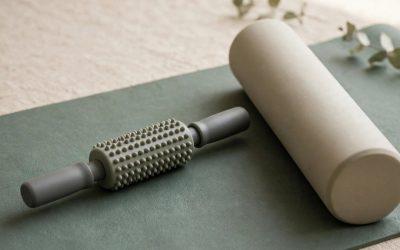
Skip inversion entirely, or clear it with a doctor first, if you have high blood pressure, glaucoma or other eye conditions affected by pressure, a heart condition, or a hernia, or if you are pregnant. The same applies after recent surgery or a fresh joint injury. People with limited floor space should also pass, since even folding tables are bulky, and anyone who gets dizzy easily may find that even shallow angles are unpleasant. A stretching bench or a foam roller covers some of the same ground without turning you upside down.
Frequently Asked Questions
How long should a beginner stay inverted?
Start with one or two minutes at a shallow angle, around 20 to 30 degrees, once a day. Add time and angle gradually over several weeks as your body adapts. Most home users settle into sessions of five to fifteen minutes. Come up slowly, pause partway for a few seconds, and stop if you feel dizzy or unwell.
Do inversion tables fold for storage?
Most full-size tables, including all five in this guide, fold by bringing the legs together so the table can lean against a wall or slide into a closet. Folding reduces the footprint but not the height, and the tables remain heavy, so expect a two-handed job and a storage spot with vertical clearance.
What is the difference between a pin lock and a tether strap?
A pin lock gives the table a set of fixed stopping angles, usually five or six, chosen before you mount. It is predictable and beginner-friendly. A tether strap clips to the frame and limits rotation to whatever length you set, which allows any angle in between but depends on you setting it correctly each time.
Can people of different heights share one table?
Yes. Every table here adjusts along a height bar, and each user should set it to their own height before mounting, since that setting is what balances the rotation. Households sharing a table usually mark each person’s setting on the bar with tape so swapping takes seconds.
Final verdict
Buy the Teeter FitSpine X1 if you want the most polished all-round table, or the X3 if shared daily use justifies the comfort upgrades. The Innova ITX9600 is the sensible budget route, the ITM4800 adds heat and massage for evening routines, and the Ironman Gravity 4000 is the one to choose when capacity and sheer sturdiness come first. Whichever you pick, start shallow, keep sessions short at first, and check with a doctor before inverting if any condition above applies to you.
More from Amazon
Programs that pair well with the guide above. Offers and eligibility are set by Amazon and may change.
Free shipping on eligible items, Prime Video and more. Eligible new members can start with a free trial.
Start a Prime free trialAudiobooks and podcasts to listen to on the go. Eligible new members can start with a free trial.
Try Audible freeAd-free music streaming. Eligible new subscribers can start with a free trial.
Try Music Unlimited freeA free business account with business pricing and bulk-buying tools for work, shop or home office.
Create a business accountAs an Amazon Associate we earn from qualifying purchases.



Write Your Review
No reviews yet. Be the first to share your experience!