

The best agility ladder for most athletes is a flat-rung ladder about 15 to 20 feet long with adjustable rungs, such as the SKLZ Quick Ladder Pro, while budget buyers can get the same drills from a Yes4All or GHB ladder, and coaches who set up often should look at a rigid or heavy-duty option like the Champion Sports ladder. Choose length by the drills you run, not by brand: 12 rungs cover most footwork patterns and 20 feet fits a typical garage or sideline. The details below compare rung type, length and storage so you can match the ladder to your sport.
Our top picks


As an Amazon Associate we earn from qualifying purchases at no extra cost to you.
Quick Comparison of the Best Agility Ladders
| Pick | Best for | Typical length | Rungs | Rung style | Price range |
|---|---|---|---|---|---|
| SKLZ Quick Ladder Pro | Best overall | About 15 to 30 ft | Up to 12 or more | Flat, adjustable spacing | Mid |
| Champion Sports Agility Ladder | Best for teams and schools | About 15 to 30 ft | Multiple lengths | Flat nylon straps with plastic rungs | Budget to mid |
| Yes4All Agility Ladder | Best budget | About 12 to 20 ft | Multiple lengths | Flat rungs, carry bag | Budget |
| GHB Pro Agility Ladder | Best bag-and-cones bundle | About 20 ft | 12 | Flat rungs with cones | Budget |
| Rigid hurdle-style ladder | Best for plyometric work | Varies | Varies | Raised rungs | Mid |
| Ground ladder with pegs | Best for grass fields | About 15 to 20 ft | Varies | Flat rungs with stakes | Budget |
Lengths and rung counts vary by retailer package, so confirm them on the current product page.
Best Overall: SKLZ Quick Ladder Pro
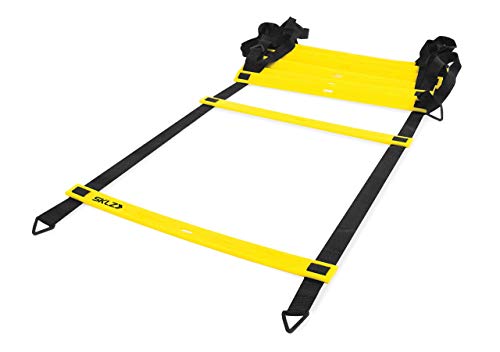
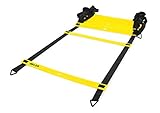
SKLZ is a mainstay in youth sports gear, and the Quick Ladder Pro is its adjustable agility ladder. Rungs slide along the straps so you can set the box width, and the flat profile means you can step on it without tripping. A carry bag is included.
The straps can curl in the heat and slip on smooth floors, so use it on grass, turf or a rubberized surface. For tight indoor spaces, lay it on a mat or tape the ends to the floor.
Best for Teams: Champion Sports Agility Ladder
Champion Sports focuses on school and team equipment, and its ladders are sold in multiple lengths for gyms and fields. The nylon straps and plastic rungs are durable under repeated use, and the design is simple enough to deploy quickly between stations.
They are not the lightest and the finish is basic. For a team that sets up the same drill every day, it is a practical and economical choice.
Best Budget: Yes4All Agility Ladder
Yes4All sells inexpensive ladders in several lengths, usually with a carry bag. The flat rungs and adjustable straps deliver the core footwork drills at a lower price, so it is a good place to start if you are not sure how often you will use one.
Materials are thinner, and rung clips can loosen over time. Check the stitching after several weeks of use and replace the ladder if the straps fray.
Best Bundle: GHB Pro Agility Ladder
GHB’s offering includes a 12-rung ladder, often with cones or a bag, making it popular for parents and coaches who want a complete speed kit. It is easy to carry and set up on a driveway or field.
Because it is geared toward value, plastic parts are lighter and wear faster. It suits light to moderate use, such as youth practice.
Best for Plyometrics: Rigid Hurdle-Style Ladder
Instead of a flat strap ladder, some athletes use raised-rung or hurdle ladders. These force higher knee drive and give you a visible obstacle for quick-feet drills and low hops.
They are bulkier to store and can be a trip hazard for beginners. Introduce them after you are comfortable with the flat ladder.
Best for Grass Fields: Ground Ladder With Pegs
For outdoor use, ladders with stakes or pegs hold position on grass and turf. This avoids the creeping and slipping that happens when you push off at speed.
Make sure to remove stakes and store the ladder dry. Pegs can be hazardous if left in the ground on a shared field.
Ladder Drills and What They Train
| Drill | Pattern | Trains | Starting volume |
|---|---|---|---|
| One foot in each | Step one foot in each box | Quick steps, coordination | 3 runs |
| Two feet in each | Both feet into every box | Foot speed | 3 runs |
| Icky shuffle | In-in-out sidestep | Lateral movement | 3 runs per side |
| Lateral shuffle | Sideways through each box | Hip mobility and agility | 3 runs per side |
| Hop scotch | Alternating one and two feet | Balance and rhythm | 2 to 3 runs |
How to Choose an Agility Ladder
Length. 15 feet works for beginners and tight spaces, while 20 feet or more lets you run longer sequences. Multi-athlete sessions benefit from longer ladders.
Rungs. Adjustable rungs let you change box spacing. Fixed rungs are simpler for kids.
Material. Look for sturdy straps with reinforced stitching, and rungs that lie flat. Avoid thin tape that rolls up.
Surface. Grass and turf need pegs or a heavier ladder. Indoor floors need a non-slip back or tape.
Storage. A carry bag keeps the ladder tidy and protects it from the sun.
Beyond the Ladder: Making Training Count
Ladders improve coordination and foot placement, but speed in competition also depends on strength, power and sport-specific skill. Combine ladder work with short sprints, cone drills and strength training for the best transfer. Keep sessions short, around 10 to 15 minutes, and quit when form drops. Quality beats quantity.
Decision Matrix: Which Ladder for Which Athlete
| Your situation | Choose | Reason |
|---|---|---|
| Youth athlete, backyard practice | GHB bundle or Yes4All | Low cost, bag included |
| High school or club team | Champion Sports | Built for repeated team use |
| Individual training, varied drills | SKLZ Quick Ladder Pro | Adjustable rung spacing |
| Grass field, windy day | Ground ladder with pegs | Stays in place |
| Advanced athlete adding jumps | Rigid hurdle-style ladder | Raises knee drive |
Worked Example: A 12-Minute Ladder Session
A simple session uses five drills with a short rest between each. Start with a two-minute jog and dynamic stretches. Then run one-foot-in-each three times, two-feet-in-each three times, icky shuffle three times per side, and finish with lateral shuffles three times per side. Walk back to the start between runs so each pass is fast and clean. With about 15 seconds of rest per run and 14 runs, the total is around 12 minutes including warm-up.
Progress by adding one new pattern every week rather than increasing speed first. Once you can complete a pattern without touching the rungs, add a ball or a reaction cue from a partner. This trains decision-making along with footwork and keeps sessions from becoming repetitive.
Ownership Realities
The first things to wear are the plastic rung clips and the stitching at the strap ends. Sun exposure fades and stiffens the strap, and sand grinds into hook points. Rinse and air dry a ladder after use on wet turf, and store it coiled in its bag. If one rung cracks, you can often replace the whole ladder for less than the cost of a shipping fee for parts, so budget models are treated as consumables over a few seasons.
Frequently Asked Questions
How long should an agility ladder be?
Fifteen to twenty feet suits most athletes. Twelve rungs allow a wide range of drills without too much setup time.
Do agility ladders improve speed?
They improve footwork and coordination, which can support speed, but they do not replace sprint training or strength work.
Can I use an agility ladder indoors?
Yes, on a non-slip surface. Tape the ends down or lay it on a mat to stop slipping.
How often should I use one?
Two to three short sessions a week are enough for most athletes. Include a warm-up first.
Are agility ladders good for kids?
Yes, when used as a fun coordination drill. Keep it simple and avoid high-volume sessions.





Write Your Review
No reviews yet. Be the first to share your experience!