

Key takeaways
- Compare the best power towers for home pull-up, dip, and knee raise training, with capacity, height range, and footprint specs for five stations.
The best power tower for most home gyms is an adjustable steel station rated well above your body weight, with a pull-up bar, dip handles, a vertical knee raise station, and push-up grips in one footprint. The Sportsroyals 360 lb tower is the adjustable all-rounder, the Steelbody STB-98501 is the heavy premium frame for tall users, and the Stamina 1690 is the compact fixed-height pick for smaller rooms. Below, five power towers are compared on rated capacity, bar height, footprint, and station layout so you can match one to your space and training style.
As an Amazon Associate, we earn from qualifying purchases.
Table of Contents
- Why a Power Tower Anchors Bodyweight Training
- The 5 Best Power Towers Compared
-
- Sportsroyals Power Tower, 360 lb
-
- Steelbody Power Tower STB-98501
-
- Weider Power Tower
-
- SogesPower Power Tower PSBB005
-
- Stamina 1690 Power Tower
- How to Choose the Right Power Tower
- Frequently Asked Questions
- Conclusion
- Product and ASIN Reference
Why a Power Tower Anchors Bodyweight Training
A power tower is a freestanding steel frame that combines the four core bodyweight stations: a pull-up bar, a pair of dip handles, a vertical knee raise station with arm pads and a backrest, and push-up grips near the floor. It needs no wall mounting, no door frame, and no weights, which makes it one of the simplest ways to train the back, chest, arms, and core at home.
The format suits progressive calisthenics. Beginners start with assisted pull-ups, bench-height dips, and bent-knee raises, then progress toward full pull-ups, straight-bar dips, and straight-leg raises on the same frame. Because the stations sit at fixed positions, a full upper-body session moves quickly from one movement to the next with no setup changes between exercises.
The main buying decisions are rated capacity, bar height, and footprint. Capacity should clear your body weight with room to spare, especially if weighted dips or pull-ups with a dip belt are part of the plan. Bar height has to fit both your reach and your ceiling. Footprint decides whether the tower lives in a garage corner, a spare room, or a bedroom. The five towers below span all three concerns, from a 119 lb premium frame to a light 28 lb budget station.
The 5 Best Power Towers Compared
The lineup is split into three tiers. The premium tier holds the Steelbody STB-98501, a 119 lb frame with a 91-inch top height and a dip station that doubles as a squat rack. The mid-range tier holds the Sportsroyals 360 lb tower, with eight bar heights for shared households, and the Weider Power Tower, a fixed-height four-station design from a long-running home gym brand. The budget tier holds the SogesPower PSBB005, a light adjustable tower with ten bar positions, and the Stamina 1690, a compact fixed tower with a slim footprint for tight rooms.
1. Sportsroyals Power Tower, 360 lb

Tier: Mid-range
The Sportsroyals 360 lb tower is the adjustable pick for households where more than one person trains. The pull-up bar moves through eight height settings from 57.09 to 83.07 inches, so shorter users can reach the bar without a jump and taller users can raise it for full hang clearance. The backrest and handles also adjust forward and back, and the padded armrests sit at a 10-degree angle for knee raises.
The frame is alloy steel with a base that measures 41.34 by 34.25 inches, a moderate footprint for a full-size tower. At roughly 47 lb it is far lighter than the Steelbody below, which makes it easier to slide against a wall between sessions, though heavy users doing aggressive kipping work should note the 360 lb rating is the limit to respect. This is the exact 360 lb model, part number 92-5501-001; Sportsroyals sells several look-alike towers with higher ratings, so match the part number when ordering.
Specs:
- Rated capacity: 360 lb
- Pull-up bar height: 8 settings, 57.09 to 83.07 inches
- Base footprint: 41.34 x 34.25 inches
- Assembled size: 44 x 38 x 83 inches at maximum height
- Frame: alloy steel
- Armrests: padded, angled at 10 degrees
- Stations: pull-up, dip, vertical knee raise, push-up
- Unit weight: about 47 lb
- Part number: 92-5501-001
2. Steelbody Power Tower STB-98501
Tier: Premium
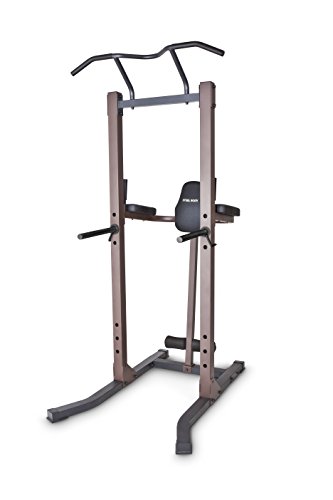
The Steelbody STB-98501 is the heavy-duty option, built from 14-gauge steel tubing with a powder-coated finish and an assembled weight of 119 lb. That mass is the point: the frame stays planted during weighted dips and strict pull-ups, and the 91-inch top height gives tall users the most headroom of any tower in this roundup. The multi-grip pull-up bar offers wide, narrow, and neutral hand positions.
The dip handles adjust in height, and the dip station doubles as a squat rack, an unusual extra that lets the frame support barbell work as well as bodyweight training. The vertical knee raise station uses an angled back pad to keep the spine in position during raises, and a sit-up station rounds out the core work. The trade-offs are size and permanence: at 58.25 inches long and 91 inches tall, this tower needs a garage or a dedicated training room with a high ceiling, and it is not a frame you will move often.
Specs:
- Rated capacity: 300 lb
- Assembled dimensions: 58.25 x 42.25 x 91 inches
- Frame: 14-gauge steel tubing, powder-coated finish
- Pull-up bar: multi-grip (wide, narrow, neutral)
- Dip station: height-adjustable handles, doubles as a squat rack
- Stations: pull-up, dip, vertical knee raise, push-up, sit-up
- Unit weight: 119 lb
- Model number: STB-98501
- UPC: 096362993456
3. Weider Power Tower
Tier: Mid-range
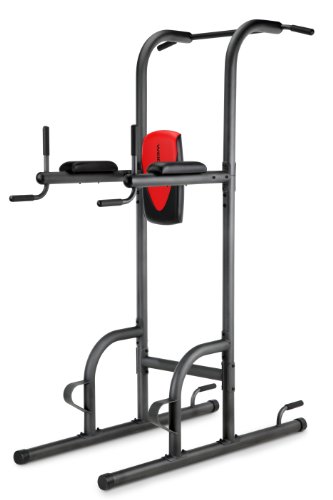
The Weider Power Tower, model WEBE99712, is the fixed-height four-station design from one of the oldest names in home gyms. It covers the standard movement set: a multi-grip pull-up station, a dip station, a vertical knee raise station, and a push-up station with molded hand grips at the base. Sewn vinyl cushions pad the backrest and arm supports, a detail that holds up better over time than glued padding.
At 57 by 41 by 84 inches and 94 lb, it sits between the light budget towers and the Steelbody in both footprint and frame weight. The 300 lb user capacity matches the Steelbody’s rating, and the fixed geometry keeps assembly simple because there are no height mechanisms to align. The fixed 84-inch height is the main check before buying: users well over six feet tall may find their knees bent at the bottom of a hang, and rooms with low ceilings should be measured first.
Specs:
- Rated capacity: 300 lb user weight
- Assembled dimensions: 57 x 41 x 84 inches
- Pull-up station: multi-grip
- Push-up station: molded hand grips
- Cushions: sewn vinyl
- Stations: pull-up, dip, vertical knee raise, push-up
- Unit weight: 94 lb
- Model number: WEBE99712
- UPC: 043619554588
4. SogesPower Power Tower PSBB005
Tier: Budget
The SogesPower PSBB005 is the lightest tower in this roundup at about 28 lb, which makes it the easiest to assemble, move, and store in a rented space. The pull-up bar adjusts through ten height positions, the widest adjustment count here, and the H-shaped base measures 32.3 inches across, a narrow footprint that fits along a wall.
The rated capacity is 330 lb, which sits above the Stamina below and close to the mid-range towers, but the light frame is best matched to controlled, strict movements rather than swinging or kipping work. The station set is complete: pull-ups and chin-ups at the bar, dips, knee raises, and push-ups at the base. For a first tower bought to build a bodyweight habit, the PSBB005 covers the fundamentals at an entry-level specification. One caution from the listing itself: the published height range appears in two different forms in the product copy, so measure your ceiling against the taller figure before ordering.
Specs:
- Rated capacity: 330 lb
- Pull-up bar height: 10 adjustable positions
- Base: H-shaped, 32.3 inches wide
- Stations: pull-up, chin-up, dip, knee raise, push-up
- Unit weight: about 28 lb
- Model number: PSBB005
- UPC: 190543339658
5. Stamina 1690 Power Tower
Tier: Budget
The Stamina 1690, model 50-1690, is the compact pick for small rooms. Its footprint of 49 by 42.5 inches and fixed 81-inch height tuck into corners that full-size towers cannot use, and the simple steel frame has been a staple of home gym lineups for years. It covers pull-ups and chin-ups, dips, push-ups, vertical knee raises, and sit-ups, and it connects with the muuv smart workout app for guided programming.
The compromises are capacity and padding. The 250 lb rating is the lowest in this roundup, so it suits bodyweight-only training for lighter users rather than weighted work. The knee raise station has padded armrests but no backrest, which some users prefer for a freer hanging position and others find less supportive on long sets. For an apartment dweller who wants the core stations in the smallest fixed footprint, the 1690 remains the reference design.
Specs:
- Rated capacity: 250 lb
- Assembled dimensions: 49 x 42.5 x 81 inches
- Height: fixed, not adjustable
- Stations: pull-up, chin-up, dip, push-up, vertical knee raise, sit-up
- App: muuv smart workout app access
- Unit weight: about 60 lb
- Model number: 50-1690
- UPC: 022643516908
How to Choose the Right Power Tower
Start with capacity. The rating should exceed your body weight by a clear margin, and by more if you plan to add a dip belt or weighted vest later. Ratings in this roundup run from 250 lb on the Stamina 1690 to 360 lb on the Sportsroyals. Treat the printed figure as a ceiling, not a target, and remember that dynamic movements load a frame harder than a static hang.
Next, measure your ceiling and your reach. Adjustable towers such as the Sportsroyals and the SogesPower change bar height across a wide range, which helps in rooms with ceilings under eight feet. Fixed towers need a direct check: the Steelbody stands 91 inches tall, the Weider 84 inches, and the Stamina 81 inches. Whatever the bar height, allow extra clearance above the bar for your head at the top of a pull-up.
Then look at the base. Long or wide H-shaped bases resist tipping during dips and knee raises, and a heavier frame flexes less. The 119 lb Steelbody is the stability pick, while the 28 lb SogesPower trades some of that planted feel for portability. Place any tower on a flat, hard floor, and check the frame bolts after the first few sessions as part of routine maintenance.
Finally, match the station list to your program. Every tower here covers pull-ups, dips, knee raises, and push-ups. The differences are in the extras: multi-grip bars on the Steelbody and Weider for varied back work, a squat-rack function on the Steelbody dip station, sit-up anchors on the Steelbody and Stamina, and app guidance on the Stamina. Buy the frame that fits your space first, then let the extras break the tie.
Frequently Asked Questions
How much ceiling height does a power tower need?
The tower itself should stand at least a few inches below the ceiling, and you need additional room above the bar for your head at the top of a pull-up. Adjustable models set near 83 inches, such as the Sportsroyals at its maximum, work best in rooms with ceilings above eight feet. The Stamina 1690, at 81 inches fixed, is the safer fit for lower rooms, while the 91-inch Steelbody belongs in garages and rooms with high ceilings.
Can a power tower handle weighted pull-ups and dips?
Yes, as long as your body weight plus the added load stays under the rated capacity. The Sportsroyals at 360 lb and the 300 lb Steelbody and Weider towers leave the most headroom for dip belt work. The 250 lb Stamina 1690 is better kept to bodyweight-only training. Whichever tower you choose, keep movements strict and controlled, since swinging loads stress a frame far more than the same weight held still.
Do power towers wobble during dips?
Some flex is normal on tall steel frames, and heavier frames wobble less. Frame weight is a useful guide: the 119 lb Steelbody is the most planted design here, while the lightest towers can shift slightly during hard dip sets. A flat, hard floor, fully tightened bolts, and a wide base all reduce movement. If a tower rocks on carpet, moving it to a hard surface usually solves the problem.
Are power towers good for beginners?
Yes. A tower supports regressions as well as full movements: assisted pull-ups with a band or a foot on a step, dips with feet on the floor, and bent-knee raises instead of straight-leg raises. The padded knee raise stations on towers such as the Sportsroyals and Weider make core work approachable from the first session, and the same frame keeps challenging you as the full versions of each movement come within reach.
Conclusion
A power tower is the simplest single purchase that covers upper-body bodyweight training at home. Choose the Sportsroyals 360 lb tower if several people of different heights will share one adjustable station. Choose the Steelbody STB-98501 if you are tall, want the heaviest frame, or like the idea of a dip station that doubles as a squat rack. The Weider is the balanced fixed-height option, the SogesPower PSBB005 is the light and portable budget tower, and the Stamina 1690 fits the smallest rooms. Match capacity to your body weight, bar height to your ceiling, and the footprint to your floor, and any of the five will anchor years of pull-ups, dips, and core work.

More from Amazon
Programs that pair well with the guide above. Offers and eligibility are set by Amazon and may change.
Free shipping on eligible items, Prime Video and more. Eligible new members can start with a free trial.
Start a Prime free trialAudiobooks and podcasts to listen to on the go. Eligible new members can start with a free trial.
Try Audible freeAd-free music streaming. Eligible new subscribers can start with a free trial.
Try Music Unlimited freeA free business account with business pricing and bulk-buying tools for work, shop or home office.
Create a business accountAs an Amazon Associate we earn from qualifying purchases.



Write Your Review
No reviews yet. Be the first to share your experience!