

Key takeaways
- Dog size: Standard 24 inch spacing and roughly 36 inch pole height are designed for typical agility dogs. Very small or very large dogs may need a trainer’s advice on adjusting the setup, and some small dogs benefit from starting with the poles guided open.
- Surface: Spiked sets need soft ground. Metal-base sets work on grass, dirt and many indoor floors, and Handler’s Choice includes grass stakes for outdoor stability. Always check how a base behaves on a smooth floor before running a dog at speed.
- Rust and weather: The Handler’s Choice maker advises monitoring outdoor sets for rust and oxidation, and suggests rust-preventative spray or paint as needed. Powder coating helps but does not make steel immune.
- Transport: Sets that split into 2-pole or 6-pole sections are much easier to carry to classes. A carry bag is a real convenience, not a gimmick, when you are moving 12 poles and two bases.
- Dog safety: Inspect poles for cracks, loose tips and sharp edges before every session. If your dog has joint, back or mobility concerns, talk to a veterinarian before beginning weave training, since repeated rapid turns are physically demanding.
For most backyard handlers, a 12-pole set with a guided-training base, such as the Handler’s Choice hinged steel base, is the safest bet, because it lets a dog learn the weave in steps. Buyers who only want to try the sport on a small budget are better served by a lightweight PVC or spike-style set, while anyone planning to enter trials should look at a continuous competition set with a steel or aluminum channel base. This guide compares the main styles of weave pole set, what the makers state about them, and where each one falls short.
Our top picks
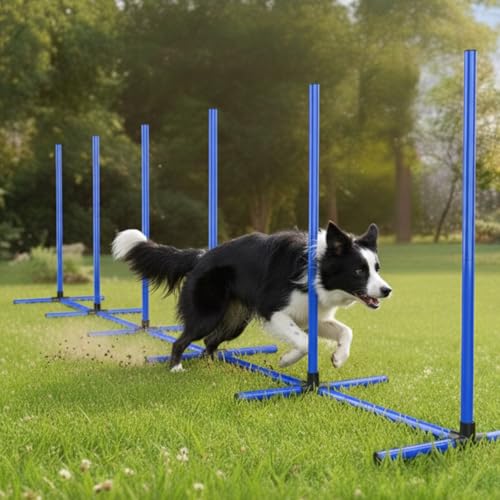


As an Amazon Associate we earn from qualifying purchases at no extra cost to you.
Weave Pole Sets at a Glance
| Set | Best for | Stated specs | Limits |
|---|---|---|---|
| Handler’s Choice Training Weave Poles (set of 12) | Serious home trainers teaching the weave in stages | Poles about 35.5 in tall, 1-1/8 in outside diameter, 24 in center spacing, powder-coated steel base with hinged feet, two 6-pole sections plus connector | Steel base needs rust care outdoors; heavier than plastic sets |
| The Dog Agility Shop set of 12 | First-time backyard users on a tight budget | Assembled 3/4 in PVC poles, about 36 in tall, grommeted pole placer with 24 in spacing | Listed for outdoor use only; light poles can shift with a pushy dog |
| J&J Dog Supplies competition poles | Handlers working toward AKC or UKC trials | Steel channel base, continuous sets of 6, 10 or 12, breaks into 2-pole sections for 2×2 work | More expensive and bulkier to store |
| J&J spiked set | Soft lawn, quick setup | 12 PVC poles with stainless steel spikes and a ground strip for spacing | Not suited to hard ground, gravel or indoor floors |
| Trixie slalom set | Casual play and travel | 12 poles that pack into a carrying bag | Training-grade rather than competition-grade |
| PAWISE slalom set | Lowest-cost entry | 12 training poles for outdoor use, named a value pick by BestReviews | Light construction; fewer training aids |
| Aluminum 2×2 system from specialist suppliers | Dogs that push or knock poles | Welded aluminum base, 24 in spacing, rubberized no-slip surface, available in 6 and 12 pole sets | Premium tier; limited to the training method it was built for |
What a Weave Pole Set Actually Has to Do
Weaving is one of the hardest obstacles for a dog to learn, because the dog must enter between the first and second poles with the first pole on its left shoulder, then thread the whole line without skipping a gap. Equipment affects how quickly that clicks. Poles that wobble, tip or slide can teach a dog to avoid them, and a base that is the wrong shape for your training method can make progress slower. That is why the base design matters more than the poles themselves.
The standard spacing reported by makers and training suppliers is 24 inches between pole centers, and nearly every set in this guide uses that measurement. Sets with a smaller or adjustable gap exist, but a dog who learns on narrow spacing can struggle when the poles move out to trial distance. Pole height is typically around 36 inches, which is the figure the Handler’s Choice and Dog Agility Shop sets both list, and diameter is usually between 3/4 inch for light PVC and 1-1/8 inch for competition-style poles.
Training Methods and Which Base They Need
Channel (guided) weaving
Channel weaving starts with the poles offset into two rows, so the dog runs down a funnel and gradually the rows are straightened. The Handler’s Choice set is built for this approach. The maker says its hinged, 360-degree rotating feet let you angle the bases to the shape you want at the start and gradually straighten them until the dog weaves a straight line. A specialist supplier’s Clip and Go 3-in-1 bases are described as locking into six positions, from straight to 10 inches of offset, which does the same job in a different way.
2×2 method
In the 2×2 method the poles are arranged in pairs, and the dog learns to enter and exit gaps between each pair before the pairs are brought together. J&J Dog Supplies states that its competition sets break into 2-pole sections for this purpose, and one aluminum 2×2 system is sold in 6- and 12-pole configurations. Reviewers who follow this method often note that the sections should be sturdy enough not to roll when a dog hits them at speed.
Plain straight sets
Budget sets such as the Dog Agility Shop 12-pole set, the Trixie slalom set and the PAWISE slalom set lay out a straight line with a ground strip or a pole placer. They suit handlers who plan to use a different method, such as wire-guides or a video course, or who just want exercise and play. They do not generally offer a way to fan the poles open.
Pick by Budget Tier
Budget tier
PVC sets such as the Dog Agility Shop, PAWISE and Trixie products cover the budget tier. BestReviews names the PAWISE set as its value pick and the Trixie set as its most comprehensive. The Dog Agility Shop set is fully assembled from 3/4 inch PVC and has a pole placer with grommets set 24 inches apart, so the spacing is right from the first session. The limitation reported across this tier is stability. Light poles can be knocked over by a big, fast dog, and they are usually listed for outdoor use on grass rather than for gyms or hard surfaces.
Mid-range tier
The mid-range tier is where training-grade sets with metal bases sit. The Handler’s Choice set is the clearest example. The maker lists steel bases that weigh about 20 pounds in their storage bag and poles that weigh about 8.8 pounds, along with zippered carry bags, a connector piece for continuous 12-pole use and grass stakes for outdoor setup. Because the poles are 1-1/8 inch outside diameter, the maker says they match competition poles, so a dog is not learning on a different feel than they will meet in a ring. A specialist agility supplier notes that these bases are heavier than fiberglass-base training poles and so suit harder-driving dogs.
Premium tier
Premium sets are the continuous competition sets, such as J&J Dog Supplies’ steel channel-base poles in 6, 10 or 12 pole lengths, which the maker says meet AKC and UKC regulations. Aluminum 2×2 systems with welded bases are in this tier too. Some training suppliers point very large dogs or dogs that push poles toward the Clip and Go bases or Max 200 competition poles, since a heavier base resists movement better. The trade-off is weight, storage space and cost.
Fit, Size and Surface Notes
- Dog size: Standard 24 inch spacing and roughly 36 inch pole height are designed for typical agility dogs. Very small or very large dogs may need a trainer’s advice on adjusting the setup, and some small dogs benefit from starting with the poles guided open.
- Surface: Spiked sets need soft ground. Metal-base sets work on grass, dirt and many indoor floors, and Handler’s Choice includes grass stakes for outdoor stability. Always check how a base behaves on a smooth floor before running a dog at speed.
- Rust and weather: The Handler’s Choice maker advises monitoring outdoor sets for rust and oxidation, and suggests rust-preventative spray or paint as needed. Powder coating helps but does not make steel immune.
- Transport: Sets that split into 2-pole or 6-pole sections are much easier to carry to classes. A carry bag is a real convenience, not a gimmick, when you are moving 12 poles and two bases.
- Dog safety: Inspect poles for cracks, loose tips and sharp edges before every session. If your dog has joint, back or mobility concerns, talk to a veterinarian before beginning weave training, since repeated rapid turns are physically demanding.
Pick X If Decision Table
| Pick this | If you |
|---|---|
| Handler’s Choice 12-pole set | Want a guided-training base that opens and straightens as the dog learns, and plan to move toward competition-size poles |
| The Dog Agility Shop set | Need a simple, assembled, correctly spaced backyard set at the lowest tier |
| J&J competition set | Are training for trials and want a continuous steel channel base that breaks down for 2×2 work |
| J&J spiked set | Have a soft lawn and want quick setup and takedown |
| Trixie or PAWISE set | Want casual play or a first trial run of the sport |
| Aluminum 2×2 system or heavy-base competition set | Have a large, fast or pole-pushing dog that moves lighter bases |
Alternatives Worth Considering
Six-pole starter sets. Several makers sell 6-pole sections. These cost less, take up less storage and are enough to teach the entry and the first few gaps. You can add a second section later, and sections from the same maker often connect.
Wire-guide or channel-style training aids. Some trainers use guide wires or temporary channel pieces with ordinary poles. If your dog already knows the basics, this can be a cheaper route than buying a whole new base system.
Group classes. An introductory class lets you learn on the instructor’s equipment and buy once you know which method is taught.
What the Reviews Agree On and Where They Are Thin
Reviewers and supplier guides broadly agree on three points: spacing should be 24 inches, base stability matters more than pole material, and competition-minded handlers should choose steel or aluminum channel bases that can do a 2×2 or channel progression. They also agree that PVC sets are fine for casual use. Durability data is thin, since independent long-term reporting on weave pole sets is rare. Several roundups carry affiliate links, so the maker’s own specification list is the most dependable source.
Frequently Asked Questions
How many weave poles do I need?
Twelve is the usual number for a full set and is the number most trials use. Beginners can start with six, since the skill is learned in sections, and add more later. Check the rules of the organization you plan to compete in, as requirements can differ.
What spacing should the poles have?
Most makers and training suppliers list 24 inches between pole centers, and that is the spacing used in the Handler’s Choice and Dog Agility Shop sets. Some organizations allow different spacing in particular classes, so read the rulebook if you plan to trial. Training with the same spacing you will compete with avoids relearning.
Is PVC good enough for a beginner?
For a casual or first-time handler, yes. Light PVC sets are listed by their makers for outdoor use and are easy to set up. They can move if a dog hits them hard, so if your dog is large or energetic you may outgrow them quickly.
Which is better, channel weaving or 2×2?
Both are accepted methods and trainers have strong preferences. Channel weaving uses a funnel that gradually straightens, while 2×2 teaches the dog to pass through gaps between pairs before they are joined. The best choice is the method your trainer uses, and equipment can suit one, the other or both.
Can I use weave poles indoors?
Some can. Metal-base sets usually sit steadily on many floors, while spike sets and the Dog Agility Shop set are listed for outdoor use. Make sure the base cannot slide on the floor, and ask your veterinarian if you are unsure about how many repetitions are good for your dog’s joints.
How do I stop rust on a steel base?
Dry the base after wet weather and store it under cover. The Handler’s Choice maker suggests watching for rust and oxidation and using rust-preventative spray or paint when needed. Replace any base that becomes weak or sharp.









Write Your Review
No reviews yet. Be the first to share your experience!