

Key takeaways
- Compare the best seated row machines for home gyms, from plate-loaded lever rows to cable stack and chest-supported picks, with capacities and fit notes.
Every machine in this guide is a strength machine: you sit facing a chest pad or a cable station, brace your feet, and pull handles toward your torso against loaded weight. That is a different category from cardio rowing machines, which use a flywheel, a sliding seat, and long pulling strokes for conditioning. Nothing here has a flywheel or a performance monitor, and none of these machines will train your lungs the way a rower does. They exist for one job — building the lats, rhomboids, traps, rear delts, and biceps with controlled, repeatable resistance.
The five picks below cover the main designs sold for home gyms: a plate-loaded lever row, a cable machine with a pin-selected weight stack, a chest-supported T-bar style row, a compact linear-bearing machine for small rooms, and a budget plate-loaded model. They differ in how the resistance is loaded, how much floor they take, and how much adjustment they offer for different body sizes. Capacities and dimensions are quoted only as the Amazon listings state them, so check the listing for the exact configuration you plan to order.
As an Amazon Associate, we earn from qualifying purchases.
Quick answer
The Valor Fitness CB-14 is the top pick for most home gyms: independent converging arms, a 400 lb capacity, and separate seat and chest pad adjustment cover the widest range of lifters. Cable shoppers should look at the Body-Solid EXM2500S, space-limited buyers at the Mikolo SR06 Ultra, and tight budgets at the GYHPD.
Valor Fitness CB-14 Plate-Loaded Seated Row Machine
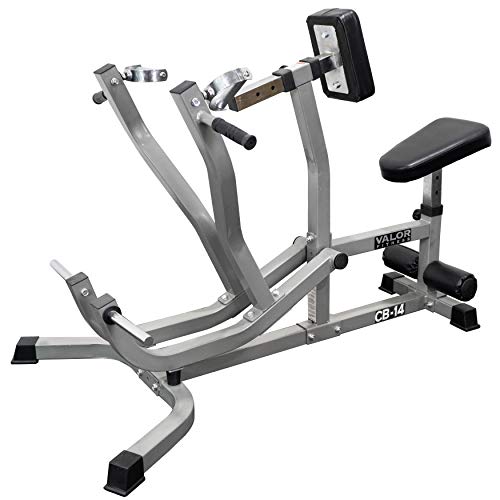
The CB-14 represents the plate-loaded lever class, where weight plates load onto sleeves and the handles travel on pivoting arms rather than along a cable. Valor’s arms are independent and converging, so each side moves on its own and the handles draw inward as you pull, and you can row one arm at a time to even out a weaker side. Both stationary and rotating grips are included, which lets you change hand position between sets without swapping attachments.
The listing states a maximum capacity of 400 lb, split as 200 lb per arm, on a 12-gauge steel frame. The seat adjusts through four positions and the chest pad through five, so most lifters can set a position where the pad supports the sternum and the handles reach the lower ribs at full contraction. The sleeves accept both 1-inch standard plates and 2-inch Olympic plates, and two Olympic sleeve adapters with spring clips come in the box. The assembled machine measures 54 x 34 x 41 inches and weighs 81 lb, which is a moderate footprint for a dedicated back station.
The honest limits are simple ones. The grip positions are fixed by the arm design, so lifters who like to fine-tune wrist angles with cable attachments will find fewer options here. There is also no weight storage on the frame, so plates need a rack or a corner of the floor nearby. For a single-purpose row station with proven capacity and real adjustment range, though, this is the most complete package in the guide.
Body-Solid StrengthTech EXM2500S Home Gym

The cable and weight stack class trades plate loading for pin selection: you move a selector pin in a cast iron stack and the resistance changes in seconds, with the cable delivering even tension through the whole pull. The EXM2500S builds its seated row as a low pulley station inside a full multi-station home gym, and its listing states a 210 lb cast iron weight stack. A no-cable-change design means the row station is ready without re-routing cables between exercises, which keeps back sessions moving.
Because the row shares its frame with other stations, the same footprint also holds a multi-press arm, a pec station, a lat pulldown, an ab crunch station, and a leg extension and leg curl developer. The frame is 2 x 4 inch 12-gauge steel. For lifters who want one machine to cover pressing, pulling, and leg work, that consolidation is the entire appeal, and the row benefits from the smooth, guided feel that cable resistance gives at lighter and moderate loads.
The trade-off is size and ceiling. Assembled dimensions are listed at 85 x 61 x 83 inches, which is far more floor and height than any dedicated row machine here, so measure the room before ordering. The 210 lb stack is also a hard ceiling: strong lifters who already row heavy with plates will outgrow it, and there is no way to add load beyond the stack. Buy this one for convenience and variety, not for maximum rowing weight.
Titan Fitness Plate-Loaded Chest Supported T-Bar Row Machine

Chest-supported rows solve the biggest weakness of unsupported rowing: the lower back fatiguing before the upper back does. On this Titan machine your chest rests against an angled pad while you pull, so the lats and mid-back do the work and your torso position stays fixed from the first rep to the last. It follows the T-bar layout, with the handles pulling up from a single loading sleeve in front of the pad, and an adjustable footplate with a diamond texture helps you brace at the right height for your leg length.
The listing data states a 400 lb capacity and an 11-gauge steel frame, with a machine weight of 100 lb. Multiple grip positions on the handles let you shift emphasis between the lats and the upper back by changing hand width and angle. A single 13.5-inch Olympic sleeve takes the plates, so loading is quick and the plates you already own for a barbell will fit.
Two cautions apply. First, the chest pad that makes this design so effective also means your breathing is partly restricted at heavy loads, and lifters who dislike pressure on the sternum will prefer the upright CB-14. Second, T-bar layouts run long, so this machine needs a generous stretch of floor despite its narrow width. If your lower back limits your barbell rows, this is the design that works around the problem.
Mikolo SR06 Ultra Linear Row Machine

The compact class exists for spare rooms, apartment corners, and garage gyms where a full-size row station simply will not fit. The Mikolo SR06 Ultra is a plate-loaded machine whose arms run on a linear bearing track, giving a fixed, guided path that feels closer to a cable pull than a free-swinging lever. The listing gives dimensions of 38.4 x 58.4 x 32.6 inches and quotes a footprint of just 5.8 square feet, the smallest in this guide by a wide margin.
Mikolo builds the frame from alloy steel and lists the model with a 1-year manufacturer warranty, which is more coverage than the budget pick below states. The fixed track is the defining trait: it keeps every rep on the same path, which newer lifters often find easier to learn, and it removes the side-to-side sway that independent lever arms can have when fatigue sets in.
The compromises follow from the size. A guided path cannot adapt to your natural arm angle the way independent arms or a cable can, so some lifters will find the groove slightly off for their build. Mikolo also does not headline a capacity figure the way the 400 lb machines do, so heavier lifters should confirm the limit on the listing before buying. For a small room that still needs a real row station, this is the pick.
GYHPD Plate-Loaded Seated Row Machine

The budget class keeps the core design — plate-loaded independent arms with a chest pad — and trims cost in materials, finish, and support rather than in the movement itself. The GYHPD machine keeps independent arms and rotating grips, and its listing states a 400 lb capacity, matching the top pick on paper. Adjustment is generous for the class: the chest pad offers seven positions, and the seat adjusts through seven vertical and five horizontal positions, so dialing in a fit should be possible for a wide range of heights.
Assembly is quoted at about 30 minutes on the listing, the quickest build in this guide, which suits buyers who want the machine working the day it arrives. The rotating grips let your wrists settle into a natural angle during the pull, a feature budget machines often skip in favor of fixed handles.
The honesty points matter here. GYHPD is a newer, lesser-known brand, and the listing states no warranty coverage, so long-term support is unproven. Budget hardware also deserves a bolt check after the first few sessions as parts settle. None of that changes what the machine does on day one — it rows with independent arms and real adjustment range — but buyers who train heavy several times a week should weigh the unknown track record against the savings.
How to choose
Pick the resistance type first. Plate-loaded machines cost less per pound of capacity and use plates you may already own, but loading and unloading sleeves takes time between sets. A weight stack changes resistance with a pin and feels smoother at light loads, yet it caps how heavy you can ever row.
Next, decide on arm design. Independent arms expose and correct side-to-side imbalances and allow one-arm rows. A fixed bar or a guided track feels more stable and is easier to learn. Chest support is worth prioritizing if your lower back is the weak link in your rowing.
Then measure your space honestly, including room to load plates on both sides of the machine. The listings here range from under six square feet to a full multi-gym footprint, and height matters too for stack machines with tall frames.
Finally, check capacity and plate fit against your own training. Most dedicated rows here state 400 lb, while the stack machine tops out at its 210 lb stack. Confirm whether a machine takes 1-inch or 2-inch plates, and whether adapters are included, before assuming your current plates will work.
Who should skip
Skip this whole category if you want cardio conditioning — buy a rowing machine instead, since none of these strength machines will raise your heart rate the way a rower does. Skip plate-loaded models if you own no plates and are not willing to buy them, because the machines ship without plates and the cost adds up. Skip the big multi-station gym if your room cannot fit its listed footprint with space to spare. And skip the budget pick if you row near the stated capacity several days a week, since its unproven support record is the real price of the savings.
Frequently Asked Questions
Is a seated row machine the same as a rowing machine?
No. A rowing machine is a cardio device with a flywheel and a sliding seat, built for long conditioning sessions. A seated row machine is a strength device that loads weight plates or a stack so you can pull heavy for sets of back work. They train different qualities and are not substitutes for each other.
Do these machines include weight plates?
No. The plate-loaded models ship as frames with empty sleeves, and plates are bought separately. The CB-14 includes Olympic sleeve adapters and spring clips, which is hardware for holding plates, not the plates themselves. The stack machine is the exception, since its 210 lb stack is built into the frame.
How much floor space does a seated row machine need?
It depends on the design. The compact Mikolo lists a footprint of 5.8 square feet, while the multi-station Body-Solid needs an 85 x 61 inch area plus ceiling height for its 83-inch frame. Measure your room, then add clearance on both sides of any plate-loaded machine for loading sleeves.
Should I choose a cable stack or a plate-loaded row?
Choose the stack if quick weight changes and a smooth pull matter most, and if 210 lb is enough resistance for your goals. Choose plate-loaded if you already own plates, want a higher ceiling for heavy rows, or prefer a dedicated single-purpose station. Neither is better in general — they suit different rooms and different training styles.
Final verdict
For most home gyms, the Valor Fitness CB-14 is the right buy: independent converging arms, a stated 400 lb capacity, and separate seat and chest pad adjustment make it the most versatile dedicated row here. The Body-Solid EXM2500S suits lifters who want one frame for many exercises and prefer pin-selected resistance. The Titan chest-supported row is the answer when your lower back gives out before your back muscles do. The Mikolo SR06 Ultra fits rooms nothing else here will, and the GYHPD delivers the same basic movement for the least commitment, with a warranty gap you should accept with open eyes.
Product and ASIN Reference
| Product | ASIN |
|---|---|
| Valor Fitness CB-14 Seated Row Machine | B00NVSACU6 |
| Body-Solid StrengthTech EXM2500S Home Gym | B00332ARK0 |
| Titan Fitness Plate-Loaded Chest Supported T-Bar Row Machine | B07HCMKZZ9 |
| Mikolo SR06 Ultra Linear Row Machine | B0FZ9KR4B8 |
| GYHPD Plate-Loaded Seated Row Machine | B0D5GRQ72Y |
More from Amazon
Programs that pair well with the guide above. Offers and eligibility are set by Amazon and may change.
Free shipping on eligible items, Prime Video and more. Eligible new members can start with a free trial.
Start a Prime free trialAudiobooks and podcasts to listen to on the go. Eligible new members can start with a free trial.
Try Audible freeAd-free music streaming. Eligible new subscribers can start with a free trial.
Try Music Unlimited freeA free business account with business pricing and bulk-buying tools for work, shop or home office.
Create a business accountAs an Amazon Associate we earn from qualifying purchases.










Write Your Review
No reviews yet. Be the first to share your experience!